Department of Biology, McGill University, 1205 Docteur Penfield, Montreal, Canada H3A 1B1.
Smithsonian Tropical Research Institute, Gamboa, Panama.
Biol Lett. 2020 Sep;16(9):20200424. doi: 10.1098/rsbl.2020.0424. Epub 2020 Sep 23.
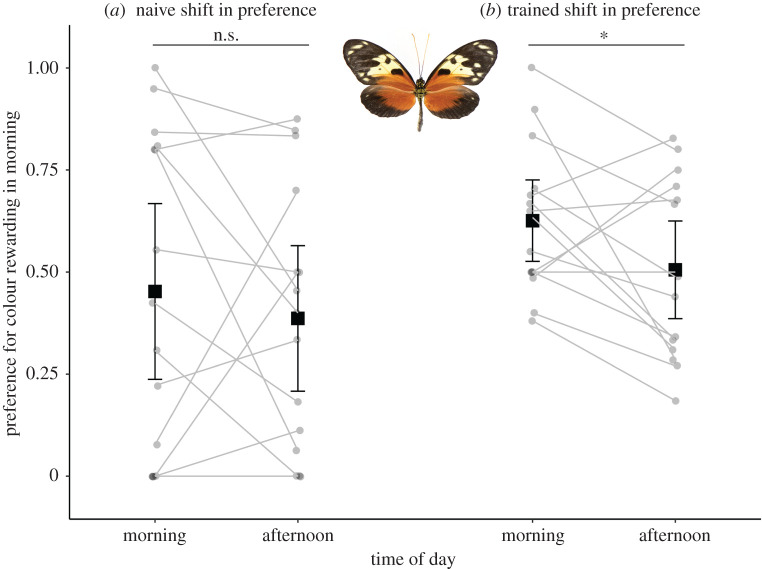
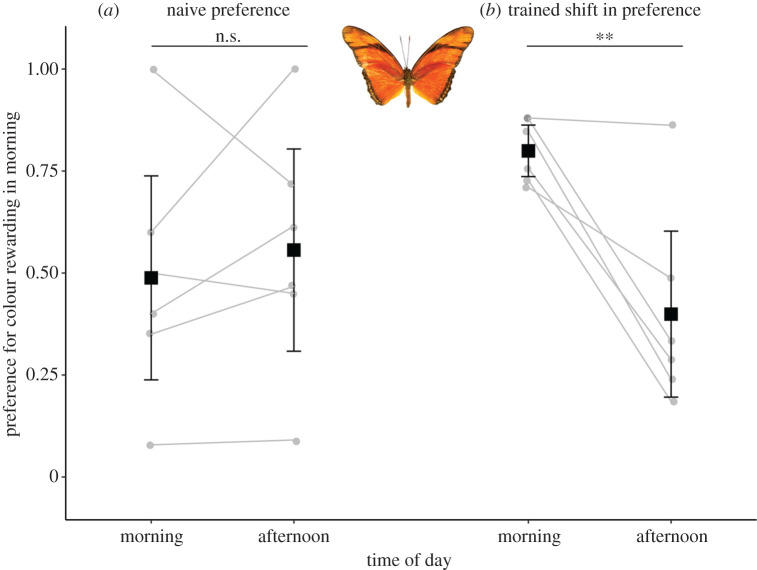
For many pollinators, flowers provide predictable temporal schedules of resource availability, meaning an ability to learn time-dependent information could be widely beneficial. However, this ability has only been demonstrated in a handful of species. Observations of butterflies suggest that they may have an ability to form time-dependent foraging preferences. are unique among butterflies in actively collecting pollen, a dietary behaviour linked to spatio-temporally faithful 'trap-line' foraging. Time dependency of foraging preferences is hypothesized to allow to exploit temporal predictability in alternative pollen resources. Here, we provide the first experimental evidence in support of this hypothesis, demonstrating that can learn opposing colour preferences in two time periods. This shift in preference is robust to the order of presentation, suggesting that preference is tied to the time of day and not due to ordinal or interval learning. However, this ability is not limited to , as previously hypothesized, but also present in a related genus of non-pollen feeding butterflies. This demonstrates time learning likely pre-dates the origin of pollen feeding and may be prevalent across butterflies with less specialized foraging behaviours.
对于许多传粉者来说,花朵提供了可预测的资源可用性时间安排,这意味着能够学习依赖时间的信息可能会带来广泛的好处。然而,这种能力仅在少数几种物种中得到了证明。对蝴蝶的观察表明,它们可能具有形成依赖时间的觅食偏好的能力。在积极收集花粉方面,蝴蝶是独特的,这是一种与时空忠实的“陷阱线”觅食行为有关的饮食行为。觅食偏好的时间依赖性被假设可以让蝴蝶利用替代花粉资源的时间可预测性。在这里,我们提供了第一个支持这一假设的实验证据,证明蝴蝶可以在两个时间段内学会相反的颜色偏好。这种偏好的转变对呈现顺序具有鲁棒性,表明偏好与一天中的时间有关,而不是由于顺序或间隔学习。然而,这种能力不仅限于之前假设的花粉食性蝴蝶,也存在于相关的非花粉食性蝴蝶属中。这表明时间学习可能早于花粉食性的起源,并且可能在具有较少专门觅食行为的蝴蝶中普遍存在。