Perlman Amichai, Vodonos Zilberg Alina, Bak Peter, Dreyfuss Michael, Leventer-Roberts Maya, Vurembrand Yael, Jeffries Howard E, Fisher Eyal, Steuerman Yael, Namir Yinat, Goldschmidt Yaara, Souroujon Daniel
K Health Inc, New York, NY, United States.
Icahn School of Medicine at Mount Sinai, New York, NY, United States.
J Med Internet Res. 2020 Oct 20;22(10):e23197. doi: 10.2196/23197.
Patient-facing digital health tools have been promoted to help patients manage concerns related to COVID-19 and to enable remote care and self-care during the COVID-19 pandemic. It has also been suggested that these tools can help further our understanding of the clinical characteristics of this new disease. However, there is limited information on the characteristics and use patterns of these tools in practice.
The aims of this study are to describe the characteristics of people who use digital health tools to address COVID-19-related concerns; explore their self-reported symptoms and characterize the association of these symptoms with COVID-19; and characterize the recommendations provided by digital health tools.
This study used data from three digital health tools on the K Health app: a protocol-based COVID-19 self-assessment, an artificial intelligence (AI)-driven symptom checker, and communication with remote physicians. Deidentified data were extracted on the demographic and clinical characteristics of adults seeking COVID-19-related health information between April 8 and June 20, 2020. Analyses included exploring features associated with COVID-19 positivity and features associated with the choice to communicate with a remote physician.
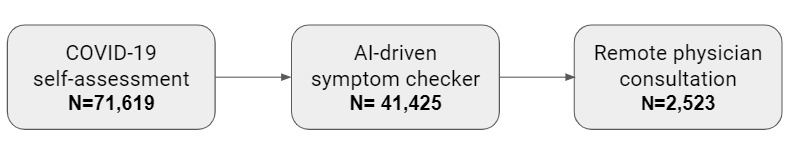
During the period assessed, 71,619 individuals completed the COVID-19 self-assessment, 41,425 also used the AI-driven symptom checker, and 2523 consulted with remote physicians. Individuals who used the COVID-19 self-assessment were predominantly female (51,845/71,619, 72.4%), with a mean age of 34.5 years (SD 13.9). Testing for COVID-19 was reported by 2901 users, of whom 433 (14.9%) reported testing positive. Users who tested positive for COVID-19 were more likely to have reported loss of smell or taste (relative rate [RR] 6.66, 95% CI 5.53-7.94) and other established COVID-19 symptoms as well as ocular symptoms. Users communicating with a remote physician were more likely to have been recommended by the self-assessment to undergo immediate medical evaluation due to the presence of severe symptoms (RR 1.19, 95% CI 1.02-1.32). Most consultations with remote physicians (1940/2523, 76.9%) were resolved without need for referral to an in-person visit or to the emergency department.
Our results suggest that digital health tools can help support remote care and self-management of COVID-19 and that self-reported symptoms from digital interactions can extend our understanding of the symptoms associated with COVID-19.
面向患者的数字健康工具已得到推广,以帮助患者应对与2019冠状病毒病(COVID-19)相关的问题,并在COVID-19大流行期间实现远程护理和自我护理。也有人认为,这些工具有助于加深我们对这种新疾病临床特征的理解。然而,关于这些工具在实际应用中的特点和使用模式的信息有限。
本研究的目的是描述使用数字健康工具解决与COVID-19相关问题的人群的特征;探索他们自我报告的症状,并描述这些症状与COVID-19的关联;以及描述数字健康工具提供的建议。
本研究使用了K Health应用程序上三款数字健康工具的数据:基于协议的COVID-19自我评估、人工智能(AI)驱动的症状检查器以及与远程医生的沟通。提取了2020年4月8日至6月20日期间寻求与COVID-19相关健康信息的成年人的人口统计学和临床特征的去识别数据。分析包括探索与COVID-19阳性相关的特征以及与选择与远程医生沟通相关的特征。
在评估期间,71619人完成了COVID-19自我评估,41425人还使用了AI驱动的症状检查器,2523人咨询了远程医生。使用COVID-19自我评估的人以女性为主(51845/71619,72.4%),平均年龄为34.5岁(标准差13.9)。2901名用户报告进行了COVID-19检测,其中433人(14.9%)报告检测呈阳性。COVID-19检测呈阳性的用户更有可能报告嗅觉或味觉丧失(相对率[RR]6.66,95%置信区间5.53-7.94)以及其他已确定的COVID-19症状和眼部症状。由于存在严重症状,自我评估建议与远程医生沟通的用户更有可能接受立即医疗评估(RR 1.19,95%置信区间1.02-1.32)。与远程医生的大多数咨询(1940/2523,76.9%)在无需转诊至面对面就诊或急诊科的情况下得到解决。
我们的结果表明数字健康工具有助于支持COVID-19的远程护理和自我管理,并且数字交互中自我报告的症状可以扩展我们对与COVID-19相关症状的理解。