Chair of Urban Ageing, Faculty of Social Work & Education, The Hague University of Applied Sciences, Johanna Westerdijkplein 75, 2521 EN Den Haag, The Netherlands.
Faculty of Health, Nutrition & Sport, The Hague University of Applied Sciences, Johanna Westerdijkplein 75, 2521 EN Den Haag, The Netherlands.
Int J Environ Res Public Health. 2020 Sep 20;17(18):6867. doi: 10.3390/ijerph17186867.
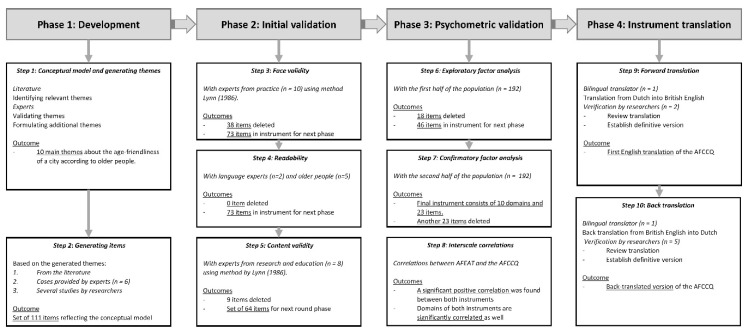
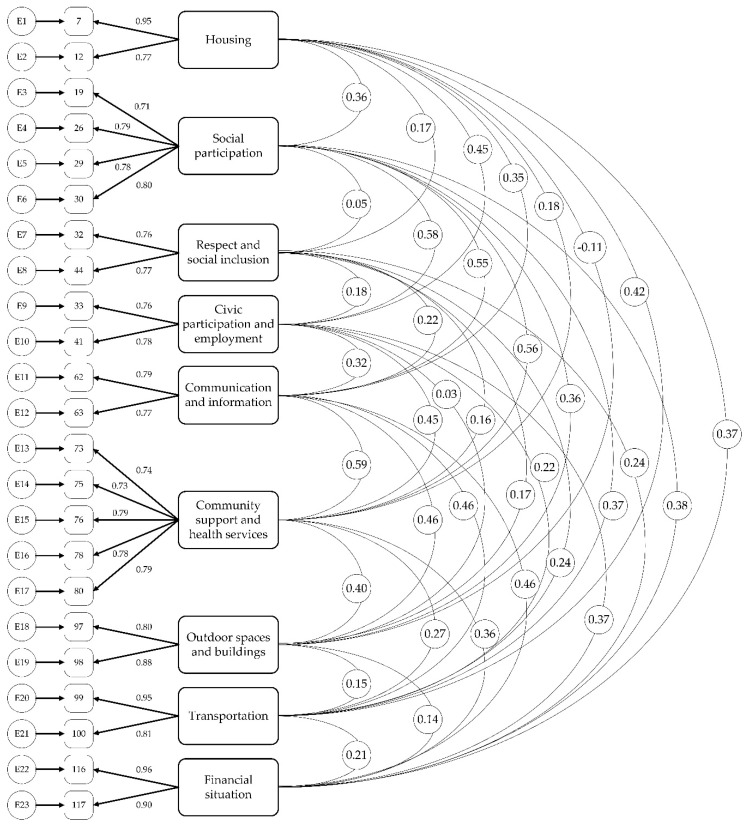
The World Health Organization engages cities and communities all over the world in becoming age-friendly. There is a need for assessing the age-friendliness of cities and communities by means of a transparently constructed and validated tool which measures the construct as a whole. The aim of this study was to develop a questionnaire measuring age-friendliness, providing full transparency and reproducibility. The development and validation of the Age Friendly Cities and Communities Questionnaire (AFCCQ) followed the criteria of the COnsensus-based Standards for selection of health Measurement INstruments (COSMIN). Four phases were followed: (1) development of the conceptual model, themes and items; (2) initial (qualitative) validation; (3) psychometric validation, and (4) translating the instrument using the forward-backward translation method. This rigorous process of development and validation resulted in a valid, psychometrically sound, comprehensive 23-item questionnaire. This questionnaire can be used to measure older people's experiences regarding the eight domains of the WHO Age-Friendly Cities model, and an additional financial domain. The AFCCQ allows practitioners and researchers to capture the age-friendliness of a city or community in a numerical fashion, which helps monitor the age-friendliness and the potential impact of policies or social programmes. The AFCCQ was created in Dutch and translated into British-English.
世界卫生组织促使全球各地的城市和社区努力实现对老年人友好。需要有一种透明构建和验证的工具,通过该工具来评估城市和社区的友好程度,该工具能够全面衡量整体构建。本研究的目的是开发一种衡量对老年人友好程度的问卷,提供完全的透明度和可重复性。《宜居城市和社区问卷》(AFCCQ)的开发和验证遵循了共识基础健康测量工具选择标准(COSMIN)的标准。研究共分为四个阶段:(1)概念模型、主题和项目的开发;(2)初始(定性)验证;(3)心理测量学验证;(4)使用正向-反向翻译法进行仪器翻译。经过严格的开发和验证过程,最终形成了一个有效、具有良好心理测量特性、全面的 23 项问卷。该问卷可用于衡量老年人对世界卫生组织“宜居城市”模型八个领域和一个额外的财务领域的体验。AFCCQ 使实践者和研究人员能够以数字方式捕捉城市或社区的对老年人友好程度,有助于监测对老年人友好程度以及政策或社会项目的潜在影响。AFCCQ 最初是用荷兰语创建的,并被翻译成了英式英语。