Long Gong, Yao Zhang Yao, Na Yang, Ping Yi, Wei Sun, Mingsheng Tan
Department of Orthopedic, China-Japan Friendship Hospital, Peking Union Medical College, Chinese Academy of Medical College, Beijing, China.
Department of Obstetrics and Gynecology, West China Second University Hospital of Sichuan University, 610041, Chengdu, Sichuan, China.
BMC Pregnancy Childbirth. 2020 Sep 22;20(1):551. doi: 10.1186/s12884-020-03139-9.
Low back pain (LBP) is a common musculoskeletal problem during pregnancy, with an estimated prevalence ranging from 30-78% (Mota MJ et al. J Back Musculoskelet Rehabil 28(2):351-7,2015 and Abebe E et al. J Med Sc Tech 3(3). 37-44,2014). Women reporting LBP are at increased risk of developing perinatal depression. Pregnancy-related LBP is highly heterogeneous and can be divided into lumbar pain (LP), posterior pelvic pain (PPP), and combined pain (CP). Therefore, the purpose of this study was to investigate the associations between LBP and perinatal depressive symptoms.
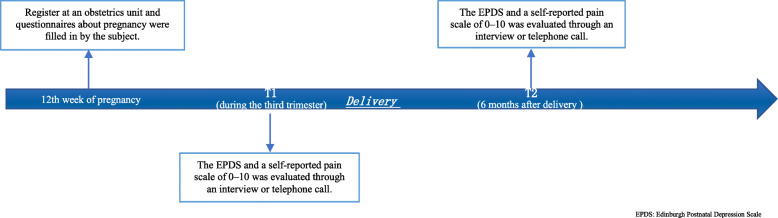
This was a retrospective case-control study conducted from January 2016 to April 2019. A total of 484 pregnant women were enrolled in this study: a case group of 242 pregnant women who were diagnosed with LBP and an age-matched control group of 242 pregnant women without LBP. The Edinburgh Postnatal Depression Scale (EPDS), LBP characteristics, and questionnaires about pregnancy that included demographic, parity, work, comorbidity, and previous pregnancy data were completed and compared between the case group and the control group.
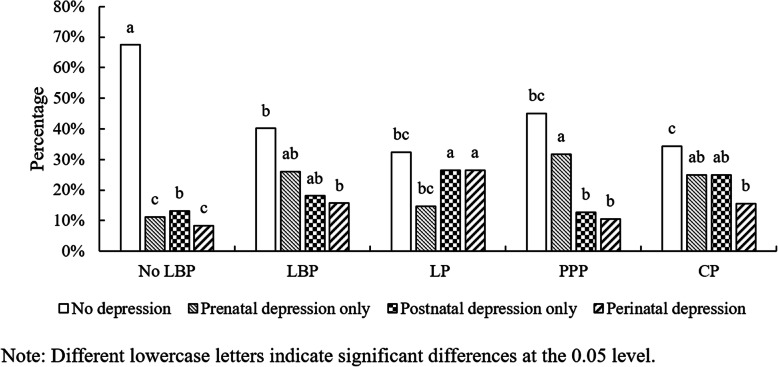
A total of 68 of 242 (28.1%) women experienced PPP, 142 (58.7%) had lumbar pain(LP), and 32 (13.2%) had combined pain. Furthermore, 26.5% of women with prenatal depression in the LP subgroup remained depressed 6 months postnatally, while the percentages for women in the PPP subgroup and CP subgroup were just 10.6% and 15.6%, respectively. The percentage of women who recovered anytime between delivery and six months postnatally in the PPP subgroup was significantly higher than that in the LP subgroup (31.7% vs. 14.7%, P < 0.001).
There is a difference in the prevalence of prenatal, postnatal, and perinatal depressive symptoms among pregnant women with different types of LBP. It is necessary to screen prenatal and postnatal depression separately and differentiate the types of LBP during pregnancy. Attention to these factors may help to outline better management strategies to improve maternal health.
腰痛(LBP)是孕期常见的肌肉骨骼问题,估计患病率在30%-78%之间(莫塔MJ等人,《背部肌肉骨骼康复杂志》28(2):351-357,2015年;阿贝贝E等人,《医学科学技术杂志》3(3):37-44,2014年)。报告有腰痛的女性患围产期抑郁症的风险增加。与妊娠相关的腰痛具有高度异质性,可分为腰部疼痛(LP)、骨盆后部疼痛(PPP)和混合性疼痛(CP)。因此,本研究的目的是调查腰痛与围产期抑郁症状之间的关联。
这是一项于2016年1月至2019年4月进行的回顾性病例对照研究。本研究共纳入484名孕妇:一个病例组为242名被诊断为腰痛的孕妇,一个年龄匹配的对照组为242名无腰痛的孕妇。完成了爱丁堡产后抑郁量表(EPDS)、腰痛特征以及包括人口统计学、产次、工作、合并症和既往妊娠数据在内的妊娠问卷,并在病例组和对照组之间进行比较。
242名女性中共有68名(28.1%)经历了骨盆后部疼痛,142名(58.7%)有腰部疼痛,32名(13.2%)有混合性疼痛。此外,腰部疼痛亚组中26.5%的产前抑郁女性产后6个月仍处于抑郁状态,而骨盆后部疼痛亚组和混合性疼痛亚组女性的这一比例分别仅为10.6%和15.6%。骨盆后部疼痛亚组中在分娩至产后6个月之间任何时候康复的女性比例显著高于腰部疼痛亚组(31.7%对14.7%,P<0.001)。
不同类型腰痛的孕妇在产前、产后和围产期抑郁症状的患病率存在差异。有必要分别筛查产前和产后抑郁症,并区分孕期腰痛的类型。关注这些因素可能有助于制定更好的管理策略,以改善孕产妇健康。