Ko Hyun Min, Choi Seung-Han, Kim Yumi, An Eun-Jin, Lee Seung-Hyeon, Kim Kwanil, Jung Hee-Jae, Jang Hyeung-Jin
College of Korean Medicine, Kyung Hee University, 26 Kyungheedae-ro, Dongdaemun-gu, Seoul 02447, Republic of Korea.
Department of Science in Korean Medicine, Graduate School, Kyung Hee University, Seoul 02447, Republic of Korea.
Evid Based Complement Alternat Med. 2020 Sep 7;2020:2893609. doi: 10.1155/2020/2893609. eCollection 2020.
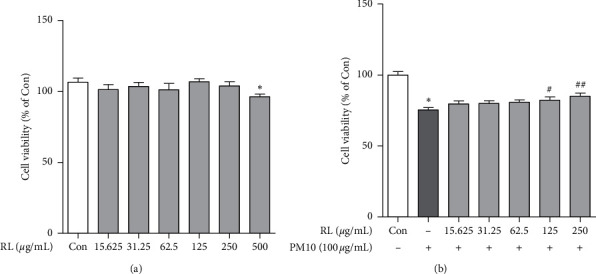
Particulate matter 10 (PM10) with a diameter of less than 10 mm causes inflammation and allergic reactions in the airways and lungs, which adversely affects asthmatic patients. In this study, we examined the anti-inflammatory effects of (RL), which has been previously investigated medicinally in Korea and China for the discovery of plant-derived anti-inflammatory agents with low side effects, using a PM10-induced lung inflammatory disease model. Using MTT assay, we confirmed that in A549 cells pretreated with RL, cytotoxicity induced by PM10 (100 g/mL) exposure was attenuated. In addition, western blotting revealed that RL suppressed the expression level of MAPK/NF-B pathways and its downstream signal, COX-2 in PM10-induced A549 cells. Moreover, real-time PCR demonstrated that RL downregulated the mRNA expression level of inflammatory cytokines (TNF-, IL-1, IL-6, IL-13, and IL-17) in PM10-induced A549 cells. Based on the results of this study, RL has been shown to relieve inflammation in the lungs due to PM10 exposure. Therefore, RL may be developed as a natural remedy for respiratory diseases caused by PM10 exposure.
直径小于10毫米的可吸入颗粒物10(PM10)会引发气道和肺部的炎症及过敏反应,对哮喘患者产生不利影响。在本研究中,我们使用PM10诱导的肺部炎症疾病模型,研究了红参(RL)的抗炎作用。此前在韩国和中国已对红参进行过药用研究,旨在发现副作用小的植物源性抗炎剂。通过MTT法,我们证实,在用RL预处理的A549细胞中,PM10(100微克/毫升)暴露诱导的细胞毒性有所减弱。此外,蛋白质印迹法显示,RL抑制了PM10诱导的A549细胞中MAPK/NF-κB通路及其下游信号COX-2的表达水平。而且,实时定量PCR表明,RL下调了PM10诱导的A549细胞中炎性细胞因子(TNF-α、IL-1、IL-6、IL-13和IL-17)的mRNA表达水平。基于本研究结果,已证明红参可缓解因暴露于PM10而导致的肺部炎症。因此,红参可能被开发成为一种针对由PM10暴露引起的呼吸系统疾病的天然药物。