Lou Hongfei, Wang Xueyan, Wei Qingyu, Zhao Changqing, Xing Zhimin, Zhang Qinna, Meng Juan, Zhang Shaoqiang, Zhou Huifang, Ma Ruixia, Zhang Hua, Liu Hui, Xue Weiguo, Wang Chengshuo, Zhang Luo
Department of Otolaryngology Head and Neck Surgery, Beijing TongRen Hospital, Capital Medical University, Beijing, 100730, China.
Beijing Key Laboratory of Nasal Diseases, Beijing Institute of Otolaryngology, Beijing, 100005, China.
World Allergy Organ J. 2020 Sep 8;13(9):100458. doi: 10.1016/j.waojou.2020.100458. eCollection 2020 Sep.
is the most common outdoor aeroallergen throughout Northern China; however, no multicenter study has investigated sublingual immunotherapy (SLIT) as a treatment option for -induced allergic rhinitis (AR). The aim of this study was to evaluate the efficacy and safety of an innovative SLIT for -related AR.
This was a randomized, double-blind, placebo-controlled, multicenter, phase 3 clinical trial conducted in China (NCT XXX). A total of 702 -sensitized eligible patients were randomized in a ratio of 2:1 to receive -SLIT or placebo. The treatment lasted 32 weeks; including 5-weeks up-dosing phase and 27-weeks maintenance phase. The primary endpoint was the daily combined score of medication and rhinoconjunctivitis symptom (CSMRS), and secondary endpoints were daily total nasal symptom score (dTNSS) and daily rescue medication score (dRMS) during peak pollen period. Safety of treatment was evaluated according to adverse events (AEs) experienced.
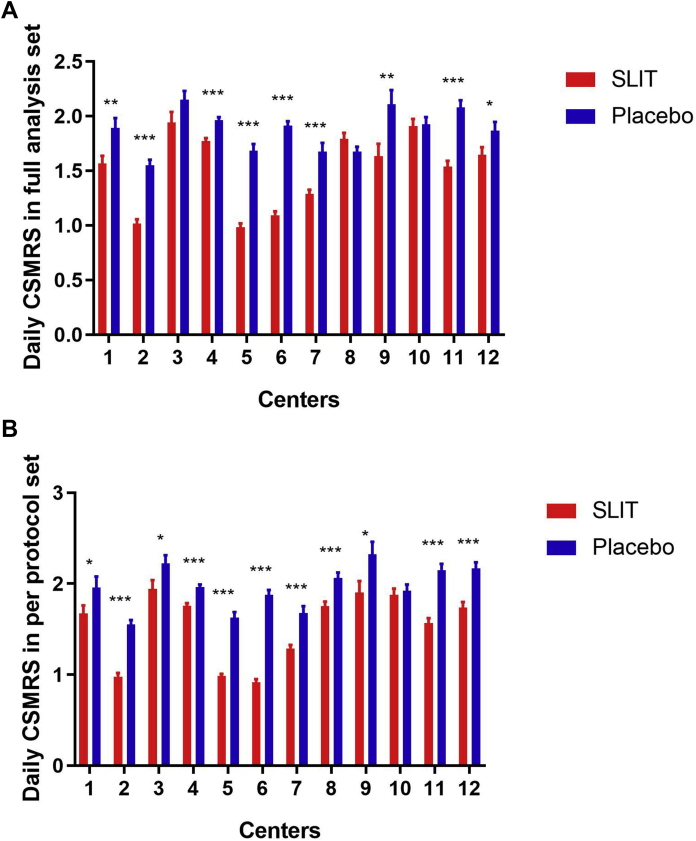
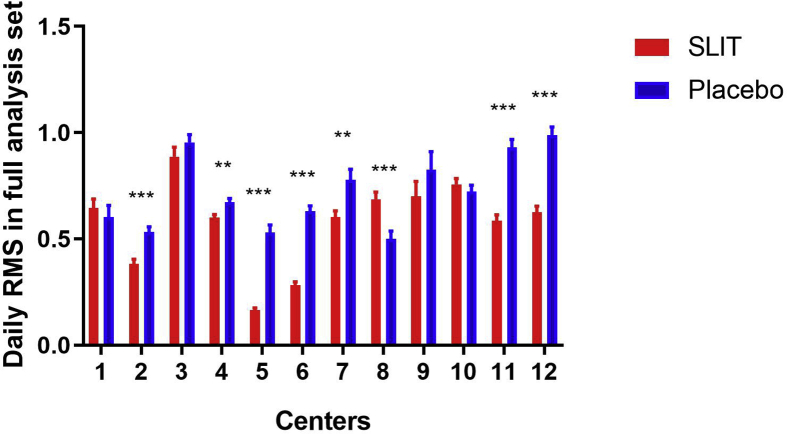
Mean daily CSMRS was significantly improved during the peak pollen period in the SLIT group compared with the placebo group (1.46 ± 0.47 vs 1.88 ± 0.42, P < 0.0001 in full analysis set [FAS]; 1.49 ± 0.52 vs 1.95 ± 0.46, P < 0.0001 in per protocol set [PPS]); representing a 22.3% and 23.6% reduction, respectively, relative to placebo. In specifically monosensitized patients, mean daily CSMRS reductions were demonstrated as 24.1% and 27.0% in the FAS and PPS populations, respectively, when comparing the active treatment to placebo treatment. Similarly, SLIT decreased dTNSS in peak pollen period by 19.0% in FAS and 22.3% in PPS, respectively, relative to placebo. In coincidence, dRMS in peak pollen period was reduced by 22.0% in FAS and 26.0% in PPS. 65.8% patients in SLIT group experienced treatment-related AEs, none of which was serious.
This study indicates that SLIT with drops is an effective and safe treatment option in Chinese patients with -induced AR.
是中国北方最常见的室外空气过敏原;然而,尚无多中心研究调查舌下免疫疗法(SLIT)作为治疗诱导性过敏性鼻炎(AR)的一种选择。本研究的目的是评估一种创新的针对相关AR的SLIT的疗效和安全性。
这是一项在中国进行的随机、双盲、安慰剂对照、多中心3期临床试验(NCT XXX)。总共702名致敏的合格患者按2:1的比例随机分组,接受SLIT或安慰剂治疗。治疗持续32周;包括5周的剂量递增期和27周的维持期。主要终点是药物和鼻结膜炎症状的每日综合评分(CSMRS),次要终点是花粉高峰期的每日总鼻症状评分(dTNSS)和每日急救药物评分(dRMS)。根据经历的不良事件(AE)评估治疗的安全性。
与安慰剂组相比,SLIT组在花粉高峰期的平均每日CSMRS有显著改善(全分析集[FAS]中为1.46±0.47对1.88±0.42,P<0.0001;符合方案集[PPS]中为1.49±0.52对1.95±0.46,P<0.0001);相对于安慰剂分别降低了22.3%和23.6%。在特定的单致敏患者中,将活性治疗与安慰剂治疗相比,FAS和PPS人群中的平均每日CSMRS降低分别为24.1%和27.0%。同样,相对于安慰剂,SLIT在花粉高峰期分别使FAS中的dTNSS降低了约19.0%,PPS中降低了22.3%。同时,花粉高峰期的dRMS在FAS中降低了22.0%,PPS中降低了26.0%。SLIT组65.8%的患者经历了与治疗相关的AE,均不严重。
本研究表明,使用滴剂的SLIT对中国诱导性AR患者是一种有效且安全的治疗选择。