Kim Sooyong, Oancea Sanda Cristina
Behavioral Sciences Group, Sanford Research, 2301 East 60th St N, Sioux Falls, SD, 57104, USA.
Present address: Pinney Associates, Inc, 201 North Craig Street, Suite 320, Pittsburgh, PA, 15213, USA.
BMC Pregnancy Childbirth. 2020 Sep 23;20(1):557. doi: 10.1186/s12884-020-03247-6.
Conventional cigarette (CC) smoking is one of the most preventable causes of adverse birth outcomes. Although electronic cigarettes (ECs) are considered to be safer than CCs during pregnancy, the evidence is yet to be presented. This study examines the effects of prenatal EC use on neonatal birth outcomes compared to those of CC smokers and complete tobacco abstainers.
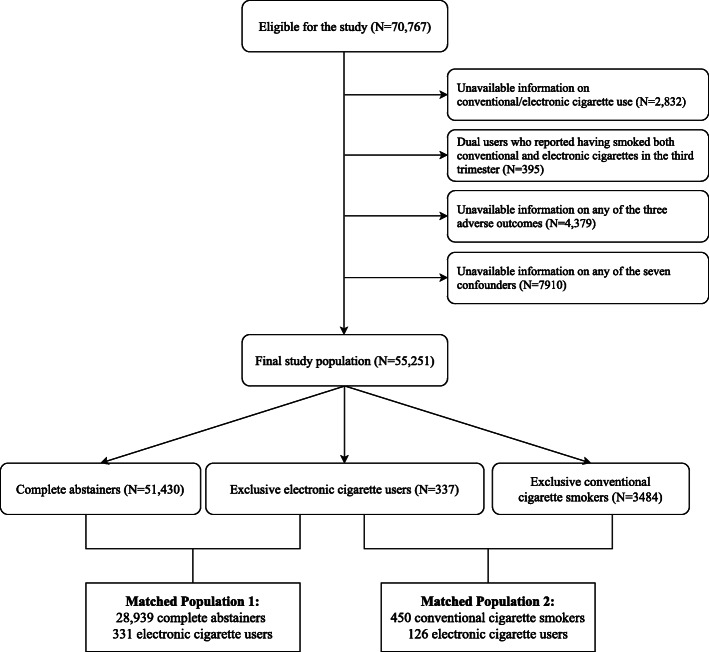
Data was extracted from 55,251 pregnant women who participated in the Phase 8 survey of the Pregnancy Risk Assessment Monitoring System between 2016 and 2018. Participants were classified into three groups based on their smoking behaviors in the third trimester: complete tobacco abstinence, exclusive CC smoking, or exclusive EC use. Adverse outcomes included infants being small-for-gestational-age (SGA), having low birthweight (LBW), and being born at preterm. EC users were matched to complete abstainers and CC smokers who share the same baseline characteristics in race/ethnicity, age, educational attainment, income, prenatal care adequacy, and first- and second-trimester CC smoking statuses. The association between EC use and adverse birth outcomes were examined by survey-weighted logistic regression analyses in the matched population.
Among participants, 1.0% of women reported having used ECs during the third trimester, 60% of which reported using ECs exclusively. Neonates of EC users were significantly more likely to be SGA (OR 1.76; 95% CI 1.04, 2.96), have LBW (OR 1.53; 95% CI 1.06, 2.22), or be born preterm (OR 1.86; 95% CI 1.11, 3.12) compared to tobacco abstainers. However, odds of EC users' pregnancies resulting in SGA (OR 0.67; 95% CI 0.30, 1.47), LBW (OR 0.71; 95% CI 0.37, 1.37), or preterm birth (OR 1.06; 95% CI 0.46, 2.48) were not significantly lower than those of CC smokers.
Even after accounting for shared risk factors between prenatal tobacco use and adverse birth outcomes, EC use remains an independent risk factor for neonatal complications and is not a safer alternative to CC smoking during pregnancy. Until further research is completed, all pregnant women are encouraged to abstain from all tobacco products including ECs.
传统香烟(CC)吸烟是导致不良出生结局的最可预防原因之一。尽管电子烟(EC)在孕期被认为比传统香烟更安全,但相关证据仍有待呈现。本研究比较了产前使用电子烟与传统香烟吸烟者及完全戒烟者相比,对新生儿出生结局的影响。
数据提取自2016年至2018年参与妊娠风险评估监测系统第8阶段调查的55251名孕妇。根据她们在孕晚期的吸烟行为,参与者被分为三组:完全戒烟、仅吸传统香烟或仅使用电子烟。不良结局包括小于胎龄儿(SGA)、低出生体重(LBW)和早产。电子烟使用者与在种族/民族、年龄、教育程度、收入、产前护理充足程度以及孕早期和孕中期传统香烟吸烟状况方面具有相同基线特征的完全戒烟者和传统香烟吸烟者进行匹配。在匹配人群中,通过调查加权逻辑回归分析来研究电子烟使用与不良出生结局之间的关联。
在参与者中,1.0%的女性报告在孕晚期使用过电子烟,其中60%报告仅使用电子烟。与戒烟者相比,电子烟使用者的新生儿更有可能成为小于胎龄儿(OR 1.76;95%CI 1.04,2.96)、低出生体重(OR 1.53;95%CI 1.06,2.22)或早产(OR 1.86;95%CI 1.11,3.12)。然而,电子烟使用者的妊娠导致小于胎龄儿(OR 0.67;95%CI 0.30,1.47)、低出生体重(OR 0.71;95%CI 0.37,1.37)或早产(OR 1.06;95%CI 0.46,2.48)的几率并不显著低于传统香烟吸烟者。
即使考虑到产前吸烟与不良出生结局之间的共同风险因素,使用电子烟仍然是新生儿并发症的独立风险因素,并且在孕期并非比吸传统香烟更安全的选择。在进一步研究完成之前,鼓励所有孕妇戒除包括电子烟在内的所有烟草制品。