Nuffield Department of Population Health, NIHR Policy Research Unit in Maternal Health and Care, National Perinatal Epidemiology Unit, University of Oxford, Oxford, United Kingdom.
PLoS One. 2021 Jun 4;16(6):e0252817. doi: 10.1371/journal.pone.0252817. eCollection 2021.
Exposure to tobacco products during pregnancy presents a potential harm to both mother and baby. This study sought to estimate the prevalence of vaping during pregnancy and to explore the factors and outcomes associated with vaping in pregnancy.
England.
Women who gave birth between 15th and 28th October 2017.
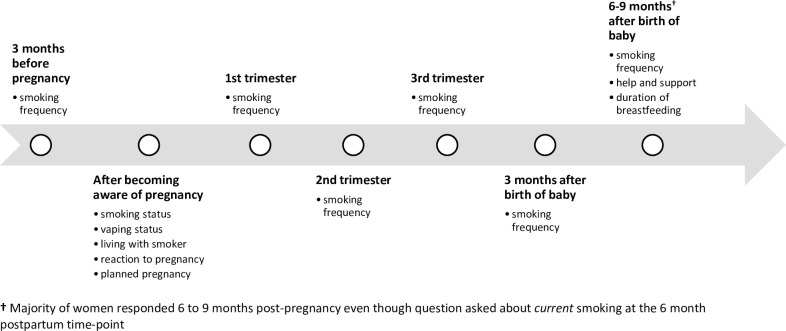
A cross-sectional population-based postal survey of maternal and infant health, the National Maternity Survey (NMS) 2018. The prevalence of vaping and patterns of cigarette smoking were estimated, and regression analysis was used to explore associations between maternal characteristics and vaping, and between vaping and birth outcomes.
Unweighted and weighted prevalence of vaping with 95% confidence intervals, and unadjusted and adjusted relative risks or difference in means for the association of participant characteristics and secondary outcomes with vaping. Secondary outcome measures were: preterm birth, gestational age at birth, birthweight, and initiation and duration of breastfeeding.
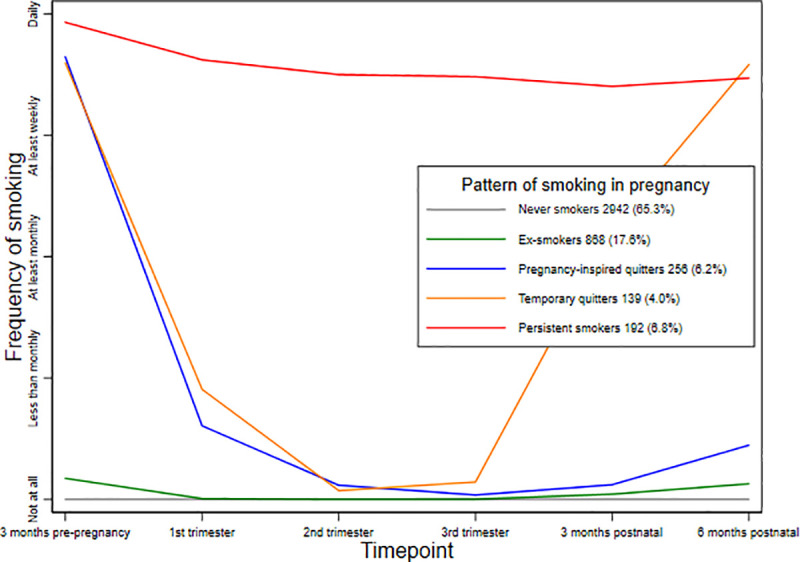
A total of 4,509 women responded to the survey. The prevalence of vaping in pregnancy was 2.8% (95%CI 2.4% to 3.4%). This varied according to the pattern of cigarette smoking in pregnancy: 0.3% in never-smokers; 3.3% in ex-smokers; 7.7% in pregnancy-inspired quitters; 9.5% in temporary quitters; and 17.7% in persistent smokers. Younger women, unmarried women, women with fewer years of formal education, women living with a smoker, and persistent smokers were more likely to vape, although after adjusting for pattern of cigarette smoking and maternal characteristics, persistent smoking was the only risk factor. We did not find any association between vaping and preterm birth, birthweight, or breastfeeding.
The prevalence of vaping during pregnancy in the NMS 2018 was low overall but much higher in smokers. Smoking was the factor most strongly associated with vaping. Co-occurrence of vaping with persistent smoking has the potential to increase the harms of tobacco exposure in pregnant women and their infants.
孕妇接触烟草制品对母婴均存在潜在危害。本研究旨在评估孕妇电子烟使用的流行率,并探讨与孕期电子烟使用相关的因素和结局。
英格兰。
2017 年 10 月 15 日至 28 日期间分娩的女性。
对产妇和婴儿健康进行了一项基于人群的横断面邮政调查,即 2018 年全国产妇调查(NMS)。估计了电子烟使用的流行率和吸烟模式,并使用回归分析探讨了母体特征与电子烟使用之间以及电子烟使用与出生结局之间的关联。
未加权和加权的电子烟使用流行率及其 95%置信区间,以及参与者特征和次要结局与电子烟使用之间关联的未调整和调整后的相对风险或均值差异。次要结局测量指标包括早产、出生时的胎龄、出生体重以及母乳喂养的开始和持续时间。
共有 4509 名女性对调查做出了回应。孕期电子烟使用的流行率为 2.8%(95%CI 2.4%至 3.4%)。这一比例因孕期吸烟模式而异:从不吸烟者中为 0.3%;曾经吸烟者中为 3.3%;因怀孕而戒烟者中为 7.7%;临时戒烟者中为 9.5%;持续吸烟者中为 17.7%。年轻女性、未婚女性、受教育年限较少的女性、与吸烟者同住的女性和持续吸烟者更有可能使用电子烟,但在调整了吸烟模式和母体特征后,持续吸烟是唯一的危险因素。我们没有发现电子烟使用与早产、出生体重或母乳喂养之间存在任何关联。
NMS 2018 年孕期电子烟使用的总体流行率较低,但在吸烟者中要高得多。吸烟是与电子烟使用最密切相关的因素。电子烟与持续吸烟同时存在,有可能增加孕妇及其婴儿暴露于烟草的危害。