Departament de Genètica i de Microbiologia, Universitat Autònoma de Barcelona, Bellaterra, Spain.
Department of Biological Sciences, University of Maryland, Baltimore County, Baltimore, MD, USA.
Microb Genom. 2020 Nov;6(11). doi: 10.1099/mgen.0.000440.
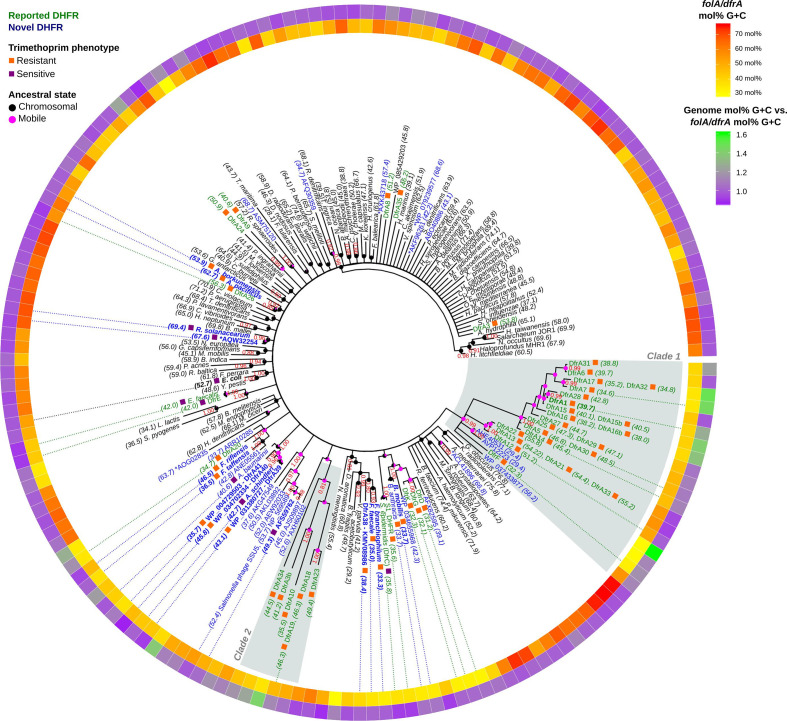
Trimethoprim is a synthetic antibacterial agent that targets folate biosynthesis by competitively binding to the di-hydrofolate reductase enzyme (DHFR). Trimethoprim is often administered synergistically with sulfonamide, another chemotherapeutic agent targeting the di-hydropteroate synthase (DHPS) enzyme in the same pathway. Clinical resistance to both drugs is widespread and mediated by enzyme variants capable of performing their biological function without binding to these drugs. These mutant enzymes were assumed to have arisen after the discovery of these synthetic drugs, but recent work has shown that genes conferring resistance to sulfonamide were present in the bacterial pangenome millions of years ago. Here, we apply phylogenetics and comparative genomics methods to study the largest family of mobile trimethoprim-resistance genes (). We show that most of the genes identified to date map to two large clades that likely arose from independent mobilization events. In contrast to sulfonamide resistance () genes, we find evidence of recurrent mobilization in genes. Phylogenetic evidence allows us to identify novel genes in the emerging pathogen , and we confirm their resistance phenotype . We also identify a cluster of homologues in cryptic plasmid and phage genomes, but we show that these enzymes do not confer resistance to trimethoprim. Our methods also allow us to pinpoint the chromosomal origin of previously reported genes, and we show that many of these ancient chromosomal genes also confer resistance to trimethoprim. Our work reveals that trimethoprim resistance predated the clinical use of this chemotherapeutic agent, but that novel mutations have likely also arisen and become mobilized following its widespread use within and outside the clinic. Hence, this work confirms that resistance to novel drugs may already be present in the bacterial pangenome, and stresses the importance of rapid mobilization as a fundamental element in the emergence and global spread of resistance determinants.
甲氧苄啶是一种合成抗菌剂,通过竞争性结合二氢叶酸还原酶(DHFR)来靶向叶酸生物合成。甲氧苄啶通常与磺胺类药物联合使用,磺胺类药物是另一种靶向同一路径中二氢喋呤合成酶(DHPS)的化疗药物。对这两种药物的临床耐药性很普遍,是由能够在不结合这些药物的情况下发挥其生物学功能的酶变体介导的。这些突变酶被认为是在发现这些合成药物之后出现的,但最近的研究表明,赋予磺胺类药物耐药性的基因在细菌泛基因组中存在于数百万年前。在这里,我们应用系统发生学和比较基因组学方法来研究最大的移动甲氧苄啶耐药基因家族()。我们表明,迄今为止鉴定的大多数基因都映射到两个可能来自独立移动事件的大型进化枝上。与磺胺类药物耐药性()基因不同,我们发现证据表明基因在反复发生移动。系统发育证据使我们能够在新兴病原体中识别新的基因,并证实了它们的耐药表型。我们还在隐性质粒和噬菌体基因组中发现了一组基因的同源物,但我们表明这些酶不能赋予对甲氧苄啶的耐药性。我们的方法还使我们能够确定先前报道的基因的染色体起源,并且我们表明这些古老的染色体基因中的许多也对甲氧苄啶具有抗性。我们的工作表明,甲氧苄啶耐药性先于该化疗药物的临床使用,但在其在临床内外广泛使用后,可能也出现了新的突变并被移动。因此,这项工作证实了对新型药物的耐药性可能已经存在于细菌泛基因组中,并强调了快速移动作为耐药决定因素出现和全球传播的基本要素的重要性。