Department of Biobehavioral Health Sciences, College of Nursing, University of Arizona, Tucson, AZ, United States.
Department of Health Promotion Sciences, Mel and Enid Zuckerman College of Public Health, University of Arizona, Tucson, AZ, United States.
JMIR Mhealth Uhealth. 2020 Sep 24;8(9):e18491. doi: 10.2196/18491.
The collection of self-reported physical activity using validated questionnaires has known bias and measurement error.
Accelerometry, an objective measure of daily activity, increases the rigor and accuracy of physical activity measurements. Here, we describe the methodology and related protocols for accelerometry data collection and quality assurance using the Actigraph GT9X accelerometer data collection in a convenience sample of ovarian cancer survivors enrolled in GOG/NRG 0225, a 24-month randomized controlled trial of diet and physical activity intervention versus attention control.
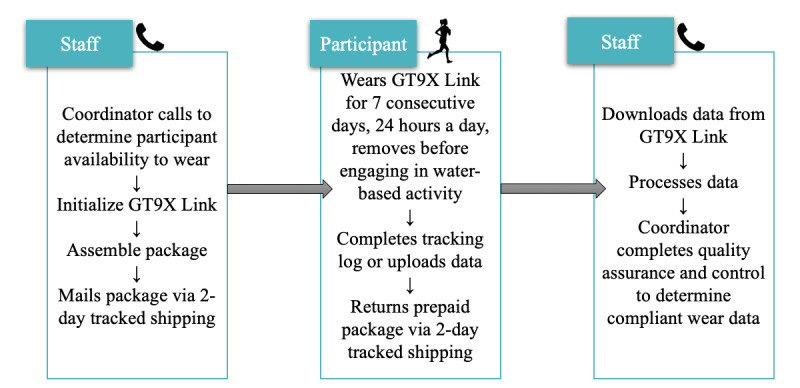
From July 2015 to December 2019, accelerometers were mailed on 1337 separate occasions to 580 study participants to wear at 4 time points (baseline, 6, 12, and 24 months) for 7 consecutive days. Study staff contacted participants via telephone to confirm their availability to wear the accelerometers and reviewed instructions and procedures regarding the return of the accelerometers and assisted with any technology concerns.
We evaluated factors associated with wear compliance, including activity tracking, use of a mobile app, and demographic characteristics with chi-square tests and logistic regression. Compliant data, defined as ≥4 consecutive days with ≥10 hours daily wear time, exceeded 90% at all study time points. Activity tracking, but no other characteristics, was significantly associated with compliant data at all time points (P<.001). This implementation of data collection through accelerometry provided highly compliant and usable activity data in women who recently completed treatment for ovarian cancer.
The high compliance and data quality associated with this protocol suggest that it could be disseminated to support researchers who seek to collect robust objective activity data in cancer survivors residing in a wide geographic area.
使用经过验证的问卷收集自我报告的身体活动存在已知的偏差和测量误差。
加速度计是一种日常活动的客观测量方法,可提高身体活动测量的严谨性和准确性。在这里,我们描述了在卵巢癌幸存者便利样本中使用 Actigraph GT9X 加速度计收集数据和进行质量保证的方法学和相关协议,这些幸存者参加了 GOG/NRG 0225 研究,这是一项为期 24 个月的饮食和身体活动干预与对照的随机对照试验。
从 2015 年 7 月到 2019 年 12 月,向 580 名研究参与者邮寄了 1337 次加速度计,要求他们在 4 个时间点(基线、6、12 和 24 个月)佩戴 7 天,每天佩戴时间不少于 10 小时。研究人员通过电话联系参与者,确认他们是否有佩戴加速度计的时间,并审查有关归还加速度计的说明和程序,并协助解决任何技术问题。
我们评估了与佩戴依从性相关的因素,包括活动跟踪、使用移动应用程序以及与卡方检验和逻辑回归相关的人口统计学特征。在所有研究时间点,符合要求的数据(定义为连续 4 天每天佩戴时间不少于 10 小时)均超过 90%。活动跟踪,但不是其他特征,与所有时间点的符合要求的数据显著相关(P<.001)。这种通过加速度计收集数据的方法在最近完成卵巢癌治疗的女性中提供了高度依从和可用的活动数据。
该方案与高依从性和高质量的数据相关,这表明它可以在希望在广泛地理区域收集稳健客观活动数据的癌症幸存者中推广。