School of Psychology, University of New South Wales, Sydney, Australia.
Neuroscience Research Australia, Sydney, Australia.
J Med Internet Res. 2020 Sep 24;22(9):e19431. doi: 10.2196/19431.
There is a need to develop interventions to reduce the risk of dementia in the community by addressing lifestyle factors and chronic diseases over the adult life course.
This study aims to evaluate a multidomain dementia risk reduction intervention, Body Brain Life in General Practice (BBL-GP), targeting at-risk adults in primary care.
A pragmatic, parallel, three-arm randomized trial involving 125 adults aged 18 years or older (86/125, 68.8% female) with a BMI of ≥25 kg/m or a chronic health condition recruited from general practices was conducted. The arms included (1) BBL-GP, a web-based intervention augmented with an in-person diet and physical activity consultation; (2) a single clinician-led group, Lifestyle Modification Program (LMP); and (3) a web-based control. The primary outcome was the Australian National University Alzheimer Disease Risk Index Short Form (ANU-ADRI-SF).
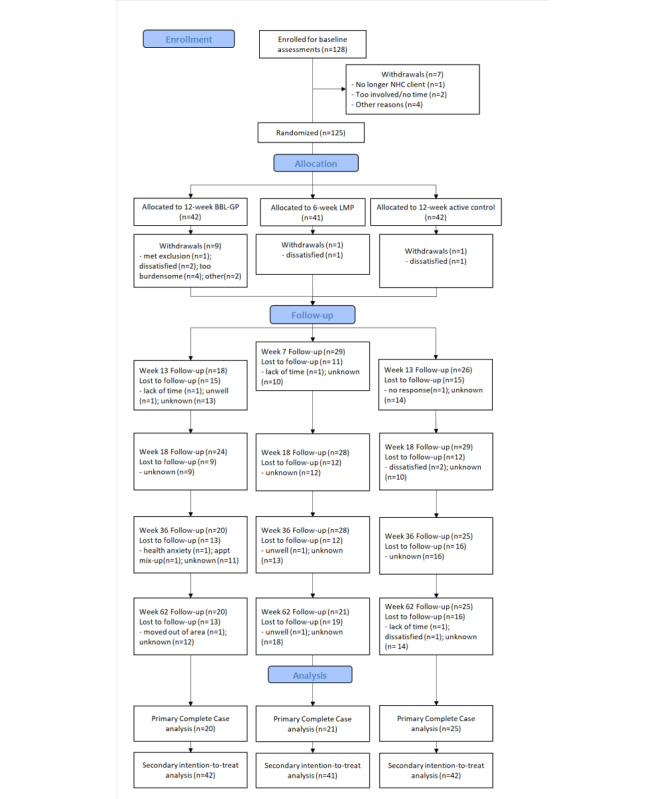
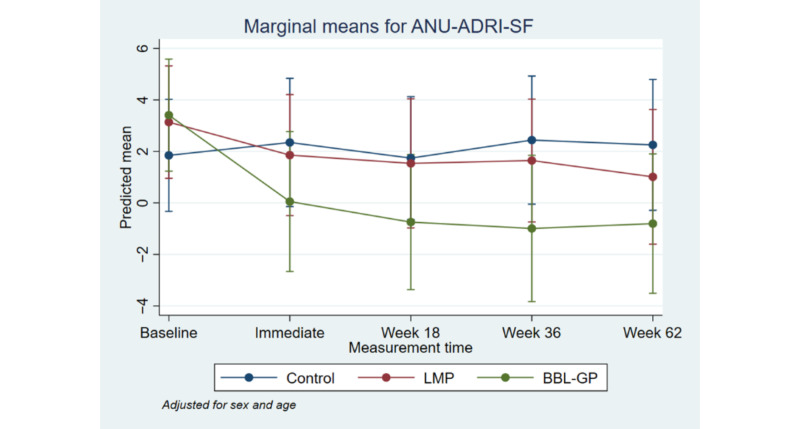
Baseline assessments were conducted on 128 participants. A total of 125 participants were randomized to 3 groups (BBL-GP=42, LMP=41, and control=42). At immediate, week 18, week 36, and week 62 follow-ups, the completion rates were 43% (18/42), 57% (24/42), 48% (20/42), and 48% (20/42), respectively, for the BBL-GP group; 71% (29/41), 68% (28/41), 68% (28/41), and 51% (21/41), respectively, for the LMP group; and 62% (26/42), 69% (29/42), 60% (25/42), and 60% (25/42), respectively, for the control group. The primary outcome of the ANU-ADRI-SF score was lower for the BBL-GP group than the control group at all follow-ups. These comparisons were all significant at the 5% level for estimates adjusted for baseline differences (immediate: difference in means -3.86, 95% CI -6.81 to -0.90, P=.01; week 18: difference in means -4.05, 95% CI -6.81 to -1.28, P<.001; week 36: difference in means -4.99, 95% CI -8.04 to -1.94, P<.001; and week 62: difference in means -4.62, 95% CI -7.62 to -1.62, P<.001).
A web-based multidomain dementia risk reduction program augmented with allied health consultations administered within the general practice context can reduce dementia risk exposure for at least 15 months. This study was limited by a small sample size, and replication on a larger sample with longer follow-up will strengthen the results.
Australian clinical trials registration number (ACTRN): 12616000868482; https://anzctr.org.au/ACTRN12616000868482.aspx.
需要通过解决成年期的生活方式因素和慢性疾病来制定干预措施,以减少社区中痴呆症的风险。
本研究旨在评估一种多领域的痴呆症风险降低干预措施,即 Body Brain Life in General Practice(BBL-GP),该措施针对初级保健中的高危成年人。
一项实用、平行、三臂随机试验涉及 125 名年龄在 18 岁或以上(86/125,68.8%为女性)、BMI 为≥25 kg/m2 或患有慢性疾病的成年人,他们从普通诊所招募。手臂包括(1)BBL-GP,一种基于网络的干预措施,辅以面对面的饮食和身体活动咨询;(2)单一临床医生主导的小组,生活方式修改计划(LMP);和(3)基于网络的对照组。主要结局指标是澳大利亚国立大学阿尔茨海默病风险指数短表(ANU-ADRI-SF)。
在 128 名参与者中进行了基线评估。共有 125 名参与者被随机分配到 3 组(BBL-GP=42、LMP=41 和对照组=42)。在即时、第 18 周、第 36 周和第 62 周随访中,BBL-GP 组的完成率分别为 43%(18/42)、57%(24/42)、48%(20/42)和 48%(20/42);LMP 组分别为 71%(29/41)、68%(28/41)、68%(28/41)和 51%(21/41);对照组分别为 62%(26/42)、69%(29/42)、60%(25/42)和 60%(25/42)。ANU-ADRI-SF 评分的主要结局指标在所有随访中均低于对照组。这些比较在调整基线差异后的估计值在 5%水平上均具有统计学意义(即时:差异均值-3.86,95%CI-6.81 至-0.90,P=.01;第 18 周:差异均值-4.05,95%CI-6.81 至-1.28,P<.001;第 36 周:差异均值-4.99,95%CI-8.04 至-1.94,P<.001;和第 62 周:差异均值-4.62,95%CI-7.62 至-1.62,P<.001)。
基于网络的多领域痴呆症风险降低计划,辅以普通实践环境中的联合健康咨询,可以减少至少 15 个月的痴呆症风险暴露。本研究的样本量较小,在更大的样本量和更长的随访时间上进行复制将加强结果。
澳大利亚临床试验注册编号(ACTRN):12616000868482;https://anzctr.org.au/ACTRN12616000868482.aspx。