Peters Ruth, Ee Nicole, Peters Jean, Beckett Nigel, Booth Andrew, Rockwood Kenneth, Anstey Kaarin J
Neuroscience Research Australia, Barker Street, Randwick, Sydney, New South Wales, 2031, Australia.
University of New South Wales, Sydney, NSW, Australia.
Ther Adv Chronic Dis. 2019 Oct 15;10:2040622319880392. doi: 10.1177/2040622319880392. eCollection 2019.
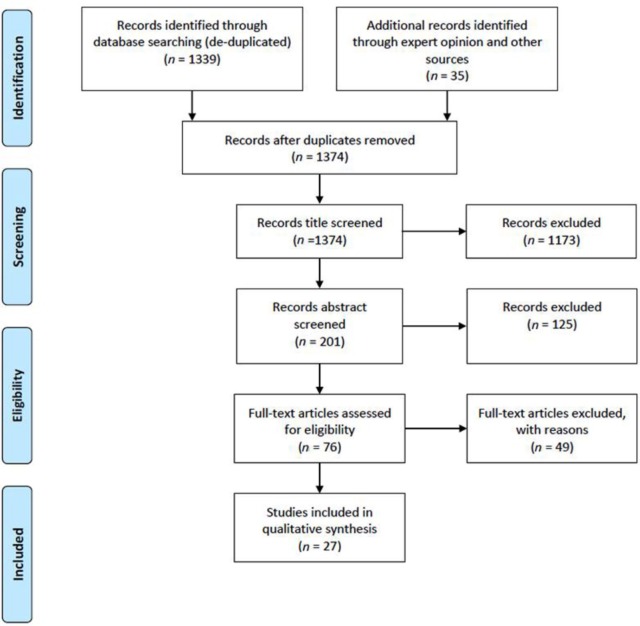
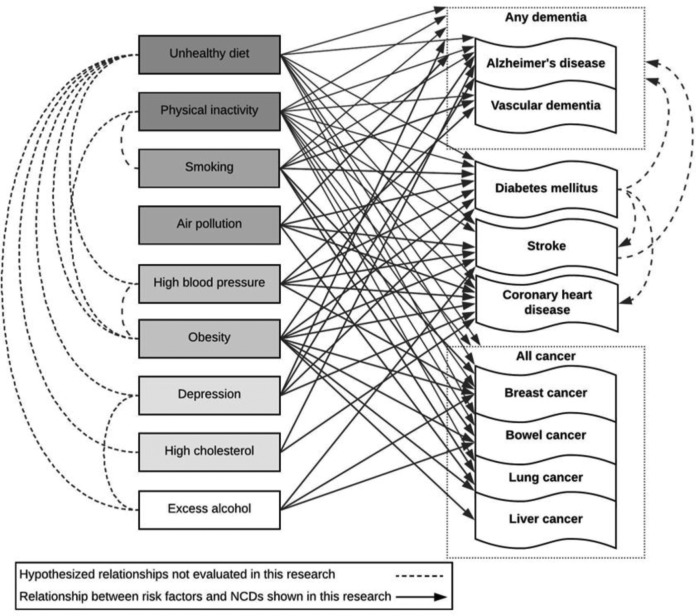
Noncommunicable disease now contributes to the World Health Organization top 10 causes of death in low-, middle- and high-income countries. Particular examples include stroke, coronary heart disease, dementia and certain cancers. Research linking clinical and lifestyle risk factors to increased risk of noncommunicable disease is now well established with examples of confirmed risk factors, including smoking, physical inactivity, obesity and hypertension. However, despite a need to target our resources to achieve risk reduction, relatively little work has examined the overlap between the risk factors for these main noncommunicable diseases. Our high-level review draws together the evidence in this area. Using a systematic overview of reviews, we demonstrate the likely commonality of established risk factors having an impact on multiple noncommunicable disease outcomes. For example, systematic reviews of the evidence on physical inactivity and poor diet found each to be associated with increased risk of cancers, coronary heart disease, stroke, diabetes mellitus and dementia. We highlight the potential for targeted risk reduction to simultaneously impact multiple noncommunicable disease areas. These relationships now need to be further quantified to allow the most effective development of public health interventions in this area.
非传染性疾病如今在低收入、中等收入和高收入国家均位列世界卫生组织的十大死因。具体例子包括中风、冠心病、痴呆症和某些癌症。将临床和生活方式风险因素与非传染性疾病风险增加联系起来的研究现已充分确立,有一些已确认的风险因素实例,包括吸烟、缺乏身体活动、肥胖和高血压。然而,尽管需要将资源用于降低风险,但相对较少的研究探讨了这些主要非传染性疾病风险因素之间的重叠情况。我们的高级别综述汇总了该领域的证据。通过对综述进行系统概述,我们证明了既定风险因素对多种非传染性疾病结局产生影响的可能共性。例如,对缺乏身体活动和不良饮食证据的系统综述发现,它们各自都与癌症、冠心病、中风、糖尿病和痴呆症风险增加有关。我们强调有针对性地降低风险有可能同时影响多个非传染性疾病领域。现在需要进一步量化这些关系,以便在该领域最有效地制定公共卫生干预措施。