Stricker Kerry Bohl, Hagan Donald, Flory S Luke
Agronomy Department, University of Florida, Gainesville, FL 32611, USA.
School of Agricultural, Forest, and Environmental Sciences, Clemson University, Clemson, SC 29634, USA.
AoB Plants. 2015 Mar 30;7:plv028. doi: 10.1093/aobpla/plv028.
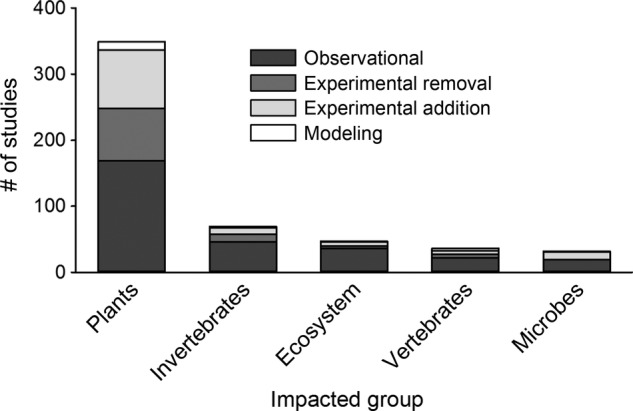
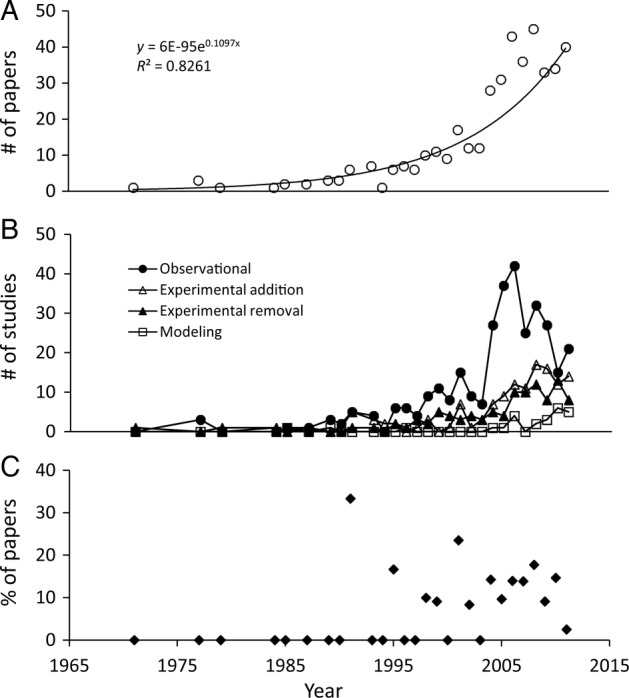
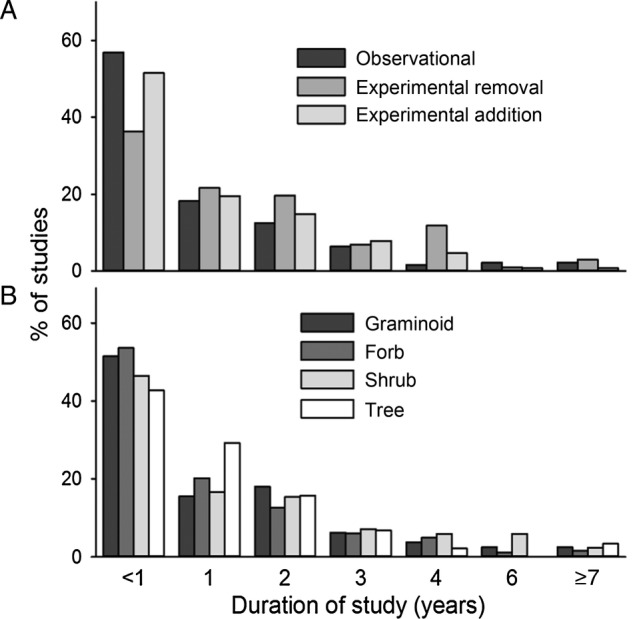
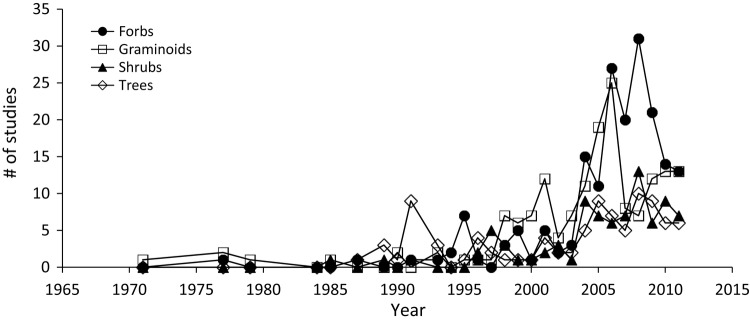
Methods used to evaluate the ecological impacts of biological invasions vary widely from broad-scale observational studies to removal experiments in invaded communities and experimental additions in common gardens and greenhouses. Different methods provide information at diverse spatial and temporal scales with varying levels of reliability. Thus, here we provide a synthetic and critical review of the methods used to evaluate the impacts of plant invasions and provide recommendations for future research. We review the types of methods available and report patterns in methods used, including the duration and spatial scale of studies and plant functional groups examined, from 410 peer-reviewed papers published between 1971 and 2011. We found that there has been a marked increase in papers published on plant invasion impacts since 2003 and that more than half of all studies employed observational methods while <5 % included predictive modelling. Most of the studies were temporally and spatially restricted with 51 % of studies lasting <1 year and almost half of all studies conducted in plots or mesocosms <1 m(2). There was also a bias in life form studied: more than 60 % of all studies evaluated impacts of invasive forbs and graminoids while <16 % focused on invasive trees. To more effectively quantify invasion impacts, we argue that longer-term experimental research and more studies that use predictive modelling and evaluate impacts of invasions on ecosystem processes and fauna are needed. Combining broad-scale observational studies with experiments and predictive modelling may provide the most insight into invasion impacts for policy makers and land managers seeking to reduce the effects of plant invasions.
用于评估生物入侵生态影响的方法多种多样,从大规模观测研究到入侵群落的去除实验,以及在普通花园和温室中的实验添加。不同方法在不同的空间和时间尺度上提供信息,可靠性程度也各不相同。因此,我们在此对用于评估植物入侵影响的方法进行综合批判性综述,并为未来研究提供建议。我们回顾了可用的方法类型,并报告了所用方法的模式,包括研究的持续时间、空间尺度以及所研究的植物功能群,这些信息来自1971年至2011年间发表的410篇同行评议论文。我们发现,自2003年以来,关于植物入侵影响的论文数量显著增加,超过一半的研究采用了观测方法,而采用预测模型的研究不到5%。大多数研究在时间和空间上受到限制,51%的研究持续时间不到1年,几乎一半的研究在面积小于1平方米的地块或中型生态系统中进行。在所研究的生活型方面也存在偏差:超过60%的研究评估了入侵草本植物和禾本科植物的影响,而关注入侵树木的研究不到16%。为了更有效地量化入侵影响,我们认为需要进行更长期的实验研究,以及更多使用预测模型并评估入侵对生态系统过程和动物影响的研究。将大规模观测研究与实验和预测模型相结合,可能会为寻求减少植物入侵影响的政策制定者和土地管理者提供关于入侵影响的最深入见解。