Institute for Advanced Biosciences, Keio University, 403-1 Nipponkoku, Daihouji, Tsuruoka, Yamagata, 997-0017, Japan.
Spiber Inc., 234-1 Mizukami, Kakuganji, Tsuruoka, Yamagata, 997-0052, Japan.
Sci Rep. 2020 Sep 24;10(1):15721. doi: 10.1038/s41598-020-72888-6.
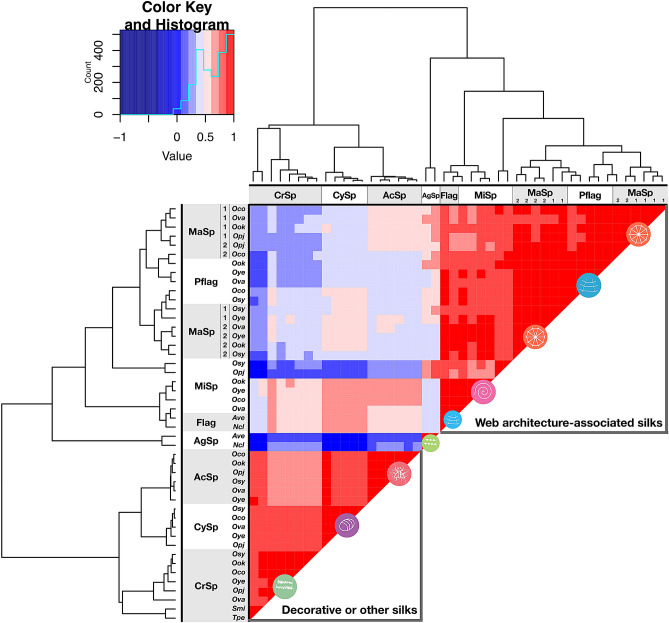
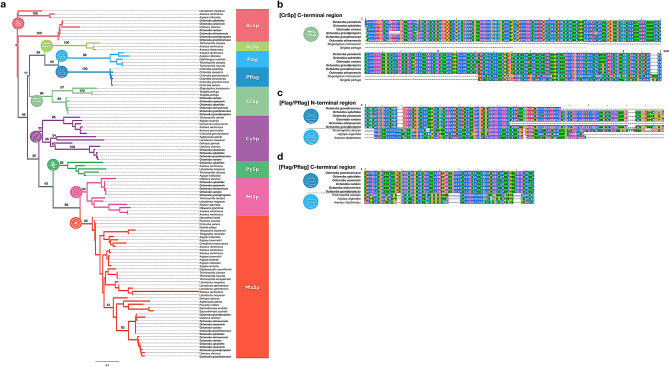
Orb-weaving spiders have two main methods of prey capture: cribellate spiders use dry, sticky capture threads, and ecribellate spiders use viscid glue droplets. Predation behaviour is a major evolutionary driving force, and it is important on spider phylogeny whether the cribellate and ecribellate spiders each evolved the orb architecture independently or both strategies were derived from an ancient orb web. These hypotheses have been discussed based on behavioural and morphological characteristics, with little discussion on this subject from the perspective of molecular materials of orb web, since there is little information about cribellate spider-associated spidroin genes. Here, we present in detail a spidroin catalogue of six uloborid species of cribellate orb-weaving spiders, including cribellate and pseudoflagelliform spidroins, with transcriptome assembly complemented with long read sequencing, where silk composition is confirmed by proteomics. Comparative analysis across families (Araneidae and Uloboridae) shows that the gene architecture, repetitive domains, and amino acid frequencies of the orb web constituting silk proteins are similar among orb-weaving spiders regardless of the prey capture strategy. Notably, the fact that there is a difference only in the prey capture thread proteins strongly supports the monophyletic origin of the orb web.
有纺器蜘蛛使用干燥、粘性的捕捉线,而无纺器蜘蛛则使用粘性的胶水滴。捕食行为是主要的进化驱动力,对于蜘蛛系统发育来说,重要的是有纺器和无纺器蜘蛛是否各自独立进化出了球形网结构,或者这两种策略都是从古老的球形网中衍生而来。这些假说已经基于行为和形态特征进行了讨论,但从球形网的分子材料角度来看,几乎没有讨论过这个问题,因为关于有纺器蜘蛛相关丝蛋白基因的信息很少。在这里,我们详细介绍了六种有纺器结网蜘蛛的六只 uloborid 物种的丝蛋白目录,包括有纺器和拟鞭毛丝蛋白,通过转录组组装和长读测序进行补充,通过蛋白质组学证实了丝的组成。跨科(Araneidae 和 Uloboridae)的比较分析表明,球形网构成丝蛋白的基因结构、重复结构域和氨基酸频率在球形蜘蛛中是相似的,无论其捕食策略如何。值得注意的是,只有在猎物捕捉线蛋白中存在差异这一事实强烈支持了球形网的单系起源。