Chen Guozhen, Du Junbao, Jin Hongfang, Huang Yaqian
Department of Pediatrics, Peking University First Hospital, Beijing, China.
Department of Pediatrics, The Affiliated Yantai Yuhuangding Hospital of Qingdao University, Yantai, China.
Front Pediatr. 2020 Aug 20;8:474. doi: 10.3389/fped.2020.00474. eCollection 2020.
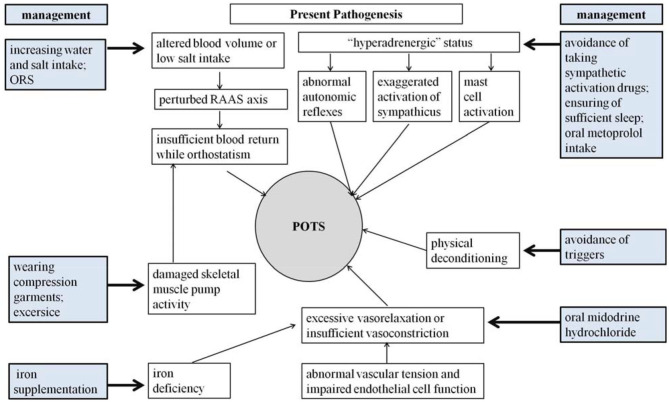
Postural tachycardia syndrome (POTS), characterized by chronic (≥6 months) orthostatic intolerance symptoms with a sustained and excessive heart rate increase while standing without postural hypotension, is common in children and adolescents. Despite the unclear pathogenesis of POTS, the present opinion is that POTS is a heterogeneous and multifactorial disorder that includes altered central blood volume, abnormal autonomic reflexes, "hyperadrenergic" status, damaged skeletal muscle pump activity, abnormal local vascular tension and vasoactive factor release, mast cell activation, iron insufficiency, and autoimmune dysfunction. A number of pediatric POTS patients are affected by more than one of these pathophysiological mechanisms. Therefore, individualized treatment strategies are initiated in the management of POTS, including basal non-pharmacological approaches (e.g., health education, the avoidance of triggers, exercise, or supplementation with water and salt) and special pharmacological therapies (e.g., oral rehydration salts, midodrine hydrochloride, and metoprolol). As such, the recent progress in the pathogenesis, management strategies, and therapeutic response predictors of pediatric POTS are reviewed here.
体位性心动过速综合征(POTS)的特征是慢性(≥6个月)直立不耐受症状,站立时心率持续过度增加且无体位性低血压,在儿童和青少年中很常见。尽管POTS的发病机制尚不清楚,但目前的观点认为,POTS是一种异质性多因素疾病,包括中心血容量改变、自主神经反射异常、“高肾上腺素能”状态、骨骼肌泵活动受损、局部血管张力和血管活性因子释放异常、肥大细胞活化、铁缺乏和自身免疫功能障碍。许多儿童POTS患者受这些病理生理机制中的一种以上影响。因此,在POTS的管理中采用个体化治疗策略,包括基础非药物方法(如健康教育、避免诱因、运动或补充水和盐)和特殊药物治疗(如口服补液盐、盐酸米多君和美托洛尔)。因此,本文综述了儿童POTS发病机制、管理策略和治疗反应预测指标的最新进展。