Singanallur Nagendrakumar B, Nampanya Sonevilay, MacPhillamy Isabel, Soukvilay Vilayvanh, Keokhamphet Chattouphone, Bush Russell D, Khounsy Syseng, Dhand Navneet K, Windsor Peter, Vosloo Wilna
Australian Centre for Disease Preparedness (Formerly Australian Animal Health Laboratory), CSIRO-Health and Biosecurity, Geelong, VIC, Australia.
Sydney School of Veterinary Science, University of Sydney, Camden, NSW, Australia.
Front Vet Sci. 2020 Aug 20;7:544. doi: 10.3389/fvets.2020.00544. eCollection 2020.
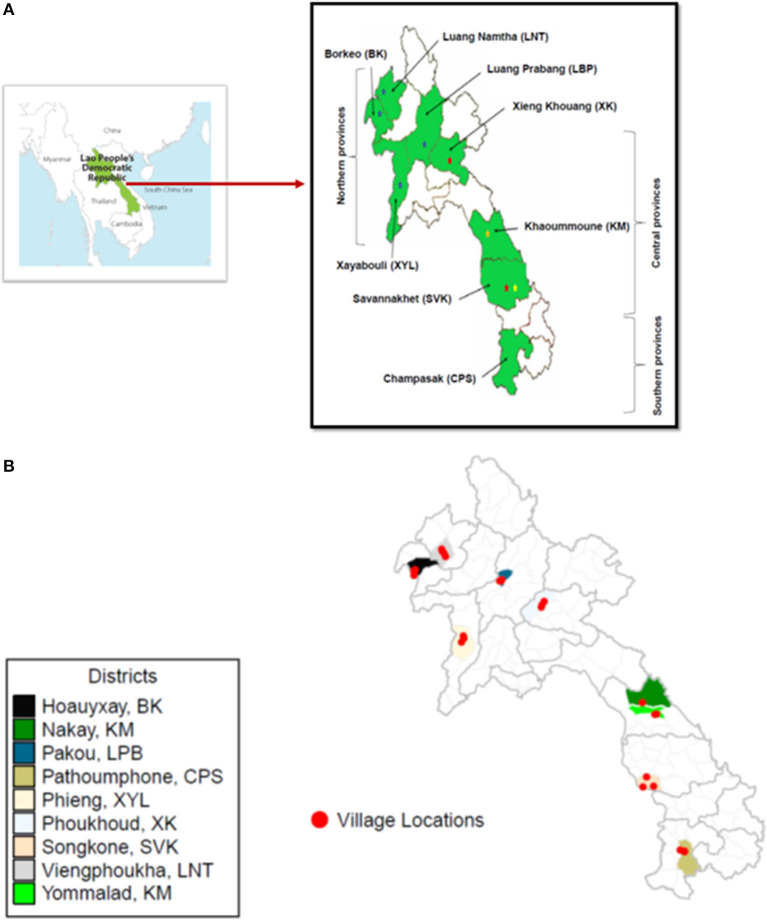
Foot and Mouth Disease (FMD) causes significant economic loss in Lao PDR (Laos) and perpetuates the cycle of smallholder poverty mainly through large ruminant productivity losses, increased costs of production and potential limitations to market access for trade in livestock and their products. Goats are emerging as an important livestock species in Laos, and there is an increasing trend in the number of households with goats, often farmed alongside cattle and buffalo. Although an FMD susceptible species, very little is known about the role of goats in the epidemiology of the disease in Laos. A cross-sectional seroprevalence study was conducted by detecting antibodies to the non-structural proteins (NSP), an indication of a previous infection, and serotype-specific structural proteins (SP) that could be due to vaccination or infection. The study commenced in late 2017 and sera were collected from 591 goats in 26 villages of northern, central and southern Laos. For a subset of sera samples, paired oral swab samples were also collected by a simple random sampling method to detect the prevalence of FMD virus infection at the time of collection. The NSP seroprevalence in the provinces of Borkeo and Xayabouli in the north was 42 and 8%, respectively and in Khammoune in the center, it was 20%. In the other five provinces, Luang Namtha and Luang Prabang (northern Laos), Xieng Khouang and Savannaket (central Laos), and Champasak (southern Laos), the seroprevalence was close to zero. The multivariable analysis indicated that age ( < 0.001) was positively associated with animal-level seropositivity and males were less likely to be seropositive than females (OR: 0.29; 95%CI: 0.10-0.83; = 0.017). Continued sero-surveillance for FMD in goats is recommended to improve our understanding of their role in the epidemiology of FMD in the region and to extend support to FMD control decisions, particularly regarding vaccination.
口蹄疫(FMD)给老挝人民民主共和国(老挝)造成了巨大的经济损失,主要通过大型反刍动物生产力下降、生产成本增加以及牲畜及其产品贸易市场准入的潜在限制,使小农户贫困循环持续存在。山羊正在成为老挝一种重要的牲畜品种,饲养山羊的家庭数量呈上升趋势,山羊通常与牛和水牛一起养殖。尽管山羊是易感染口蹄疫的物种,但对于山羊在老挝口蹄疫流行病学中的作用却知之甚少。通过检测针对非结构蛋白(NSP)的抗体(表明既往感染)以及可能因疫苗接种或感染产生的血清型特异性结构蛋白(SP),开展了一项横断面血清流行率研究。该研究于2017年末开始,从老挝北部、中部和南部26个村庄的591只山羊采集血清。对于一部分血清样本,还通过简单随机抽样方法采集配对的口腔拭子样本,以检测采集时口蹄疫病毒感染的流行率。北部博胶省和沙耶武里省的NSP血清流行率分别为42%和8%,中部甘蒙省为20%。在其他五个省份,琅南塔省和琅勃拉邦省(老挝北部)、川圹省和沙湾拿吉省(老挝中部)以及占巴塞省(老挝南部),血清流行率接近零。多变量分析表明,年龄(<0.001)与动物水平的血清阳性呈正相关,雄性动物血清阳性的可能性低于雌性(比值比:0.29;95%置信区间:0.10 - 0.83;P = 0.017)。建议继续对山羊进行口蹄疫血清监测,以增进我们对其在该地区口蹄疫流行病学中作用的了解,并为口蹄疫防控决策提供支持,特别是在疫苗接种方面。