Wolfson Institute of Preventive Medicine, Queen Mary University of London, London, United Kingdom; Division of Cancer Epidemiology and Genetics, National Cancer Institute, National Institutes of Health, Department of Health and Human Services, Bethesda, MD, USA.
School of Cancer & Pharmaceutical Sciences, King's College London, London SE1 9RT, United Kingdom.
Gynecol Oncol. 2020 Nov;159(2):344-353. doi: 10.1016/j.ygyno.2020.08.033. Epub 2020 Sep 22.
Despite widespread cervical screening, an estimated 13,800 women will be diagnosed with cervical cancer in the United States in 2020. To inform improvements, the screening histories of women diagnosed with cervical cancer in New Mexico were assessed.
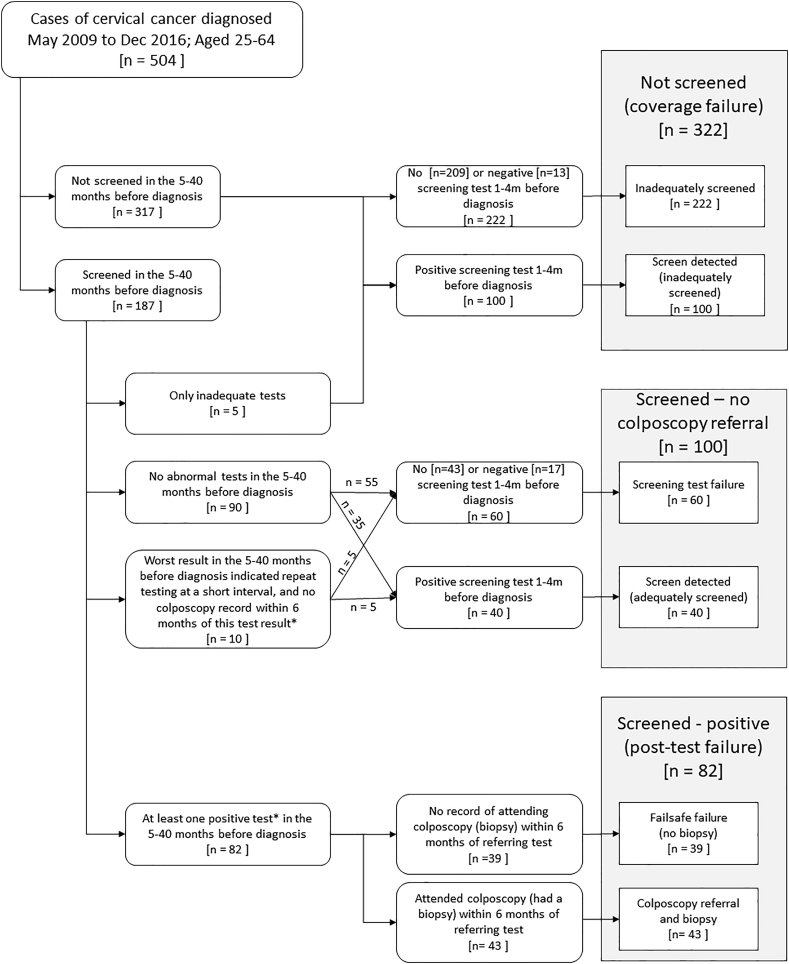
Data were collected on all cervical screening, diagnostic tests and treatment procedures for all women diagnosed with cervical cancer aged 25-64 yrs. in New Mexico from 2006 to 2016. Women were categorized by their screening attendance in the 5-40 months (screening interval) and 1-4 months (peri-diagnostic interval) prior to cancer diagnosis.
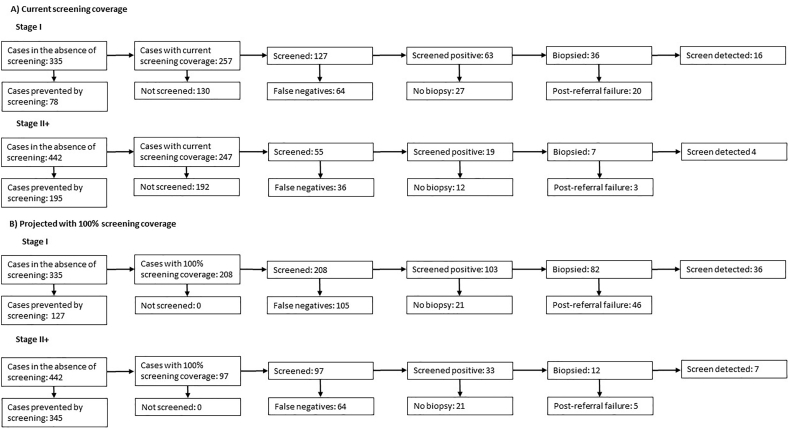
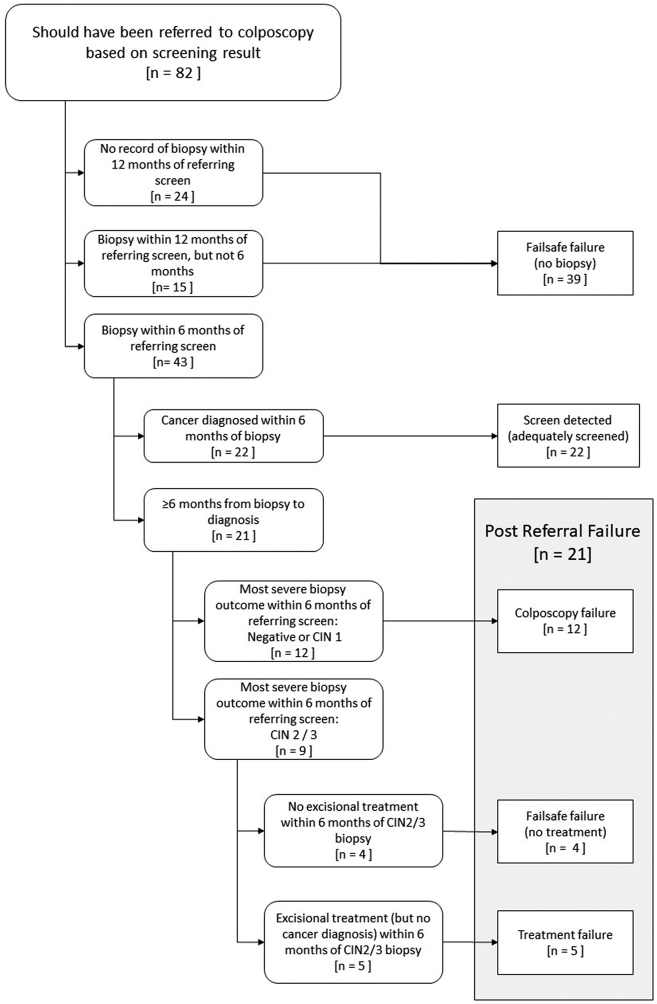
Of the 504 women diagnosed between May 2009-December 2016, 64% were not screened or had only inadequate screening tests in the 5-40 months prior to diagnosis, and 90 of 182 screened women (49%) had only negative screens in this period. Only 32% (N = 162) of cervical cancers were screen-detected. Women with adenocarcinomas were more likely to have had a recent negative screen (41/57 = 722%) than women with squamous cancers (50/112 = 45%). Both older women (aged 45-64 years) and women with more advanced cancers were less likely to have been screened, and if screened, were more likely to have a false-negative outcome. Only 9% of cancers were diagnosed in women who did not attend biopsy or treatment after positive tests requiring clinical management. Screening currently prevents 35% of cancers, whereas full screening coverage could prevent 61% of cervical cancers.
Improved screening coverage has the largest potential for reducing cervical cancer incidence, though there is also a role for improved recall procedures and screening sensitivity.
尽管广泛开展了宫颈癌筛查,但据估计,2020 年美国仍将有 13800 名女性被诊断患有宫颈癌。为了提供改进依据,评估了新墨西哥州被诊断患有宫颈癌的女性的筛查史。
收集了新墨西哥州所有 25-64 岁被诊断患有宫颈癌的女性从 2006 年至 2016 年的所有宫颈癌筛查、诊断检测和治疗程序的数据。根据女性在癌症诊断前 5-40 个月(筛查间隔)和 1-4 个月(诊断前间隔)的筛查情况对她们进行分类。
在 2009 年 5 月至 2016 年 12 月期间被诊断为 504 名女性中,64%的女性在诊断前 5-40 个月未接受筛查或仅接受了不充分的筛查检测,在这段时间内,182 名接受筛查的女性中有 90 名(49%)仅接受了阴性筛查。仅有 32%(N=162)的宫颈癌是筛查发现的。腺癌女性比鳞癌女性(50/112=45%)更有可能在最近接受了阴性筛查(41/57=722%)。年龄较大的女性(45-64 岁)和癌症分期较晚的女性更不可能接受筛查,如果接受了筛查,其假阴性结果的可能性也更高。仅有 9%的癌症是在接受阳性检测需要临床管理后未接受活检或治疗的女性中诊断出的。目前,筛查可预防 35%的宫颈癌,而全面的筛查覆盖率可预防 61%的宫颈癌。
提高筛查覆盖率对降低宫颈癌发病率的潜力最大,但改进召回程序和提高筛查敏感性也有一定作用。