Division of Oral Diagnostics and Rehabilitation, Department of Dental Medicine, Karolinska Institutet and Scandinavian Center for Orofacial Neurosciences (SCON), Huddinge, Sweden.
Pain and Rehabilitation Centre, and Department of Health, Medicine and Caring Sciences, Linköping University, Linköping, Sweden.
J Oral Rehabil. 2021 Jan;48(1):1-9. doi: 10.1111/joor.13100. Epub 2020 Oct 5.
The clinical care of chronic pain requires personalised understanding of the mechanisms involved. Temporomandibular disorders (TMD) are the most common chronic orofacial pain conditions, and oxidative stress has been proposed to be implicated in their pathophysiology, especially in arthrogenous TMD. However, few studies have explored oxidative stress in myogenous TMD (TMDM).
The aims of this study were to compare the salivary oxidative stress profiles between individuals with TMDM and healthy controls, and to explore associations of these markers with clinical characteristics.
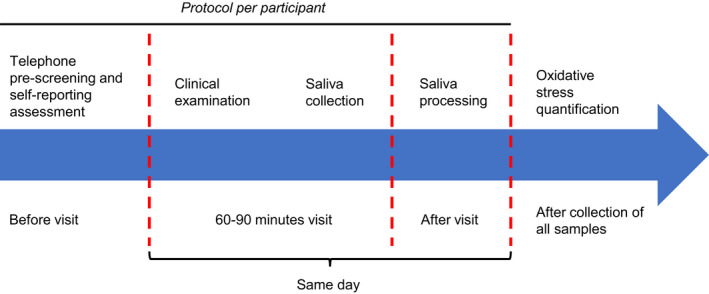
Saliva samples were collected from 39 individuals with TMDM and 37 age and sex-matched healthy volunteers. Psychological stress levels and clinical characteristics were assessed in all participants. The samples were analysed for total oxidant status (TOS), total antioxidative capacity (TAC) and superoxide dismutase activity (SODa). Comparisons between groups were performed using parametric and non-parametric tests depending on data distribution.
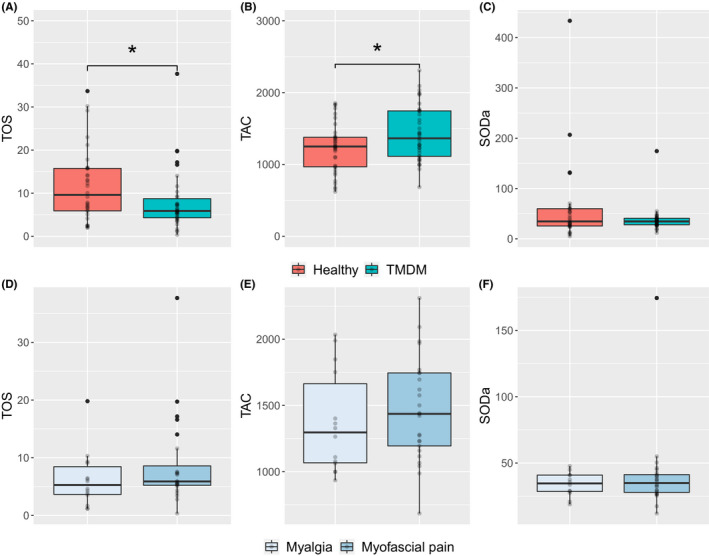
Psychological stress was higher in TMDM compared to controls (P < .001). TAC levels were significantly higher (P < .05) whereas TOS levels were significantly lower (P < .05) in TMDM compared to controls. There were no differences in SODa levels between groups and no correlations were found between clinical characteristics and oxidative stress markers.
Individuals with TMDM showed higher levels of antioxidative markers, but lower levels of oxidative markers. These results can be explained in part by chronicity and adaptation to the disease and other factors, such as psychological stress. Longitudinal studies must be conducted to clarify the role of oxidative stress in TMDM.
慢性疼痛的临床护理需要个性化地了解相关机制。颞下颌关节紊乱病(TMD)是最常见的慢性或面部疼痛疾病,氧化应激被认为与它们的病理生理学有关,尤其是在关节源性 TMD 中。然而,很少有研究探讨肌源性 TMD(TMDM)中的氧化应激。
本研究旨在比较 TMDM 患者和健康对照组之间的唾液氧化应激谱,并探讨这些标志物与临床特征的关系。
从 39 名 TMDM 患者和 37 名年龄和性别匹配的健康志愿者中采集唾液样本。所有参与者均评估心理应激水平和临床特征。分析样本中的总氧化剂状态(TOS)、总抗氧化能力(TAC)和超氧化物歧化酶活性(SODa)。根据数据分布,使用参数和非参数检验比较组间差异。
与对照组相比,TMDM 患者的心理应激水平更高(P<0.001)。TAC 水平显著升高(P<0.05),而 TOS 水平显著降低(P<0.05)。两组之间的 SODa 水平没有差异,也没有发现临床特征与氧化应激标志物之间的相关性。
TMDM 患者表现出更高水平的抗氧化标志物,但更低水平的氧化标志物。这些结果可以部分解释为慢性疾病和对疾病的适应以及其他因素,如心理应激。必须进行纵向研究以阐明氧化应激在 TMDM 中的作用。