Hirsch Jana A, Stratton-Rayner Joshua, Winters Meghan, Stehlin John, Hosford Kate, Mooney Stephen J
Urban Health Collaborative and Department of Epidemiology and Biostatistics, Drexel University, Philadelphia, USA.
Lindy Institute for Urban Innovation, Drexel University, Philadelphia, USA.
Transp Rev. 2019;39(6):706-732. doi: 10.1080/01441647.2019.1649318. Epub 2019 Aug 2.
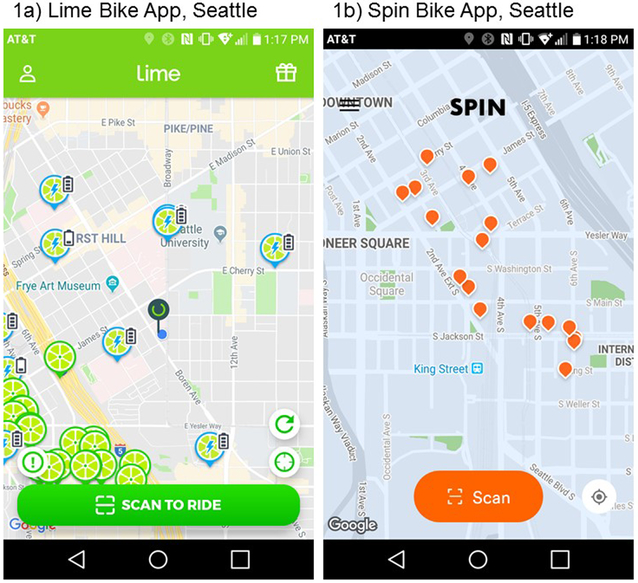
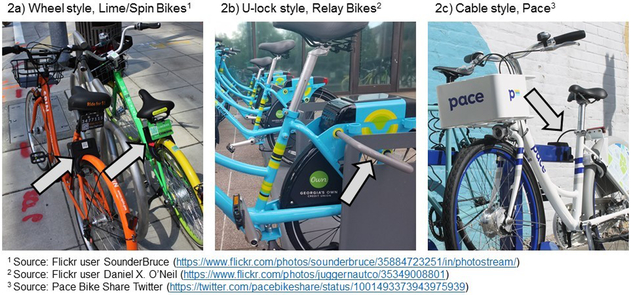
The deployment of smartphone-operated, non-station-based bicycle fleets ("dockless" or "free-floating" bikeshare) represents a new generation of bikesharing. Users locate bikes in these free-floating systems using Global Positioning Systems (GPS) and lock bikes in place at their destinations. In this paper, we review current free-floating bikesharing systems in North America and discuss priorities for future research and practice. Since launching in 2017, free-floating bikeshare has expanded rapidly to encompass 200+ systems operating 40,000+ bikes within 150+ cities. In contrast with previous systems, free-floating systems operate almost exclusively using commercial "for-profit" models, amidst concerns of financial sustainability. Governance for these systems is in early stages and can include operating fees, fleet size caps, safety requirements, parking restrictions, data sharing, and equity obligations. We identify research and practice gaps within the themes of usage, equity, sharing resources, business model, and context. While some existing bikesharing literature translates to free-floating systems, novel topics arise due to the ubiquity, fluidity, and business models of these new systems. Systems have numerous obstacles to overcome for long-term sustainability, including barriers common to station-based systems: limited supportive infrastructure, equity, theft or vandalism, and funding. Other unique obstacles arise in free-floating bikeshare around parking, sidewalk right of ways, varied bicycle types, and data sharing. This review offers background in and critical reflection on the rapidly evolving free-floating bikeshare landscape, including priorities for future research and practice. If concerns can be overcome, free-floating bikeshare may provide unprecedented opportunities to bypass congested streets, encourage physical activity, and support urban sustainability.
智能手机操控的非固定站点自行车车队(“无桩”或“自由浮动”共享单车)的部署代表了新一代的共享单车模式。用户通过全球定位系统(GPS)在这些自由浮动系统中找到自行车,并在目的地将自行车锁好。在本文中,我们回顾了北美当前的自由浮动共享单车系统,并讨论了未来研究和实践的重点。自2017年推出以来,自由浮动共享单车已迅速扩展,涵盖了150多个城市中运营着40000多辆自行车的200多个系统。与以前的系统相比,自由浮动系统几乎完全采用商业“盈利”模式,同时也存在财务可持续性方面的担忧。这些系统的治理尚处于早期阶段,可能包括运营费用、车队规模上限、安全要求、停车限制、数据共享和公平义务等。我们在使用、公平、资源共享、商业模式和背景等主题中识别出研究和实践方面的差距。虽然现有的一些共享单车文献可以应用于自由浮动系统,但由于这些新系统的普遍性、流动性和商业模式,也出现了一些新的主题。为了实现长期可持续性,这些系统有许多障碍需要克服,包括固定站点系统常见的障碍:支持性基础设施有限、公平性、盗窃或破坏行为以及资金问题。自由浮动共享单车还存在其他独特的障碍,涉及停车、人行道通行权、自行车类型多样以及数据共享等方面。本综述提供了关于快速发展的自由浮动共享单车格局的背景信息和批判性反思,包括未来研究和实践的重点。如果能够克服相关担忧,自由浮动共享单车可能会提供前所未有的机会,绕过拥堵的街道,鼓励体育活动,并支持城市可持续发展。