
天气对空气中冠状病毒存活的影响。
Weather impact on airborne coronavirus survival.
作者信息
Dbouk Talib, Drikakis Dimitris
机构信息
University of Nicosia, Nicosia CY-2417, Cyprus.
出版信息
Phys Fluids (1994). 2020 Sep 1;32(9):093312. doi: 10.1063/5.0024272.
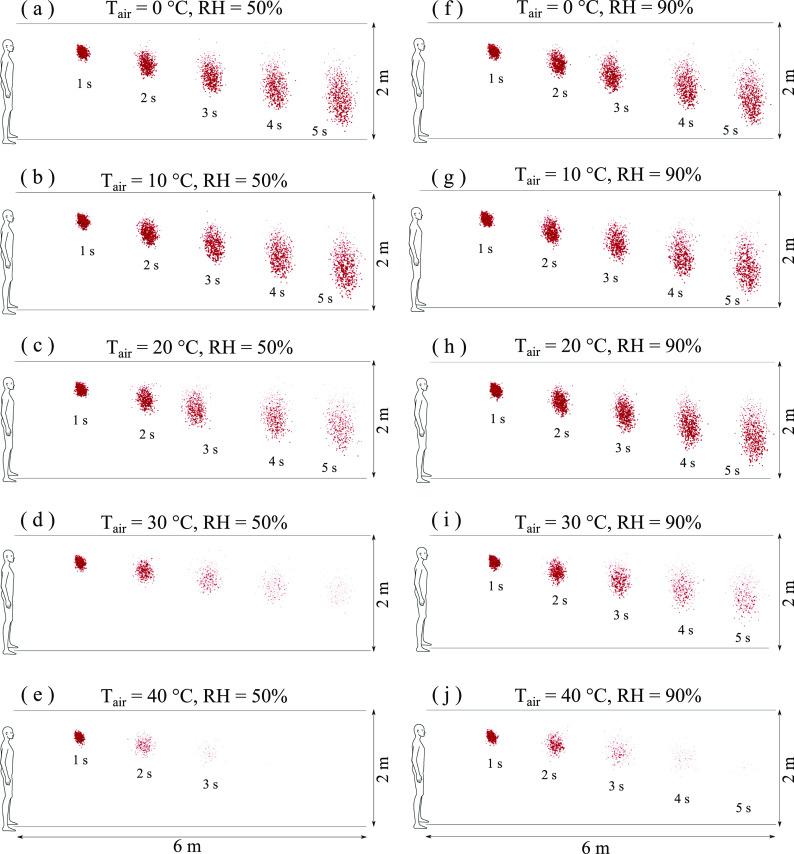
The contribution of this paper toward understanding of airborne coronavirus survival is twofold: We develop new theoretical correlations for the unsteady evaporation of coronavirus (CoV) contaminated saliva droplets. Furthermore, we implement the new correlations in a three-dimensional multiphase Eulerian-Lagrangian computational fluid dynamics solver to study the effects of weather conditions on airborne virus transmission. The new theory introduces a thermal history kernel and provides transient Nusselt (Nu) and Sherwood (Sh) numbers as a function of the Reynolds (Re), Prandtl (Pr), and Schmidt numbers (Sc). For the first time, these new correlations take into account the mixture properties due to the concentration of CoV particles in a saliva droplet. We show that the steady-state relationships induce significant errors and must not be applied in unsteady saliva droplet evaporation. The classical theory introduces substantial deviations in Nu and Sh values when increasing the Reynolds number defined at the droplet scale. The effects of relative humidity, temperature, and wind speed on the transport and viability of CoV in a cloud of airborne saliva droplets are also examined. The results reveal that a significant reduction of virus viability occurs when both high temperature and low relative humidity occur. The droplet cloud's traveled distance and concentration remain significant at any temperature if the relative humidity is high, which is in contradiction with what was previously believed by many epidemiologists. The above could explain the increase in CoV cases in many crowded cities around the middle of July (e.g., Delhi), where both high temperature and high relative humidity values were recorded one month earlier (during June). Moreover, it creates a crucial alert for the possibility of a second wave of the pandemic in the coming autumn and winter seasons when low temperatures and high wind speeds will increase airborne virus survival and transmission.
本文对理解空气传播冠状病毒的存活情况有两方面贡献
我们针对受冠状病毒(CoV)污染的唾液飞沫的非稳态蒸发建立了新的理论关联式。此外,我们将这些新的关联式应用于三维多相欧拉 - 拉格朗日计算流体动力学求解器中,以研究天气条件对空气传播病毒传播的影响。新理论引入了一个热历史内核,并给出了作为雷诺数(Re)、普朗特数(Pr)和施密特数(Sc)函数的瞬态努塞尔特(Nu)数和舍伍德(Sh)数。这些新的关联式首次考虑了由于唾液飞沫中CoV颗粒浓度导致的混合特性。我们表明稳态关系会产生显著误差,且不能应用于非稳态唾液飞沫蒸发。当增加在液滴尺度定义的雷诺数时,经典理论在Nu和Sh值上会引入较大偏差。我们还研究了相对湿度、温度和风速对空气中唾液飞沫云中CoV的传输和存活能力的影响。结果表明,当高温和低相对湿度同时出现时,病毒存活能力会显著降低。如果相对湿度较高,在任何温度下液滴云的传播距离和浓度仍然很大,这与许多流行病学家之前的看法相矛盾。上述情况可以解释7月中旬左右许多拥挤城市(如德里)中CoV病例的增加,在一个月前(6月)这些城市记录到了高温和高相对湿度值。此外,这为即将到来的秋冬季节可能出现第二波疫情发出了关键警报,届时低温和高风速将增加空气传播病毒的存活和传播。




 Zotero 插件