Zou Bin, Miao Chenfang, Chen Jiliang
Department of Orthopaedics, Affiliated Mindong Hospital of Fujian Medical University, Fuan City, Fu Jian 355000, People's Republic of China.
Department of Anesthesiology, Affiliated Mindong Hospital of Fujian Medical University, Fuan City, Fu Jian 355000, People's Republic of China.
Risk Manag Healthc Policy. 2020 Sep 9;13:1489-1497. doi: 10.2147/RMHP.S270359. eCollection 2020.
Anxiety, depression and perceived stress are risk factors for adverse health problems. Inflammation participates in the development of chronic diseases such as psychiatric disorders. This study explored the relationships between inflammatory biomarkers and depression, anxiety and perceived stress in an obese adult population.
The relationships between psychological scores and inflammatory markers were analyzed.
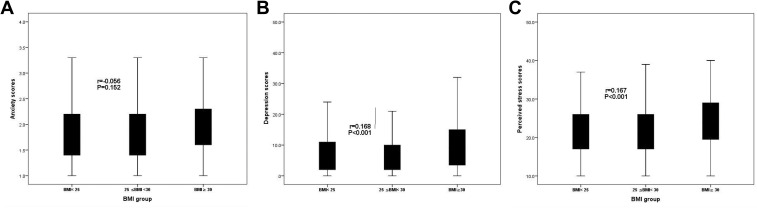
A higher BMI was not correlated with a higher anxiety score (P=0.152); however, BMI was positively associated with a higher depression score (P<0.001) and a higher perceived stress score (P<0.001). Multivariate linear regression analysis revealed that in participants with BMI≥30 and 25≤BMI<30, depression and perceived stress were significantly and independently associated with ICAM-1, E-selectin and CRP, but these associations were not observed in participants with BMI<25. The anxiety score was not associated with any inflammatory marker in any group of subjects, as determined by multivariate analysis.
Depression and perceived stress were strongly associated with increased serum levels of pro-inflammatory markers, including ICAM-1, E-selectin and CRP, among a general obese population from the United States. These results further suggest that depression and perceived stress might also be chronic systemic inflammatory diseases.
焦虑、抑郁和感知压力是不良健康问题的风险因素。炎症参与了诸如精神疾病等慢性疾病的发展。本研究探讨了肥胖成年人群中炎症生物标志物与抑郁、焦虑和感知压力之间的关系。
分析心理评分与炎症标志物之间的关系。
较高的体重指数(BMI)与较高的焦虑评分无相关性(P = 0.152);然而,BMI与较高的抑郁评分(P < 0.001)和较高的感知压力评分(P < 0.001)呈正相关。多变量线性回归分析显示,在BMI≥30以及25≤BMI<30的参与者中,抑郁和感知压力与细胞间黏附分子-1(ICAM-1)、E-选择素和C反应蛋白(CRP)显著且独立相关,但在BMI<25的参与者中未观察到这些关联。多变量分析确定,在任何一组受试者中,焦虑评分与任何炎症标志物均无关联。
在美国普通肥胖人群中,抑郁和感知压力与促炎标志物血清水平升高密切相关,包括ICAM-1、E-选择素和CRP。这些结果进一步表明,抑郁和感知压力可能也是慢性全身性炎症性疾病。