Centre National de la Recherche Scientifique (CNRS), Institut Necker Enfants Malades, Institut National de la Santé et de la Recherche Médicale (INSERM), Université de Paris, Paris, France.
Front Immunol. 2020 Sep 2;11:2077. doi: 10.3389/fimmu.2020.02077. eCollection 2020.
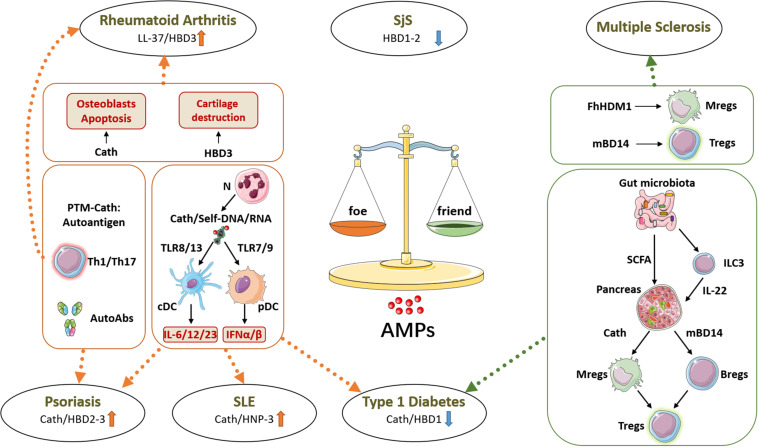
Autoimmune diseases (AiDs) are characterized by the destruction of host tissues by the host immune system. The etiology of AiDs is complex, with the implication of multiple genetic defects and various environmental factors (pathogens, antibiotic use, pollutants, stress, and diet). The interaction between these two compartments results in the rupture of tolerance against self-antigens and the unwanted activation of the immune system. Thanks to animal models, the immunopathology of many AiDs is well described, with the implication of both the innate and adaptive immune systems. This progress toward the understanding of AiDs led to several therapies tested in patients. However, the results from these clinical trials have not been satisfactory, from reversing the course of AiDs to preventing them. The need for a cure has prompted many investigators to explore alternative aspects in the immunopathology of these diseases. Among these new aspects, the role of antimicrobial host defense peptides (AMPs) is growing. Indeed, beyond their antimicrobial activity, AMPs are potent immunomodulatory molecules and consequently are implicated in the development of numerous AiDs. Importantly, according to the disease considered, AMPs appear to play a dual role in autoimmunity with either anti- or pro-inflammatory abilities. Here, we aimed to summarize the current knowledge about the role of AMPs in the development of AiDs and attempt to provide some hypotheses explaining their dual role. Definitely, a complete understanding of this aspect is mandatory before the design of AMP-based therapies against AiDs.
自身免疫性疾病(AiD)的特征是宿主免疫系统对宿主组织的破坏。AiD 的病因复杂,涉及多种遗传缺陷和多种环境因素(病原体、抗生素使用、污染物、压力和饮食)。这两个部分的相互作用导致对自身抗原的耐受性破裂和免疫系统的异常激活。得益于动物模型,许多 AiD 的免疫病理学得到了很好的描述,涉及固有免疫和适应性免疫系统。对 AiD 的理解的这一进展导致了对患者进行的几种治疗方法的测试。然而,这些临床试验的结果并不令人满意,无论是在逆转 AiD 的病程还是预防 AiD 方面都没有效果。对治愈疾病的需求促使许多研究人员探索这些疾病免疫病理学的替代方面。在这些新的方面中,抗菌宿主防御肽(AMPs)的作用越来越重要。事实上,除了它们的抗菌活性外,AMPs 还是有效的免疫调节分子,因此与许多 AiD 的发生有关。重要的是,根据所考虑的疾病,AMPs 在自身免疫中似乎具有双重作用,具有抗炎或促炎能力。在这里,我们旨在总结目前关于 AMP 在 AiD 发展中的作用的知识,并尝试提供一些解释其双重作用的假说。在设计针对 AiD 的 AMP 治疗方法之前,肯定需要对这一方面有一个完整的理解。