Hilderink Henk B M, Plasmans Marjanne H D, Poos M J J C René, Eysink Petra E D, Gijsen Ronald
National Institute for Public Health and the Environment (RIVM), P.O. Box 1, 3720 BA Bilthoven, the Netherlands.
Arch Public Health. 2020 Sep 22;78:85. doi: 10.1186/s13690-020-00461-8. eCollection 2020.
The Disability Adjusted Life Year (DALY) is a measure to prioritize in the public health field. In the Netherlands, the DALY estimates are calculated since 1997 and are included in the Public Health Status and Foresight studies which is an input for public health priority setting and policy making. Over these 20 years, methodological advancements have been made, including accounting for multimorbidity and performing projections for DALYs into the future. Most important methodological choices and improvements are described and results are presented.
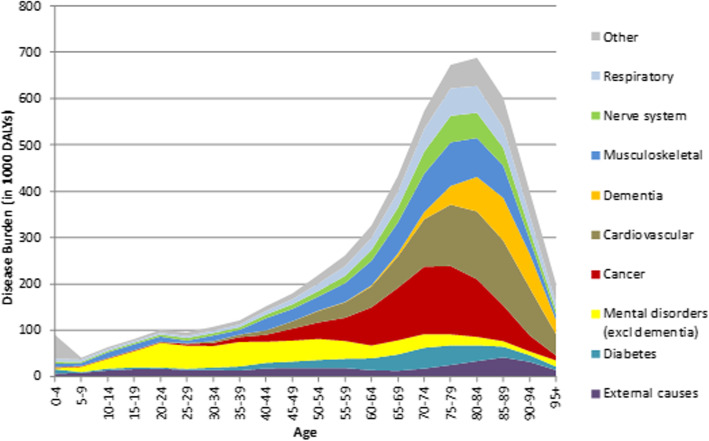
The DALY is composed of the two components years of life lost (YLL) due to premature mortality and years lost due to disability (YLD). Both the YLL and the YLD are distinguished by sex, age and health condition, allowing aggregation to the ICD-10 chapters. The YLD is corrected for multimorbidity, assuming independent occurrence of health conditions and a multiplicative method for the calculation of combined disability weights. Future DALYs are calculated based on projections for causes of death, and prevalence and incidence.
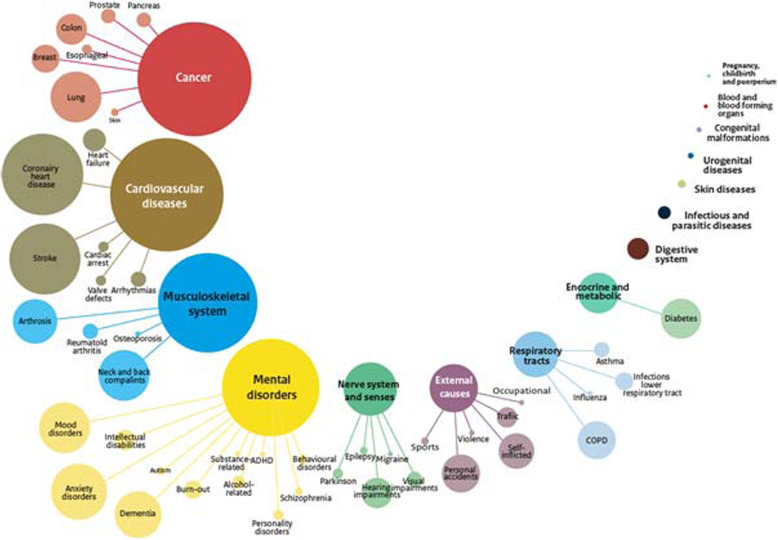
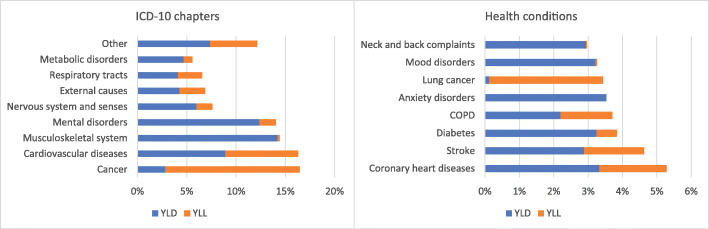
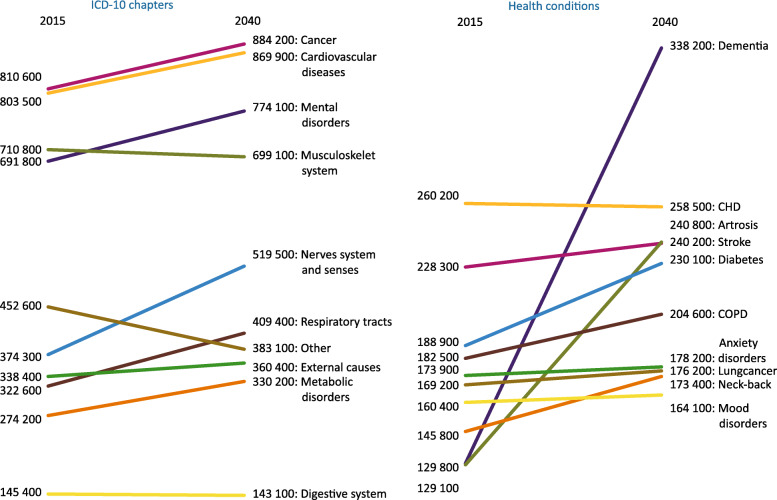
The results for 2015 show that cancer is the ICD-10 chapter with the highest disease burden, followed by cardiovascular diseases and mental disorders. For the individual health conditions, coronary heart disease had the highest disease burden in 2015. In 2040, we see a strong increase in disease burden of dementia and arthrosis. For dementia this is due to a threefold increase in dementia as a cause of death, while for arthrosis this is mainly due to the increase in prevalence.
To calculate the DALY requires a substantial amount of data, methodological choices, interpretation and presentation of results, and the personnel capacity to carry out all these tasks. However, doing a National Burden of Disease study, and especially doing that for more than 20 years, proved to have an enormous additional value in population health information and thus supports better public health policies.
伤残调整生命年(DALY)是公共卫生领域用于确定优先事项的一项指标。在荷兰,自1997年起开始计算DALY估计值,并将其纳入《公共卫生状况与展望研究》,该研究为公共卫生优先事项设定和政策制定提供了依据。在这20年里,方法学上取得了进展,包括考虑多种疾病并存情况以及对未来DALY进行预测。本文描述了最重要的方法学选择和改进,并展示了结果。
DALY由因过早死亡导致的生命损失年数(YLL)和因残疾导致的损失年数(YLD)这两个部分组成。YLL和YLD均按性别、年龄和健康状况进行区分,从而能够汇总至国际疾病分类第十版(ICD - 10)各章节。YLD针对多种疾病并存情况进行了校正,假设健康状况独立发生,并采用乘法方法计算综合残疾权重。未来的DALY是根据对死亡原因、患病率和发病率的预测来计算的。
2015年的结果表明,癌症是ICD - 10各章节中疾病负担最高的,其次是心血管疾病和精神障碍。就个体健康状况而言,冠心病在2015年疾病负担最高。到2040年,我们预计痴呆症和骨关节炎的疾病负担将大幅增加。对于痴呆症,这是由于痴呆症作为死亡原因增加了两倍,而对于骨关节炎,这主要是由于患病率上升。
计算DALY需要大量数据、方法学选择、结果的解释与呈现,以及执行所有这些任务的人员能力。然而,开展全国疾病负担研究,尤其是持续进行20多年,已证明在人群健康信息方面具有巨大的附加价值,从而有助于制定更好的公共卫生政策。