Headache Center of Southern California, The Neurology Center, Carlsbad, CA, USA.
Kansas City Bone and Joint Clinic, Overland Park, KS, USA.
J Prim Care Community Health. 2020 Jan-Dec;11:2150132720959936. doi: 10.1177/2150132720959936.
INTRODUCTION/OBJECTIVE: Chronic migraine (CM) is associated with impaired health-related quality of life and substantial socioeconomic burden, but many people with CM are underdiagnosed and do not receive appropriate preventive treatment. OnabotulinumtoxinA and topiramate have demonstrated (treatment benefit under ideal conditions) for the prevention of headaches in people with CM in clinical trials, but real-world studies suggest markedly different clinical (treatment benefit based on a blend of efficacy and tolerability). This study sought to evaluate patient-reported outcomes (PROs) of onabotulinumtoxinA versus topiramate immediate release for people with CM.
FORWARD was a prospective, multicenter, randomized, parallel-group, open-label, phase 4 study comparing onabotulinumtoxinA 155 U every 12 weeks with topiramate 50 to 100 mg/day for ≤36 weeks in people with CM. PROs measured included the Headache Impact Test (HIT-6), 9-item Patient Health Questionnaire Quick Depression Assessment (PHQ-9), Work Productivity and Activity Impairment Questionnaire: Specific Health Problem (WPAI:SHP), and Functional Impact of Migraine Questionnaire (FIMQ).
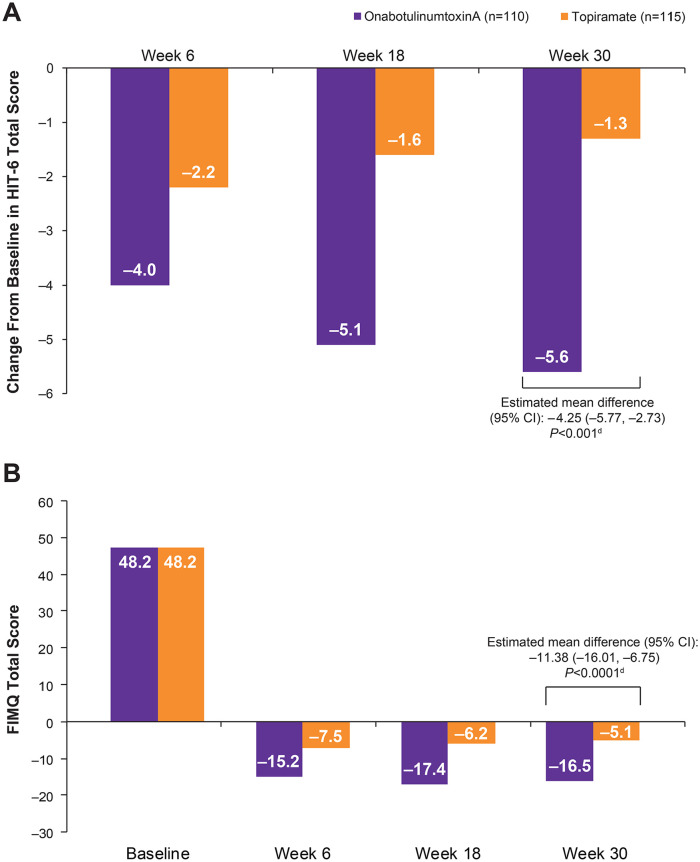
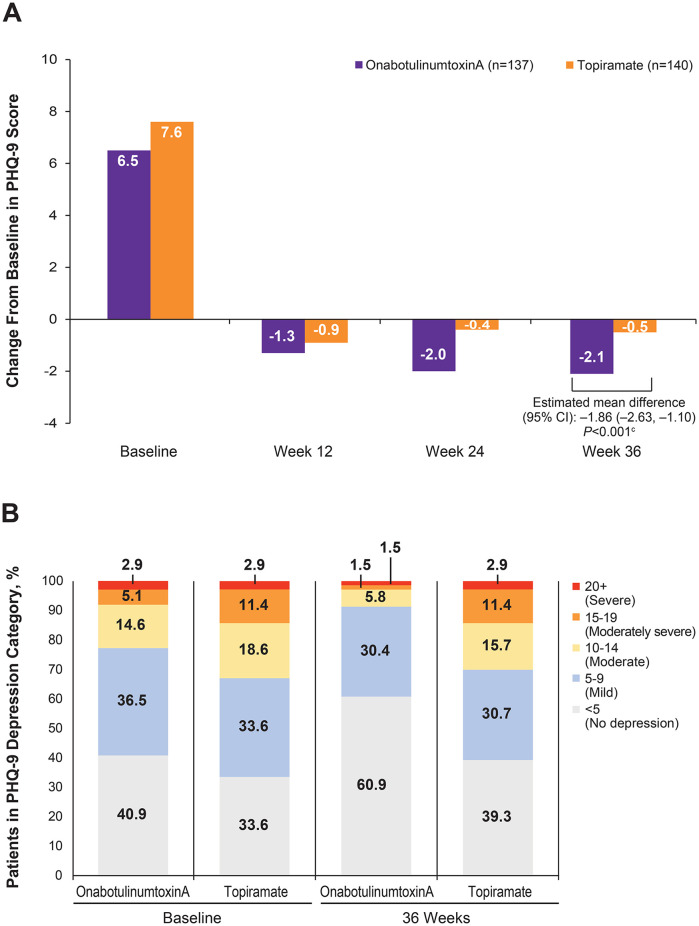
A total of 282 patients were randomized and treated with onabotulinumtoxinA (n = 140) or topiramate (n = 142). From baseline to week 30, mean HIT-6 test scores improved significantly in patients taking onabotulinumtoxinA compared with topiramate ( < .001). Improvements in depression over time were observed via larger changes in PHQ-9 scores with onabotulinumtoxinA than topiramate ( < .001). Work productivity assessed via WPAI:SHP scores revealed significant improvements with onabotulinumtoxinA versus topiramate in Work Productivity Loss ( = .024) and Activity Impairment ( < .001) domains. Results from the FIMQ also revealed a larger reduction from baseline with onabotulinumtoxinA vs topiramate ( < .0001).
OnabotulinumtoxinA treatment had more favorable real-world effectiveness than topiramate on depression, headache impact, functioning and daily living, activity, and work productivity. The overall study results suggest that the beneficial effects on a range of PROs are the result of improved effectiveness when onabotulinumtoxinA is used as preventive treatment for CM.
CLINICALTRIALS.GOV: NCT02191579; https://clinicaltrials.gov/ct2/show/NCT02191579.
简介/目的:慢性偏头痛(CM)与健康相关生活质量受损和大量的社会经济负担相关,但许多 CM 患者被误诊,未接受适当的预防性治疗。肉毒杆菌毒素 A 及托吡酯在临床试验中已显示出对 CM 患者头痛预防的(在理想条件下的治疗获益),但真实世界研究显示出显著不同的临床(基于疗效和耐受性的混合的治疗获益)。本研究旨在评估肉毒杆菌毒素 A 与托吡酯即刻释放治疗 CM 患者的患者报告结局(PRO)。
前瞻性、多中心、随机、平行组、开放标签、4 期研究比较了肉毒杆菌毒素 A 155U 每 12 周与托吡酯 50-100mg/天,最长 36 周,用于 CM 患者。测量的 PRO 包括头痛影响测试(HIT-6)、9 项患者健康问卷快速抑郁评估(PHQ-9)、工作生产力和活动障碍问卷:特定健康问题(WPAI:SHP)和偏头痛功能影响问卷(FIMQ)。
共 282 名患者随机接受肉毒杆菌毒素 A(n=140)或托吡酯(n=142)治疗。从基线到 30 周,接受肉毒杆菌毒素 A 治疗的患者 HIT-6 测试评分较托吡酯显著改善( < .001)。通过 PHQ-9 评分的更大变化,观察到抑郁随时间的改善,肉毒杆菌毒素 A 优于托吡酯( < .001)。通过 WPAI:SHP 评分评估的工作生产力显示,与托吡酯相比,肉毒杆菌毒素 A 在工作生产力损失( = .024)和活动障碍( < .001)方面有显著改善。FIMQ 的结果也显示,与托吡酯相比,基线的降低幅度更大( < .0001)。
与托吡酯相比,肉毒杆菌毒素 A 治疗在抑郁、头痛影响、功能和日常生活、活动和工作生产力方面具有更有利的真实世界疗效。总的研究结果表明,一系列 PRO 有益效果的产生,是由于肉毒杆菌毒素 A 作为 CM 的预防性治疗,提高了有效性。
CLINICALTRIALS.GOV:NCT02191579;https://clinicaltrials.gov/ct2/show/NCT02191579。