Vincent Tonia L
Centre for Osteoarthritis Pathogenesis, Versus Arthritis, Kennedy Institute of Rheumatology, University of Oxford, Oxford, UK.
Lancet Rheumatol. 2020 Oct;2(10):e633-e645. doi: 10.1016/S2665-9913(20)30279-4. Epub 2020 Sep 23.
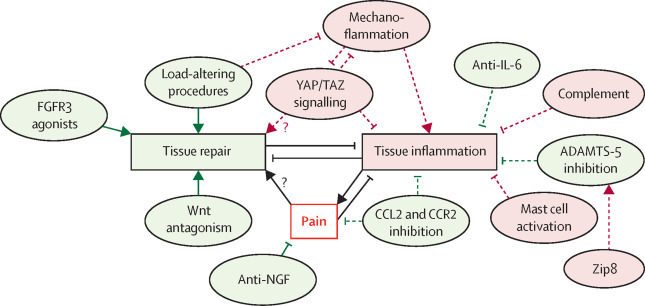
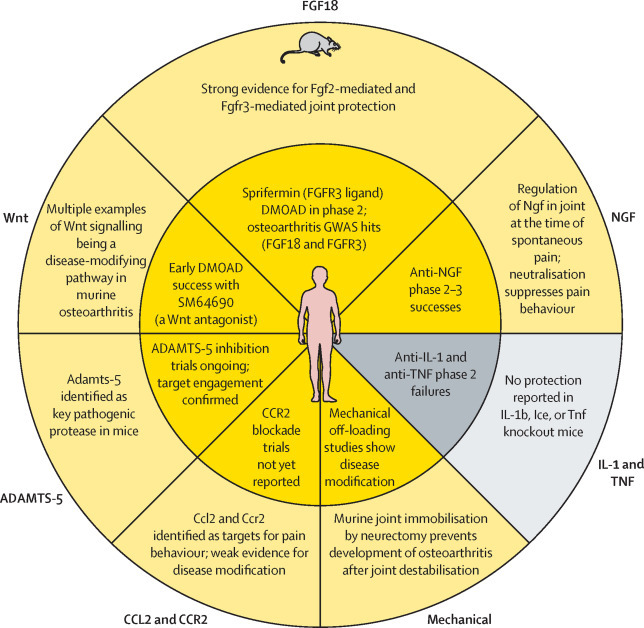
Despite an increasing burden of osteoarthritis in developed societies, target discovery has been slow and there are currently no approved disease-modifying osteoarthritis drugs. This lack of progress is due in part to a series of misconceptions over the years: that osteoarthritis is an inevitable consequence of ageing, that damaged articular cartilage cannot heal itself, and that osteoarthritis is driven by synovial inflammation similar to that seen in rheumatoid arthritis. Molecular interrogation of disease through ex-vivo tissue analysis, in-vitro studies, and preclinical models have radically reshaped the knowledge landscape. Inflammation in osteoarthritis appears to be distinct from that seen in rheumatoid arthritis. Recent randomised controlled trials, using treatments repurposed from rheumatoid arthritis, have largely been unsuccessful. Genome-wide studies point to defects in repair pathways, which accords well with recent promise using growth factor therapies or Wnt pathway antagonism. Nerve growth factor has emerged as a robust target in osteoarthritis pain in phase 2-3 trials. These studies, both positive and negative, align well with those in preclinical surgical models of osteoarthritis, indicating that pathogenic mechanisms identified in mice can lead researchers to valid human targets. Several novel candidate pathways are emerging from preclinical studies that offer hope of future translational impact. Enhancing trust between industry, basic, and clinical scientists will optimise our collective chance of success.
尽管在发达社会中骨关节炎的负担日益加重,但靶点发现进展缓慢,目前尚无获批的改善病情的骨关节炎药物。多年来缺乏进展部分归因于一系列误解:认为骨关节炎是衰老的必然结果,受损的关节软骨无法自我修复,以及骨关节炎是由类似于类风湿关节炎中所见的滑膜炎症驱动的。通过体外组织分析、体外研究和临床前模型对疾病进行分子探究,已从根本上重塑了知识格局。骨关节炎中的炎症似乎与类风湿关节炎中的炎症不同。最近使用从类风湿关节炎中重新利用的治疗方法进行的随机对照试验大多未成功。全基因组研究指出修复途径存在缺陷,这与最近使用生长因子疗法或Wnt途径拮抗作用所取得的成果相符。在2-3期试验中,神经生长因子已成为骨关节炎疼痛的一个有力靶点。这些研究,无论结果是阳性还是阴性,都与骨关节炎临床前手术模型中的研究结果高度一致,表明在小鼠中确定的致病机制可以引导研究人员找到有效的人类靶点。临床前研究中正在出现一些新的候选途径,为未来的转化影响带来了希望。加强行业、基础科学家和临床科学家之间的信任将优化我们共同取得成功的机会。