Department of Anaesthesiology and Intensive Care, Institute of Clinical Sciences, Sahlgrenska Academy, University of Gothenburg, Gothenburg, Sweden.
Department of Anaesthesiology and Intensive Care, Sahlgrenska University Hospital, Gothenburg, Sweden.
Acta Neurol Scand. 2021 Feb;143(2):195-205. doi: 10.1111/ane.13353. Epub 2020 Oct 22.
Recent reports suggest an association between the inflammatory response after aneurysmal subarachnoid haemorrhage (aSAH) and patients' outcome. The primary aim of this study was to identify a potential association between the inflammatory response after aSAH and 1-year outcome. The secondary aim was to investigate whether the inflammatory response after aSAH could predict the development of delayed cerebral ischaemia (DCI).
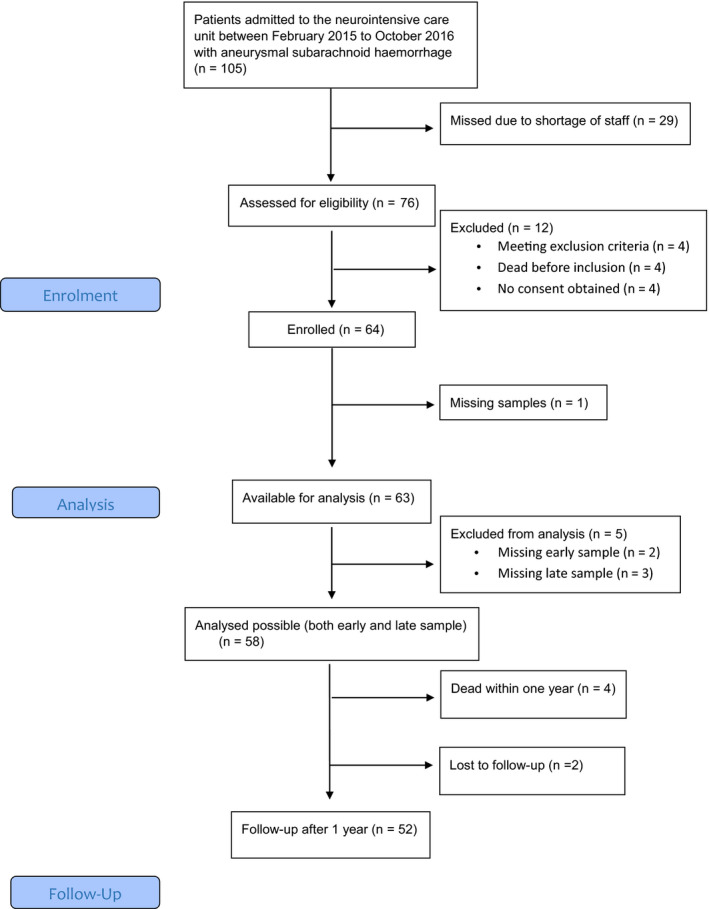
This prospective observational pilot study included patients with an aSAH admitted to Sahlgrenska University Hospital, Gothenburg, Sweden, between May 2015 and October 2016. The patients were stratified according to the extended Glasgow Outcome Scale (GOSE) as having an unfavourable (score: 1-4) or favourable outcome (score: 5-8). Furthermore, patients were stratified depending on development of DCI or not. Patient data and blood samples were collected and analysed at admission and after 10 days.
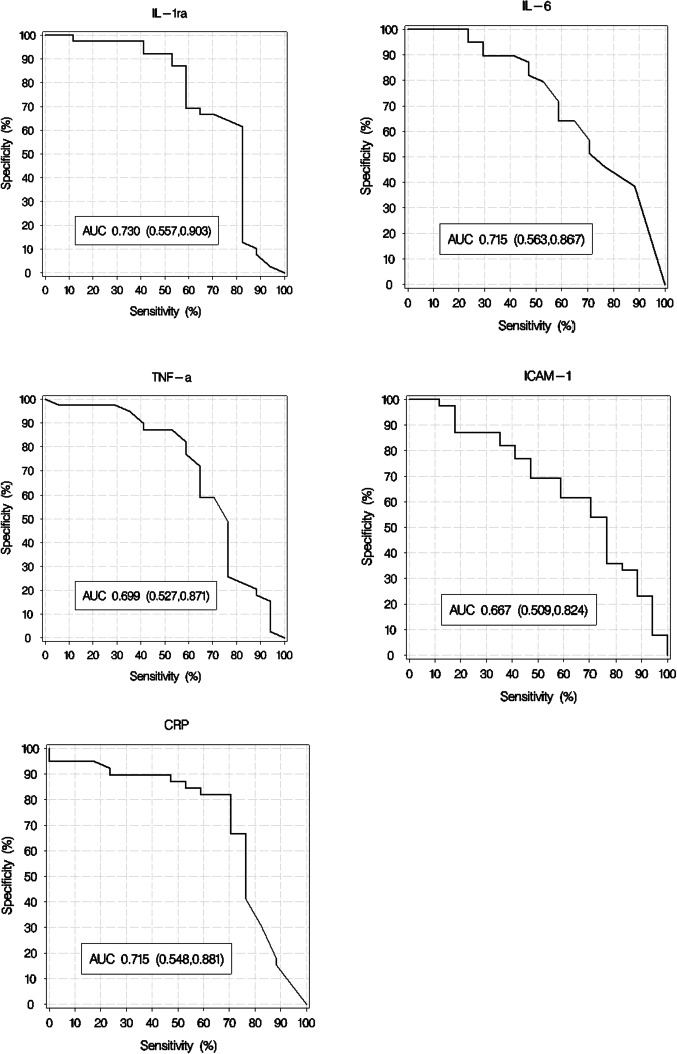
Elevated serum concentrations of inflammatory markers such as tumour necrosis factor-α and interleukin (IL)-6, IL-1Ra, C-reactive protein and intercellular adhesion molecule-1 were detected in patients with unfavourable outcome. When adjustments for Glasgow coma scale were made, only IL-1Ra remained significantly associated with poor outcome (p = 0.012). The inflammatory response after aSAH was not predictive of the development of DCI.
Elevated serum concentrations of inflammatory markers were associated with poor neurological outcome 1-year after aSAH. However, inflammatory markers are affected by many clinical events, and when adjustments were made, only IL-1Ra remained significantly associated with poor outcome. The robustness of these results needs to be tested in a larger trial.
最近的报告表明,蛛网膜下腔出血(aSAH)后炎症反应与患者的预后有关。本研究的主要目的是确定 aSAH 后炎症反应与 1 年预后之间的潜在关联。次要目的是研究 aSAH 后炎症反应是否可以预测迟发性脑缺血(DCI)的发生。
这项前瞻性观察性试点研究纳入了 2015 年 5 月至 2016 年 10 月期间入住瑞典哥德堡萨尔格兰斯卡大学医院的 aSAH 患者。根据扩展格拉斯哥预后评分(GOSE),患者分为预后不良(评分:1-4)或预后良好(评分:5-8)。此外,根据是否发生 DCI 对患者进行分层。收集并分析患者入院时和 10 天后的数据和血样。
检测到预后不良患者的血清炎症标志物(如肿瘤坏死因子-α和白细胞介素(IL)-6、IL-1Ra、C 反应蛋白和细胞间黏附分子-1)浓度升高。在对格拉斯哥昏迷评分进行调整后,只有 IL-1Ra 与不良预后仍显著相关(p=0.012)。aSAH 后的炎症反应不能预测 DCI 的发生。
aSAH 后炎症标志物的血清浓度升高与 1 年后神经功能不良预后相关。然而,炎症标志物受到许多临床事件的影响,调整后,只有 IL-1Ra 与不良预后仍显著相关。这些结果的稳健性需要在更大的试验中进行检验。