Department of Neurosurgery, Yuquan Hospital, Tsinghua University, No. 5 Shijingshan Road, Shijingshan District, Beijing, 100049, China.
Pediatric Intensive Care Unit, The First Affiliated Hospital of Xinjiang Medical University, Ürümqi, China.
Acta Neurol Belg. 2021 Oct;121(5):1311-1324. doi: 10.1007/s13760-020-01496-y. Epub 2021 Jan 9.
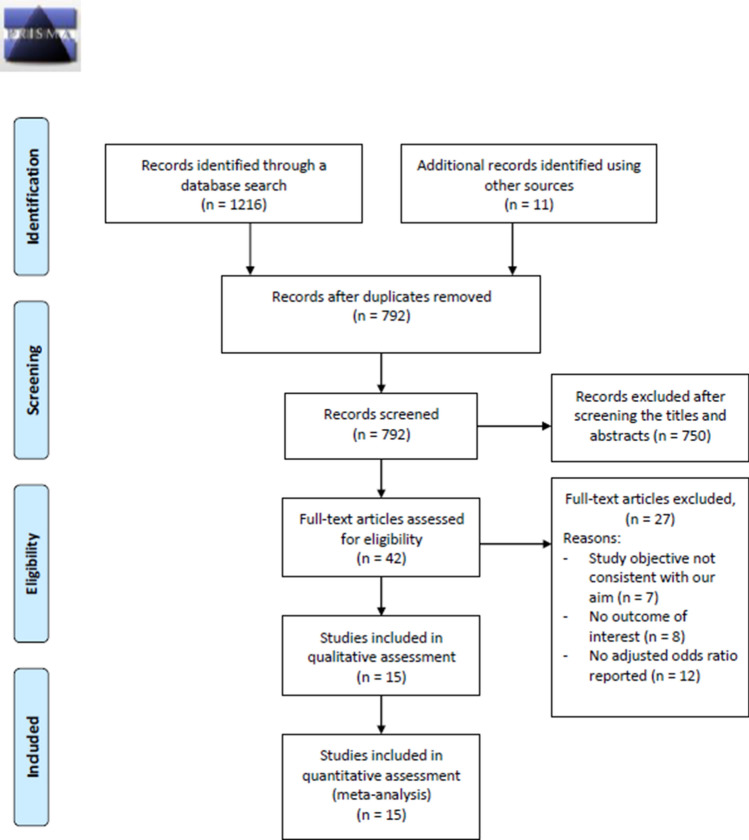
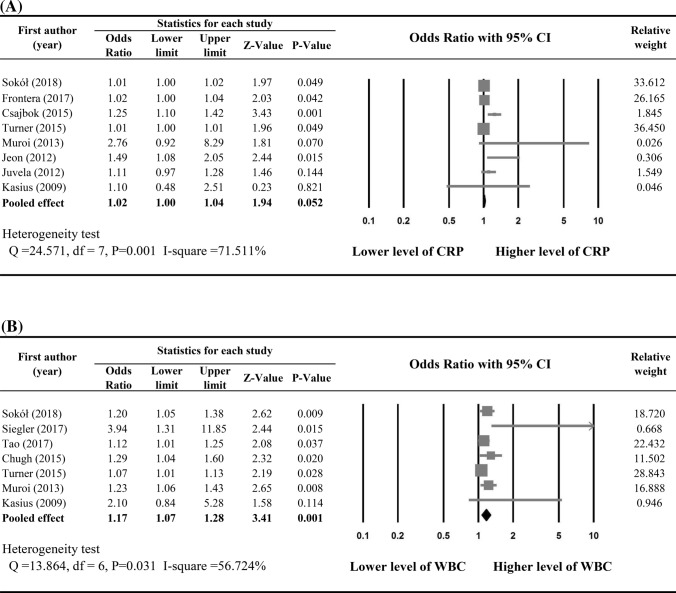
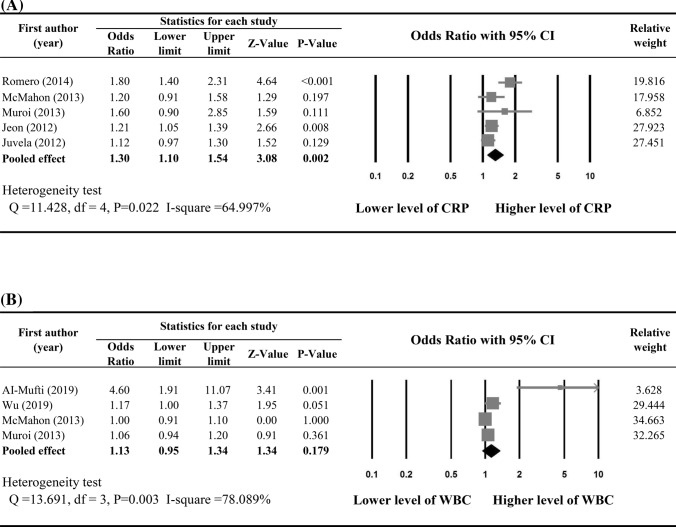
This review and meta-analysis investigated associations of systemic inflammatory marker C-reactive protein (CRP) and white blood cell count (WBC) with occurrence of delayed cerebral ischemia (DCI) and poor functional outcome after aneurysmal subarachnoid hemorrhage (aSAH). Pubmed, EMBASE, and CENTRAL databases were searched until November 30, 2019, selecting prospective and retrospective studies of patients with spontaneous SAH due to ruptured aneurysm. Outcome measures were occurrence of DCI, defined as new focal neurological deficit or a deterioration of consciousness; and/or a new infarct on computed tomography or magnetic resonance imaging that was not visible initially. Occurrence of poor functional outcome at follow-up were measured by modified Rankin Scale or Glasgow outcomes scale. Fifteen studies analyzing data of 3268 patients with aSAH were included. Meta-analysis revealed early increase in CRP was significantly associated with higher risk of occurrence of DCI (pooled OR 1.30, 95% CI 1.10-1.54; P = 0.002), whereas not with poor functional outcome (pooled OR 1.02, 95% CI 1.00-1.04, P = 0.052). No significant associations between early increase in WBC and DCI (pooled OR 1.13, 95% CI 0.95-1.34; P = 0.179) were observed, whereas increase in WBC was significantly associated with increased risk of poor functional outcome (pooled OR 1.17, 95% CI 1.07-1.28, P = 0.001). Early increase in blood CRP appears to correlate with DCI after SAH, while increase in WBC correlates with poor functional outcome. However, strong conclusion cannot be made due to the small study number, between-study heterogeneity and suspicion of uncontrolled factors. Whether early phase CRP and WBC may serve as prognostic markers for aSAH needs more investigation.
这篇综述和荟萃分析研究了全身炎症标志物 C 反应蛋白 (CRP) 和白细胞计数 (WBC) 与蛛网膜下腔出血后迟发性脑缺血 (DCI) 和不良功能预后的关系。我们检索了 PubMed、EMBASE 和 CENTRAL 数据库,截至 2019 年 11 月 30 日,纳入了因破裂动脉瘤自发性蛛网膜下腔出血的前瞻性和回顾性研究。结局指标为 DCI 的发生,定义为新的局灶性神经功能缺损或意识恶化;和/或计算机断层扫描或磁共振成像上新的梗死灶,最初不可见。通过改良 Rankin 量表或格拉斯哥结局量表测量随访时不良功能预后的发生。纳入了 15 项分析 3268 例蛛网膜下腔出血患者数据的研究。荟萃分析显示,CRP 的早期升高与 DCI 发生风险增加显著相关(汇总 OR 1.30,95%CI 1.10-1.54;P=0.002),但与不良功能预后无关(汇总 OR 1.02,95%CI 1.00-1.04,P=0.052)。白细胞计数的早期升高与 DCI 之间无显著相关性(汇总 OR 1.13,95%CI 0.95-1.34;P=0.179),而白细胞计数的增加与不良功能预后的风险增加显著相关(汇总 OR 1.17,95%CI 1.07-1.28,P=0.001)。蛛网膜下腔出血后 CRP 的早期升高似乎与 DCI 相关,而白细胞计数的增加与不良功能预后相关。然而,由于研究数量少、研究间异质性和对未控制因素的怀疑,无法得出强有力的结论。早期 CRP 和 WBC 是否可以作为蛛网膜下腔出血的预后标志物,还需要进一步研究。