Department of Geriatric Medicine, Tan Tock Seng Hospital, Singapore 308433, Singapore.
Institute of Geriatrics and Active Ageing, Tan Tock Seng Hospital, Singapore 308433, Singapore.
Nutrients. 2020 Sep 27;12(10):2957. doi: 10.3390/nu12102957.
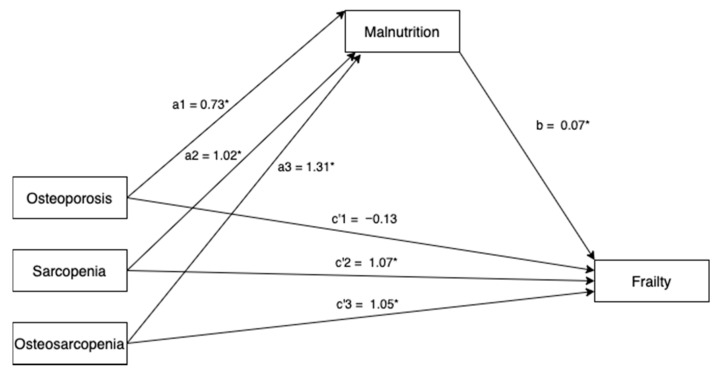
Osteosarcopenia is associated with increased risk of adverse outcomes such as falls and fractures. Its association with frailty is less well-described, particularly in independent community-dwelling older adults. Although nutrition plays a crucial role in maintaining bone and muscle health, the complex relationship between osteosarcopenia and nutrition in the pathogenesis of frailty remains to be elucidated. In this cross-sectional analysis of 230 independent, community-dwelling individuals (mean age 67.2 ± 7.4 years), we examined the associations between osteosarcopenia with nutritional status and frailty, and the mediating role of nutrition in the association between osteosarcopenia and frailty. Osteosarcopenia was defined as fulfilling both the Asian Working Group for Sarcopenia 2019 consensus definition (low relative appendicular skeletal muscle mass adjusted for height, in the presence of either of either low handgrip strength or slow gait speed) and T-score ≤ -2.5 SD on bone mineral densitometry. We assessed frailty using the modified Fried criteria and nutrition using the Mini-Nutritional Assessment. We performed multiple linear regression, followed by pathway analysis to ascertain whether nutrition mediates the relationship between osteosarcopenia and frailty. Our study population comprised: 27 (11.7%) osteosarcopenic, 35 (15.2%) sarcopenic, 36 (15.7%) osteoporotic and 132 (57.4%) normal (neither osteosarcopenic, sarcopenic nor osteoporotic). Osteosarcopenia (β = 1.1, 95% CI 0.86-1.4) and sarcopenia (β = 1.1, 95% CI 0.90-1.4) were significantly associated with frailty, but not osteoporosis. Nutrition mediated the association between osteosarcopenia and frailty (indirect effect estimate 0.09, bootstrap 95% CI 0.01-0.22). In conclusion, osteosarcopenia is associated with frailty and poorer nutritional status, with nutrition mediating the association between osteosarcopenia and frailty. Our findings support early nutritional assessment and intervention in osteosarcopenia to mitigate the risk of frailty.
骨质减少性肌少症与不良结局(如跌倒和骨折)的风险增加有关。它与虚弱的关系描述得较少,特别是在独立的社区居住的老年人中。尽管营养在维持骨骼和肌肉健康方面起着至关重要的作用,但骨质减少性肌少症与营养在虚弱发病机制中的复杂关系仍有待阐明。在这项对 230 名独立社区居住者(平均年龄 67.2 ± 7.4 岁)的横断面分析中,我们研究了骨质减少性肌少症与营养状况和虚弱之间的关联,以及营养在骨质减少性肌少症与虚弱之间关联中的中介作用。骨质减少性肌少症的定义是同时符合亚洲肌少症工作组 2019 年共识定义(相对于身高而言,四肢骨骼肌量低,伴有手握力或步态速度低中的任何一种)和骨矿物质密度测定中 T 评分≤-2.5 个标准差。我们使用改良的 Fried 标准评估虚弱,使用 Mini-Nutritional Assessment 评估营养。我们进行了多元线性回归,然后进行路径分析,以确定营养是否介导了骨质减少性肌少症与虚弱之间的关系。我们的研究人群包括:27 名(11.7%)骨质减少性肌少症、35 名(15.2%)肌少症、36 名(15.7%)骨质疏松症和 132 名(57.4%)正常(既不是骨质减少性肌少症、肌少症也不是骨质疏松症)。骨质减少性肌少症(β=1.1,95%CI 0.86-1.4)和肌少症(β=1.1,95%CI 0.90-1.4)与虚弱显著相关,但与骨质疏松症无关。营养介导了骨质减少性肌少症与虚弱之间的关联(间接效应估计值 0.09,自举 95%CI 0.01-0.22)。总之,骨质减少性肌少症与虚弱和较差的营养状况有关,营养在骨质减少性肌少症与虚弱之间的关联中起中介作用。我们的研究结果支持对骨质减少性肌少症进行早期营养评估和干预,以降低虚弱的风险。