Quagliariello Andrea, Del Chierico Federica, Reddel Sofia, Russo Alessandra, Onetti Muda Andrea, D'Argenio Patrizia, Angelino Giulia, Romeo Erminia Francesca, Dall'Oglio Luigi, De Angelis Paola, Putignani Lorenza
Area of Genetics and Rare Diseases, Unit of Human Microbiome, Bambino Gesù Children's Hospital, IRCCS, 00165 Rome, Italy.
Department of Laboratories, Unit of Parasitology, Bambino Gesù Children's Hospital, IRCCS, 00165 Rome, Italy.
Microorganisms. 2020 Sep 27;8(10):1486. doi: 10.3390/microorganisms8101486.
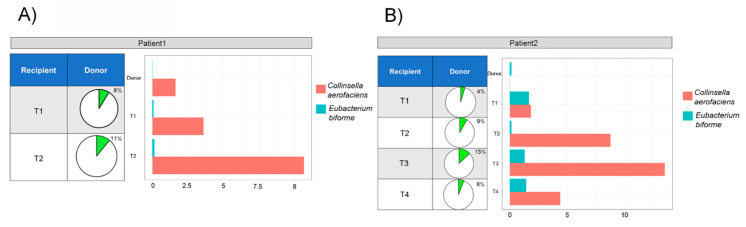
Fecal microbiota transplantation (FMT) is a promising strategy in the management of inflammatory bowel disease (IBD). The clinical effects of this practice are still largely unknown and unpredictable. In this study, two children affected by mild and moderate ulcerative colitis (UC), were pre- and post-FMT monitored for clinical conditions and gut bacterial ecology. Microbiota profiling relied on receipts' time-point profiles, donors and control cohorts' baseline descriptions. After FMT, the improvement of clinical conditions was recorded for both patients. After 12 months, the mild UC patient was in clinical remission, while the moderate UC patient, after 12 weeks, had a clinical worsening. Ecological analyses highlighted an increase in microbiota richness and phylogenetic distance after FMT. This increase was mainly due to and , inherited by respective donors. Moreover, a decrease of and , and the increment of , , , , , and were associated with remission of the patient's condition. FMT results in a long-term response in mild UC, while in the moderate form there is probably need for multiple FMT administrations. FMT leads to a decrease in potential pathogens and an increase in microorganisms correlated to remission status.
粪便微生物群移植(FMT)是治疗炎症性肠病(IBD)的一种有前景的策略。这种治疗方法的临床效果在很大程度上仍然未知且不可预测。在本研究中,对两名患有轻度和中度溃疡性结肠炎(UC)的儿童在FMT前后进行了临床状况和肠道细菌生态学监测。微生物群分析依赖于接受者的时间点概况、供体和对照队列的基线描述。FMT后,两名患者的临床状况均有改善。12个月后,轻度UC患者处于临床缓解期,而中度UC患者在12周后临床病情恶化。生态学分析表明,FMT后微生物群丰富度和系统发育距离增加。这种增加主要归因于分别从各自供体继承的 和 。此外, 和 的减少以及 、 、 、 、 和 的增加与患者病情缓解相关。FMT在轻度UC中可产生长期反应,而在中度UC中可能需要多次进行FMT。FMT导致潜在病原体减少,与缓解状态相关的微生物增加。