Ahmad Riaz, Khan Amjad, Lee Hyeon Jin, Ur Rehman Inayat, Khan Ibrahim, Alam Sayed Ibrar, Kim Myeong Ok
Division of Life Sciences and Applied Life Science (BK 21plus), College of Natural Science, Gyeongsang National University, Jinju 52828, Korea.
Biomedicines. 2020 Sep 26;8(10):380. doi: 10.3390/biomedicines8100380.
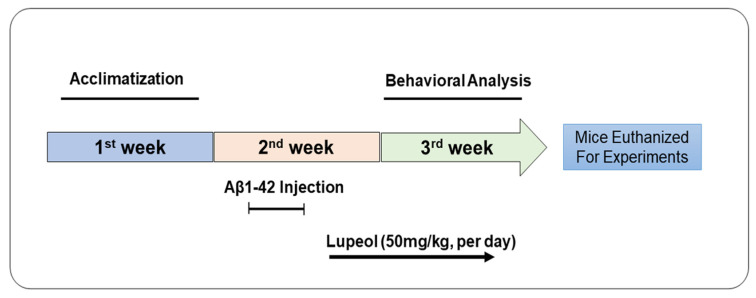
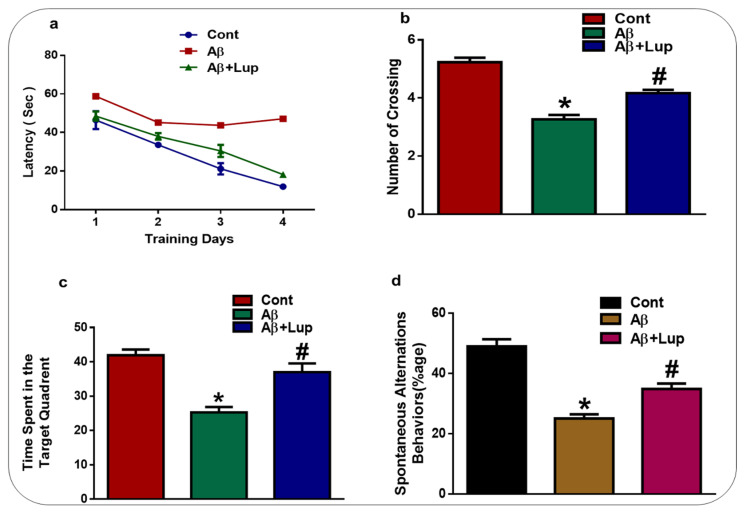
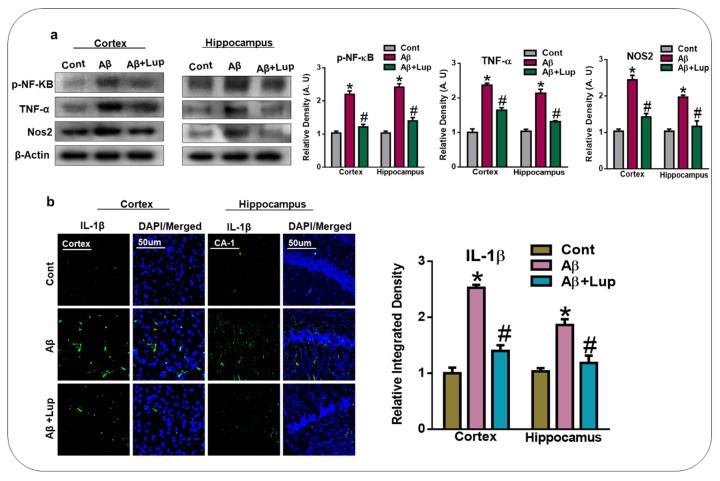
Alzheimer’s disease (AD) is a progressive neurodegenerative disorder that represents 60–70% of all dementia cases. AD is characterized by the formation and accumulation of amyloid-beta (Aβ) plaques, neurofibrillary tangles, and neuronal cell loss. Further accumulation of Aβ in the brain induces oxidative stress, neuroinflammation, and synaptic and memory dysfunction. In this study, we investigated the antioxidant and neuroprotective effects of the natural triterpenoid lupeol in the Aβ mouse model of AD. An Intracerebroventricular injection (i.c.v.) of Aβ (3 µL/5 min/mouse) into the brain of a mouse increased the reactive oxygen species (ROS) levels, neuroinflammation, and memory and cognitive dysfunction. The oral administration of lupeol at a dose of 50 mg/kg for two weeks significantly decreased the oxidative stress, neuroinflammation, and memory impairments. Lupeol decreased the oxidative stress via the activation of nuclear factor erythroid 2-related factor-2 (Nrf-2) and heme oxygenase-1 (HO-1) in the brain of adult mice. Moreover, lupeol treatment prevented neuroinflammation by suppressing activated glial cells and inflammatory mediators. Additionally, lupeol treatment significantly decreased the accumulation of Aβ and beta-secretase-1 (BACE-1) expression and enhanced the memory and cognitive function in the Aβ-mouse model of AD. To the best of our knowledge, this is the first study to investigate the anti-oxidative and neuroprotective effects of lupeol against Aβ-induced neurotoxicity. Our findings suggest that lupeol could serve as a novel, promising, and accessible neuroprotective agent against progressive neurodegenerative diseases such as AD.
阿尔茨海默病(AD)是一种进行性神经退行性疾病,占所有痴呆病例的60 - 70%。AD的特征是β-淀粉样蛋白(Aβ)斑块的形成和积累、神经原纤维缠结以及神经元细胞丢失。大脑中Aβ的进一步积累会诱导氧化应激、神经炎症以及突触和记忆功能障碍。在本研究中,我们研究了天然三萜类化合物羽扇豆醇在AD的Aβ小鼠模型中的抗氧化和神经保护作用。向小鼠脑室内注射(i.c.v.)Aβ(3 μL/5 min/小鼠)会增加活性氧(ROS)水平、神经炎症以及记忆和认知功能障碍。以50 mg/kg的剂量口服羽扇豆醇两周可显著降低氧化应激、神经炎症和记忆损伤。羽扇豆醇通过激活成年小鼠大脑中的核因子红细胞2相关因子-2(Nrf-2)和血红素加氧酶-1(HO-1)来降低氧化应激。此外,羽扇豆醇治疗通过抑制活化的神经胶质细胞和炎症介质来预防神经炎症。此外,羽扇豆醇治疗显著降低了Aβ的积累和β-分泌酶-1(BACE-1)的表达,并增强了AD的Aβ小鼠模型中的记忆和认知功能。据我们所知,这是第一项研究羽扇豆醇对Aβ诱导的神经毒性的抗氧化和神经保护作用的研究。我们的研究结果表明,羽扇豆醇可作为一种新型、有前景且易于获得的神经保护剂,用于对抗如AD等进行性神经退行性疾病。