Cicely Saunders Institute, Florence Nightingale Faculty of Nursing Midwifery and Palliative Care, King's College London, Bessemer Road, London, SE59PJ, UK.
Department of Public Health and Primary Care, University of Cambridge, Cambridge, UK.
BMC Geriatr. 2020 Sep 29;20(1):370. doi: 10.1186/s12877-020-01725-2.
Patient preferences are integral to person-centred care, but preference stability is poorly understood in older people, who may experience fluctuant illness trajectories with episodes of acute illness. We aimed to describe, and explore influences on the stability of care preferences in frail older people following recent acute illness.
Mixed-methods prospective cohort study with dominant qualitative component, parallel data collection and six-month follow up.
age ≥ 65, Rockwood Clinical Frailty score ≥ 5, recent acute illness requiring acute assessment/hospitalisation. Participants rated the importance of six preferences (to extend life, improve quality of life, remain independent, be comfortable, support 'those close to me', and stay out of hospital) at baseline, 12 and 24 weeks using a 0-4 scale, and ranked the most important. A maximum-variation sub-sample additionally contributed serial in-depth qualitative interviews. We described preference stability using frequencies and proportions, and undertook thematic analysis to explore influences on preference stability.
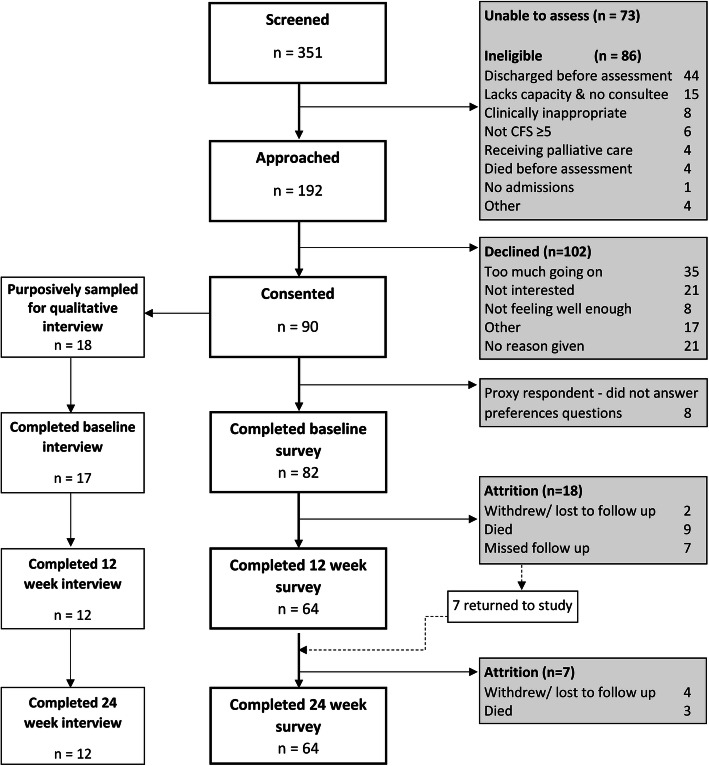
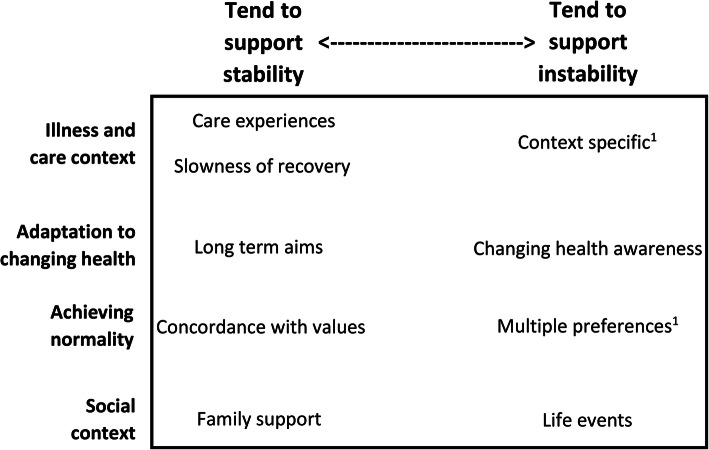
90/192 (45%) of potential participants consented. 82/90 (91%) answered the baseline questionnaire; median age 84, 63% female. Seventeen undertook qualitative interviews. Most participants consistently rated five of the six preferences as important (range 68-89%). 'Extend life' was rated important by fewer participants (32-43%). Importance ratings were stable in 61-86% of cases. The preference ranked most important was unstable in 82% of participants. Preference stability was supported by five influences: the presence of family support; both positive or negative care experiences; preferences being concordant with underlying values; where there was slowness of recovery from illness; and when preferences linked to long term goals. Preference change was related to changes in health awareness, or life events; if preferences were specific to a particular context, or multiple concurrent preferences existed, these were also more liable to change.
Preferences were largely stable following acute illness. Stability was reinforced by care experiences and the presence of family support. Where preferences were unstable, this usually related to changing health awareness. Consideration of these influences during preference elicitation or advance care planning will support delivery of responsive care to meet preferences. Obtaining longer-term data across diverse ethnic groups is needed in future research.
患者偏好是以人为本的护理的重要组成部分,但老年人的偏好稳定性却知之甚少,因为他们的疾病轨迹可能会波动,伴有急性疾病发作。我们旨在描述和探讨在最近经历急性疾病后,体弱老年人的护理偏好稳定性及其影响因素。
采用混合方法前瞻性队列研究,主要采用定性部分,平行数据收集和 6 个月随访。
年龄≥65 岁,Rockwood 临床虚弱评分≥5,近期需要急性评估/住院治疗的急性疾病。参与者在基线、12 周和 24 周时使用 0-4 分制对以下 6 种偏好(延长寿命、提高生活质量、保持独立、舒适、支持“亲近的人”和避免住院)的重要性进行评分,并进行排名。一个最大变化的子样本还提供了连续的深入定性访谈。我们使用频率和比例描述偏好稳定性,并进行主题分析以探讨偏好稳定性的影响因素。
在 192 名潜在参与者中,有 90 名(45%)同意参与。82/90(91%)名参与者回答了基线问卷;中位年龄 84 岁,63%为女性。17 名参与者接受了定性访谈。大多数参与者始终将六分之五的偏好评为重要(范围为 68-89%)。“延长寿命”的重要性被评为 32-43%的参与者评为重要。在 61-86%的情况下,重要性评分是稳定的。排名第一的偏好是不稳定的,在 82%的参与者中。偏好稳定性受到五个因素的支持:家庭支持的存在;积极或消极的护理体验;偏好与潜在价值观一致;疾病恢复缓慢;以及偏好与长期目标相关联。偏好变化与健康意识变化或生活事件有关;如果偏好特定于特定情况,或存在多个并存的偏好,则这些偏好也更容易改变。
急性疾病后,偏好基本保持稳定。稳定性通过护理经验和家庭支持得到加强。如果偏好不稳定,这通常与健康意识的变化有关。在偏好引出或预先护理计划中考虑这些影响因素,将有助于提供响应性护理以满足偏好。未来的研究需要在不同种族群体中获得更长期的数据。