Department of Clinical Studies, Faculty of Veterinary Medicine University of Nairobi, Nairobi, Kenya.
Department of Public Health Pharmacology and Toxicology, Faculty of Veterinary Medicine University of Nairobi, Nairobi, Kenya.
BMC Vet Res. 2020 Sep 29;16(1):364. doi: 10.1186/s12917-020-02584-0.
Anaplasma and Ehrlichia species are tick-borne pathogens of both veterinary and public health importance. The current status of these pathogens, including emerging species such as Ehrlichia minasensis and Anaplasma platys, infecting cattle in Kenya, remain unclear, mainly because of limitation in the diagnostic techniques. Therefore, we investigated the Anaplasma and Ehrlichia species infecting dairy cattle in Nairobi, Kenya using molecular methods.
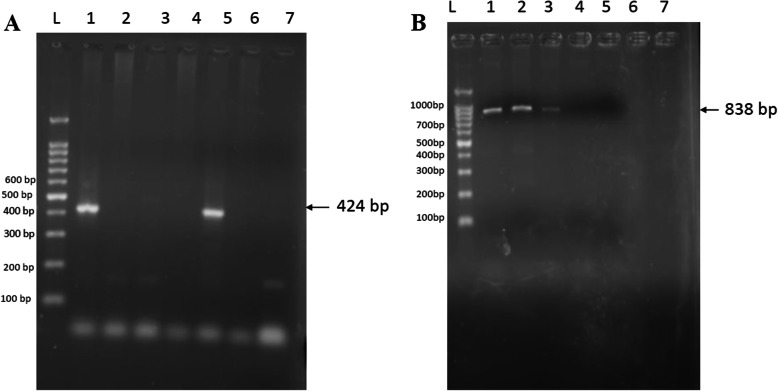
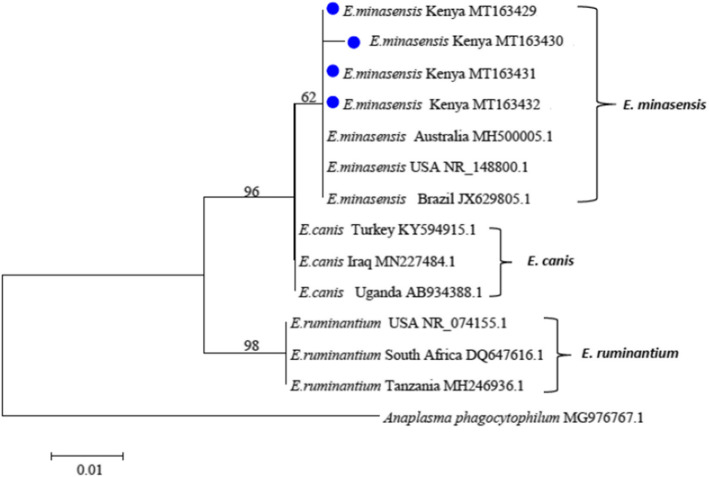
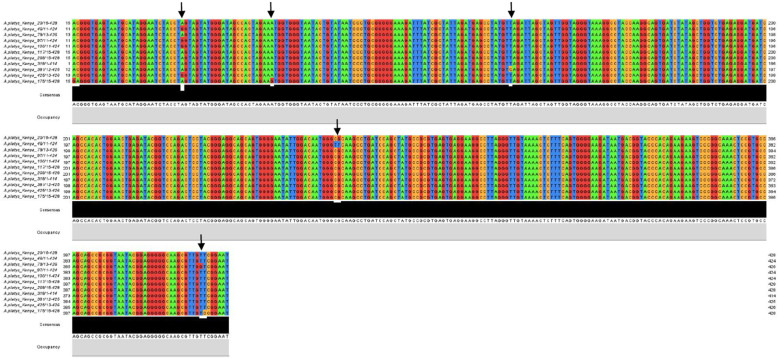
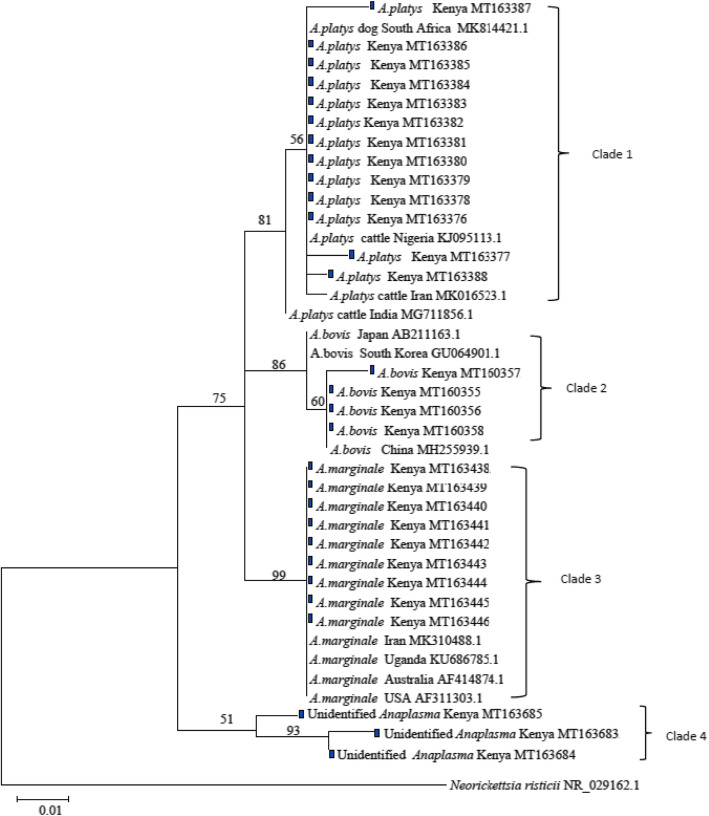
A total of 306 whole blood samples were collected from apparently healthy dairy cattle. Whole blood DNA was extracted and tested for presence of Anaplasma and Ehrlichia DNA through amplification and sequencing of the 16S rDNA gene. Sequence identity was confirmed using BLASTn analysis while phylogenetic reconstruction was performed to determine the genetic relationship between the Kenyan isolates and other annotated genotypes available in GenBank. Anaplasma and Ehrlichia species were detected in 19.9 and 3.3% of all the samples analyzed, respectively. BLASTn analysis of the sequences against non-redundant GenBank nucleotide database revealed infections with A. platys (44.8%), A. marginale (31%) and A. bovis (13.8%). All four sequenced Ehrlichia spp. were similar to Ehrlichia minasensis. Nucleotide polymorphism was observed for A. platys, A. bovis and E. minasensis. The Anaplasma species clustered in four distinct phylogenetic clades including A. marginale, A. platys, A. bovis and some unidentified Anaplasma spp. The Kenyan Ehrlichia minasensis clustered in the same clade with isolates from America and Australia but distant from E. ruminantium.
This study provides the first report of infection of dairy cattle in Kenya with A. platys and E. minasensis, which are emerging pathogens. We conclude that cattle in peri-urban Nairobi are infected with various species of Anaplasma and E. minasensis. To understand the extent of these infections in other parts of the country, large-scale screening studies as well as vector identification is necessary to inform strategic control.
无形体和埃立克体属是具有兽医和公共卫生重要性的蜱传病原体。这些病原体的现状,包括新兴物种如埃氏埃立克体和安氏无形体,在肯尼亚感染牛的情况仍不清楚,主要是因为诊断技术的限制。因此,我们使用分子方法调查了肯尼亚内罗毕的奶牛中的无形体和埃立克体属。
从看似健康的奶牛中采集了 306 份全血样本。从全血 DNA 中提取并通过扩增和测序 16S rDNA 基因来检测安氏和埃立克体 DNA 的存在。使用 BLASTn 分析确认序列同一性,同时进行系统发育重建以确定肯尼亚分离株与 GenBank 中其他注释基因型之间的遗传关系。在所有分析的样本中,分别检测到 19.9%和 3.3%的安氏和埃立克体属。针对非冗余 GenBank 核苷酸数据库的序列的 BLASTn 分析显示,感染了 A. platys(44.8%),A. marginale(31%)和 A. bovis(13.8%)。所有四个测序的埃立克体属都与埃氏埃立克体相似。在 A. platys、A. bovis 和 E. minasensis 中观察到核苷酸多态性。安氏无形体属分为四个不同的系统发育分支,包括 A. marginale、A. platys、A. bovis 和一些未鉴定的安氏无形体属。肯尼亚的埃氏埃立克体与来自美洲和澳大利亚的分离株聚集在同一分支,但与 E. ruminantium 相距较远。
本研究首次报道了肯尼亚奶牛感染 A. platys 和 E. minasensis,这是新兴的病原体。我们得出结论,内罗毕周边地区的牛感染了各种安氏无形体和 E. minasensis。为了了解这些感染在该国其他地区的程度,需要进行大规模的筛选研究以及确定传播媒介,以为策略控制提供信息。