Laboratory of Clinical Neurochemistry, Section of Neurology, University of Perugia, Piazzale Lucio Severi 1/8, 06132, Perugia, PG, Italy.
Department of Experimental Medicine, Section of Physiology and Biochemistry, University of Perugia, Piazza Lucio Severi 1/8, 06132, Perugia, PG, Italy.
Alzheimers Res Ther. 2020 Sep 29;12(1):121. doi: 10.1186/s13195-020-00689-0.
Cerebrospinal fluid (CSF) amyloid-beta (Aβ) 42/40 ratio, threonine-181-phosphorylated-tau (p-tau), and total-tau (t-tau) represent core biomarkers of Alzheimer disease (AD). The recent availability of automated platforms has represented a significant achievement for reducing the pre-analytical variability of these determinations in clinical setting. With respect to classical manual ELISAs, these platforms give us also the possibility to measure any single sample and to get the result within approximately 30 min. So far, reference values have been calculated from measurements obtained in frozen samples. In this work, we wanted to check if the values obtained in fresh CSF samples differ from those obtained in frozen samples, since this issue is mandatory in routine diagnostic work.
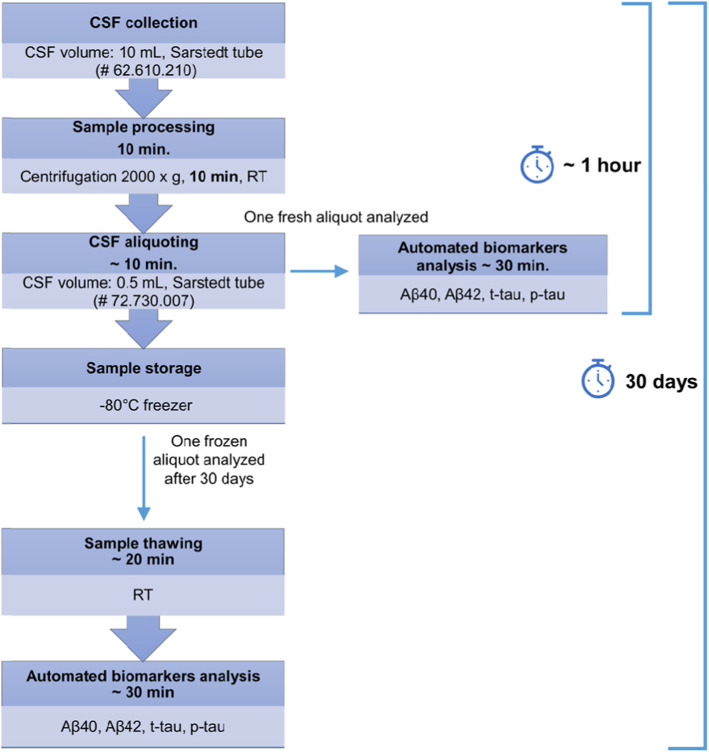
Fifty-eight consecutive CSF samples have been analyzed immediately after lumbar puncture and after 1-month deep freezing (- 80 °C). As an automated platform, we used Lumipulse G600-II (Fujirebio Inc.). Both the fresh and the frozen aliquots were analyzed in their storage tubes.
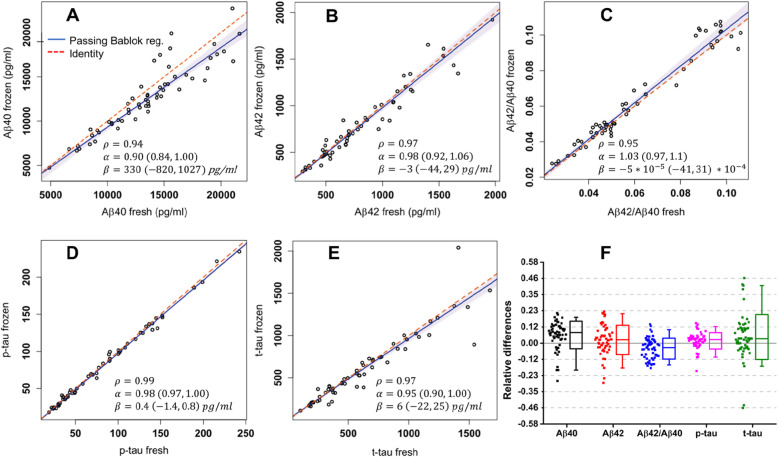
In fresh samples, a mean increase of Aβ40 (6%), Aβ42 (2%), p-tau (2%), and t-tau (4%) was observed as compared to frozen samples, whereas a slight decrease was observed for Aβ42/Aβ40 ratio (4%), due to the higher deviation of Aβ40 in fresh samples compared to Aβ42. These differences are significant for Aβ40, Aβ42/Aβ40 ratio, p-tau, and t-tau. Nevertheless, the Aβ42/Aβ40 ratio showed a lower variability (smaller standard deviation of relative differences) with respect to Aβ42. With respect to the AD profile according to the A/T/(N) criteria for AD diagnosis, no significant changes in classification were observed when comparing results obtained in fresh vs frozen samples.
Small but significant differences have been found for Aβ40, Aβ42/Aβ40 ratio, p-tau, and t-tau in fresh vs frozen samples. Importantly, these differences did not imply a modification in the A/T/(N) classification system. In order to know if different cutoffs for fresh and frozen samples are required, larger, multi-center investigations are needed.
脑脊液(CSF)β淀粉样蛋白(Aβ)42/40 比值、苏氨酸 181 位磷酸化tau(p-tau)和总 tau(t-tau)是阿尔茨海默病(AD)的核心生物标志物。最近自动平台的出现极大地降低了这些测定在临床环境中的分析前变异性。与经典的手动 ELISA 相比,这些平台还使我们能够测量任何单个样本,并在大约 30 分钟内获得结果。到目前为止,参考值是从冷冻样本中获得的测量值计算出来的。在这项工作中,我们想检查新鲜 CSF 样本与冷冻样本的测量值是否不同,因为这在常规诊断工作中是强制性的。
58 例连续 CSF 样本在腰椎穿刺后立即进行分析,并在 1 个月后进行深度冷冻(-80°C)。我们使用 Lumipulse G600-II(Fujirebio Inc.)作为自动平台。新鲜和冷冻等分试样均在其储存管中进行分析。
与冷冻样本相比,新鲜样本中 Aβ40(6%)、Aβ42(2%)、p-tau(2%)和 t-tau(4%)均有升高,而 Aβ42/Aβ40 比值(4%)略有降低,这是由于新鲜样本中 Aβ40 的偏差高于 Aβ42。这些差异在 Aβ40、Aβ42/Aβ40 比值、p-tau 和 t-tau 中均具有统计学意义。然而,Aβ42/Aβ40 比值的变异性较低(相对差异的标准偏差较小),与 Aβ42 相比。根据 AD 诊断的 A/T/(N)标准,在比较新鲜与冷冻样本的结果时,AD 患者的分类没有显著变化。
在新鲜与冷冻样本中,Aβ40、Aβ42/Aβ40 比值、p-tau 和 t-tau 存在微小但具有统计学意义的差异。重要的是,这些差异并没有改变 A/T/(N)分类系统。为了确定是否需要针对新鲜和冷冻样本设定不同的截止值,需要进行更大规模、多中心的研究。