Institute of Communication and Scientific and Technological Information in Health, Oswaldo Cruz Foundation, Rio de Janeiro, Brazil.
Faculty of Medicine, Federal University of Minas Gerais, Belo Horizonte, Brazil.
Popul Health Metr. 2020 Sep 30;18(Suppl 1):4. doi: 10.1186/s12963-020-00208-1.
In this study, infant mortality rate (IMR) inequalities are analyzed from 1990 to 2015 in different geographic scales.
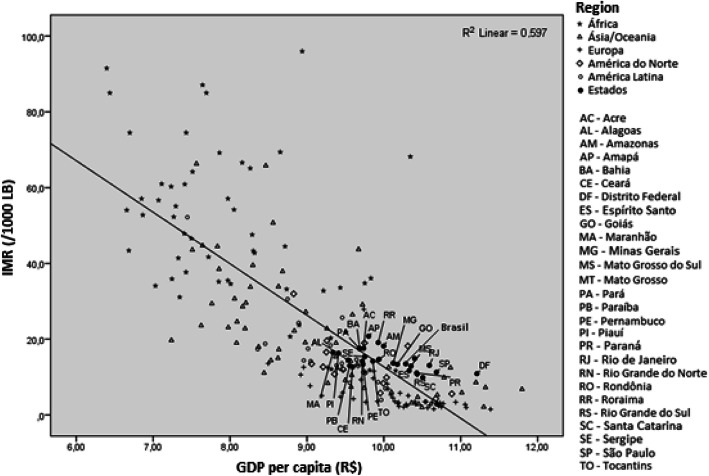
The Ministry of Health (MoH) IMR estimates by Federative Units (FU) were compared to those obtained by the Global Burden of Disease (GBD) group. In order to measure the inequalities of the IMR by FU, the ratios from highest to lowest from 1990 to 2015 were calculated. Maps were elaborated in 2000, 2010, and 2015 at the municipality level. To analyze the effect of income, IMR inequalities by GDP per capita were analyzed, comparing Brazil and the FU to other same-income level countries in 2015, and the IMR municipal estimates were analyzed by income deciles, in 2000 and 2010.
IMR decreased from 47.1 to 13.4 per 1000 live births (LB) from 1990 to 2015, with an annual decrease rate of 4.9%. The decline was less pronounced for the early neonatal annual rate (3.5%). The Northeast region showed the most significant annual decline (6.2%). The IMR estimates carried out by the GBD were about 20% higher than those obtained by the MoH, but in terms of their inequalities, the ratio from the highest to the lowest IMR among the 27 FU decreased from 4 to 2, for both methods. The percentage of municipalities with IMR higher than 40 per 1000 LB decreased from 23% to 2%, between 2000 and 2015. Comparing the IMR distribution by income deciles, all inequality measures of the IMR decreased markedly from 2000 to 2010.
The results showed a marked decrease in the IMR inequalities in Brazil, regardless of the geographic breakdown and the calculation method. Despite clear signs of progress in curbing infant mortality, there are still challenges in reducing its level, such as the concentration of deaths in the early neonatal period, and the specific increases of post neonatal mortality in 2016, after the recent cuts in social investments.
本研究分析了 1990 年至 2015 年不同地理尺度下婴儿死亡率(IMR)的不平等情况。
比较了卫生部(MoH)按联邦单位(FU)估算的 IMR 与全球疾病负担(GBD)组估算的 IMR。为了衡量 FU 之间 IMR 的不平等程度,计算了 1990 年至 2015 年期间从最高到最低的比值。2000 年、2010 年和 2015 年在市级水平上制作了地图。为了分析收入的影响,比较了 2015 年巴西和 FU 与其他相同收入水平国家的人均 GDP 与 IMR 之间的不平等,以及 2000 年和 2010 年按收入十等分的市级 IMR 估计。
1990 年至 2015 年,每 1000 例活产婴儿(LB)的 IMR 从 47.1 降至 13.4,年下降率为 4.9%。新生儿早期的年死亡率(3.5%)下降幅度较小。东北地区的年下降幅度最大(6.2%)。GBD 进行的 IMR 估计值比 MoH 高约 20%,但就其不平等程度而言,两种方法计算的 27 个 FU 中 IMR 从最高到最低的比值从 4 降至 2。2000 年至 2015 年,每 1000LB 婴儿死亡率高于 40 的市比例从 23%降至 2%。比较收入十等分的 IMR 分布,2000 年至 2010 年,IMR 的所有不平等衡量指标均显著下降。
无论地理细分和计算方法如何,巴西的 IMR 不平等程度都明显下降。尽管在遏制婴儿死亡率方面取得了明显进展,但仍面临降低死亡率水平的挑战,例如新生儿早期死亡集中,以及 2016 年新的社会投资削减后,后期新生儿死亡率的特定增加。