Smith Nicholas, Liu Sam
School of Exercise Science, Physical and Health Education, University of Victoria, McKinnon Building, PO Box 1700 STN CSC, Victoria, BC V8W 2Y2, Canada.
Internet Interv. 2020 Aug 27;22:100344. doi: 10.1016/j.invent.2020.100344. eCollection 2020 Dec.
Online physical activity interventions can be an effective strategy for weight loss. However, there is a lack of systematic reviews examining the relationship between intervention usage (dose) and participants' response to online physical activity interventions for weight loss. It remains unclear whether certain usage metrics (e.g. login frequency, percent of content accessed) would be associated with improvements in behavioral outcomes. Understanding the dose-response relationship for online physical activity interventions for weight loss would be important for designing and evaluating future interventions.
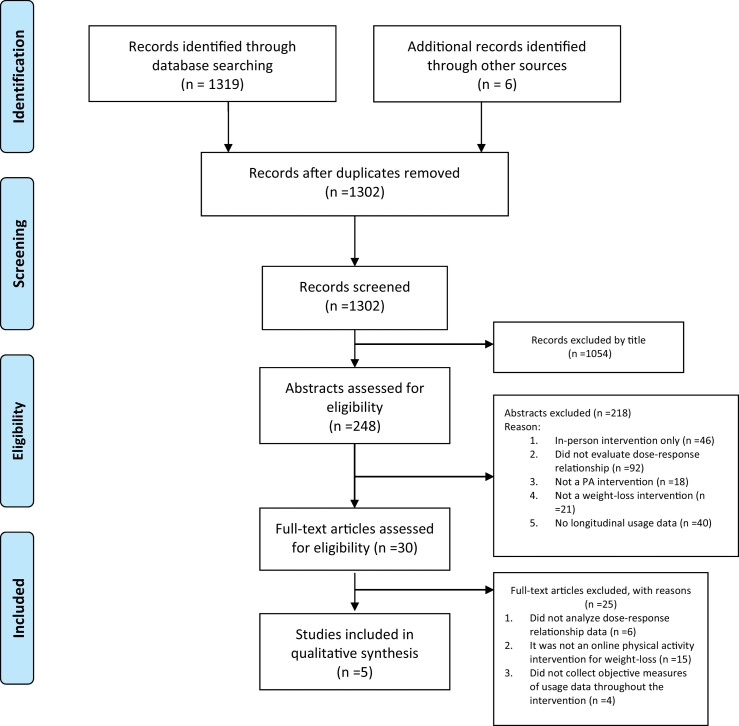
We conducted a systematic review following the PRISMA guidelines to examine the dose-response relationship of online-based interventions targeting physical activity. We used the following keywords: web OR internet OR online OR eHealth AND physical activity OR exercise, AND engagement OR dose OR dose-response OR usage AND obesity OR weight*. Peer-reviewed articles published between 2006 and 2019 were included.
A total of five articles met the inclusion criteria. The mean intervention length was 10 ± 6 months (range 2-30 months). The usage metrics were total number of logins, login frequency, and usage of online tools. All usage metrics reported were found to be related to outcomes in physical activity interventions for weight-loss.
Our findings suggest that usage metrics for online physical activity interventions for weight-loss included login frequency, login duration, and use of online tools. Increased intervention usage appeared to be associated with an improvement in participant's weight, physical activity behaviors, and intervention retention. Future research should examine innovative ways to maintain intervention usage throughout the intervention.
在线体育活动干预可能是一种有效的减肥策略。然而,缺乏系统评价来研究干预使用情况(剂量)与参与者对在线减肥体育活动干预的反应之间的关系。目前尚不清楚某些使用指标(如登录频率、访问内容的百分比)是否与行为结果的改善相关。了解在线减肥体育活动干预的剂量反应关系对于设计和评估未来的干预措施至关重要。
1)回顾用于评估干预使用情况的方法,2)探讨在线减肥体育活动干预的使用指标与结果之间的关联。
我们按照PRISMA指南进行了一项系统评价,以研究针对体育活动的在线干预的剂量反应关系。我们使用了以下关键词:网络或互联网或在线或电子健康与体育活动或锻炼,以及参与度或剂量或剂量反应或使用情况与肥胖或体重*。纳入了2006年至2019年发表的同行评审文章。
共有五篇文章符合纳入标准。平均干预时长为10±6个月(范围为2 - 30个月)。使用指标包括登录总数、登录频率和在线工具的使用情况。所有报告的使用指标都被发现与减肥体育活动干预的结果相关。
我们的研究结果表明,在线减肥体育活动干预的使用指标包括登录频率、登录时长和在线工具使用情况。干预使用的增加似乎与参与者体重、体育活动行为的改善以及干预保留率的提高有关。未来的研究应探讨在整个干预过程中维持干预使用的创新方法。