Jyonouchi Harumi, Geng Lee
Department of Pediatrics, Saint Peter's University Hospital (SPUH), New Brunswick, NJ, United States.
Epilepsy Behav Rep. 2020 Jul 3;14:100379. doi: 10.1016/j.ebr.2020.100379. eCollection 2020.
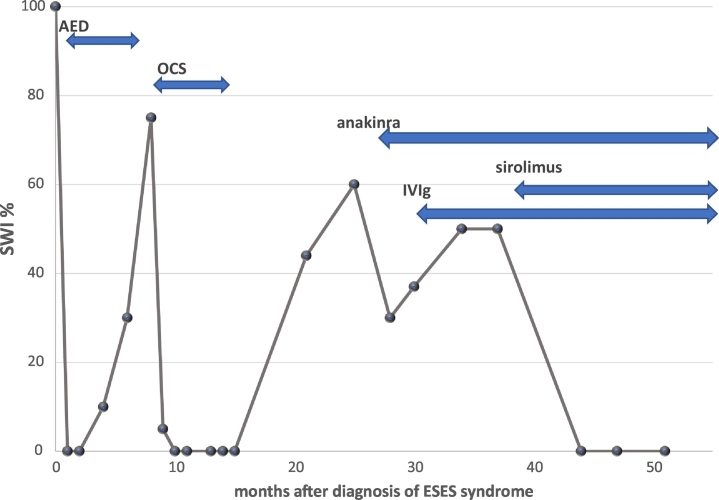
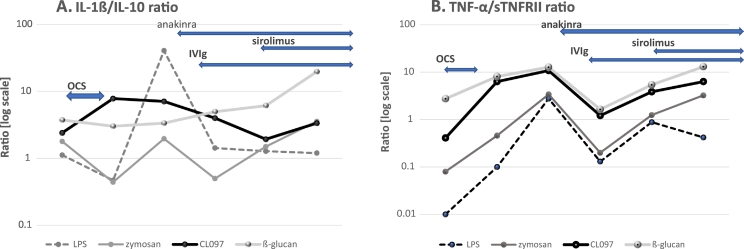
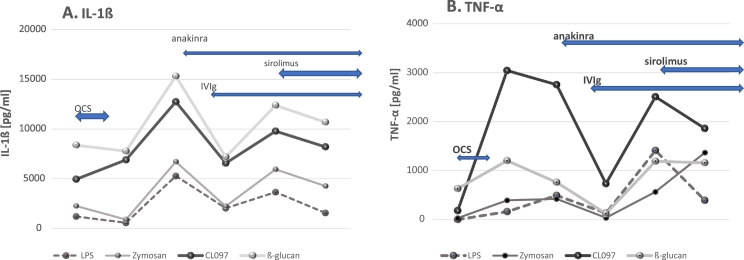
Encephalopathy with electrical status epilepticus in sleep (ESES) syndrome is characterized by a near-continuous spike-and-wave discharges during sleep with marked developmental regression, mainly in speech, and the presence of clinical seizures. Although the etiology ofESES is generally unknown, its resistance to antiseizure medication (ASM), and favorable responses to oral corticosteroids (OCS), support a role for inflammation. However, the prolonged use of OCS results in undesirable side effects and alternative treatment measures are needed. Herein, we present a patient with ESES who revealed responsed to a combination of immunomodulating agents other than OCS. The patient revealed 30, 50, and 100%, reduction in the ESES pattern on EEG with the sequential addition of anakinra (interleukin-1ß inhibitor), intravenous immunoglobulin (IVIg), and sirolimus, an inhibitor of mammalian target of rapamycin (mTOR) respectively, after discontinuation of OCS due to side effects. This combination of immune-modulating agents, that were selected based on monocyte cytokine profiles, also resulted in a gradual improvement of speech and behavioral symptoms. This case indicates a possible use of immunomodulating agents other than OCS for ESES syndrome.
睡眠期癫痫性电持续状态(ESES)综合征相关脑病的特征是睡眠期间出现近乎持续的棘慢波放电,并伴有明显的发育倒退,主要是言语方面,且存在临床癫痫发作。尽管ESES的病因通常不明,但其对抗癫痫药物(ASM)耐药,而对口服糖皮质激素(OCS)反应良好,这支持了炎症在其中所起的作用。然而,长期使用OCS会产生不良副作用,因此需要其他替代治疗措施。在此,我们报告一例ESES患者,该患者对除OCS之外的免疫调节剂联合治疗有反应。由于副作用停用OCS后,依次加用阿那白滞素(白细胞介素-1β抑制剂)、静脉注射免疫球蛋白(IVIg)和雷帕霉素靶蛋白(mTOR)抑制剂西罗莫司后,患者脑电图上的ESES模式分别减少了30%、50%和100%。这种基于单核细胞细胞因子谱选择的免疫调节剂联合治疗,还使言语和行为症状逐渐改善。该病例表明除OCS之外的免疫调节剂可能对ESES综合征有效。