Plant Systems Biology Lab, Ryan Institute & MaREI Centre for Marine, Climate and Energy, School of Natural Sciences, National University of Ireland - Galway, Galway, H91 TK33, Ireland.
UMR 8227, Integrative Biology of Marine Models, CNRS, Sorbonne Université Sciences, Station Biologique de Roscoff, CS 90074, F-29688, Roscoff, France.
J Phycol. 2021 Feb;57(1):219-233. doi: 10.1111/jpy.13079. Epub 2020 Nov 24.
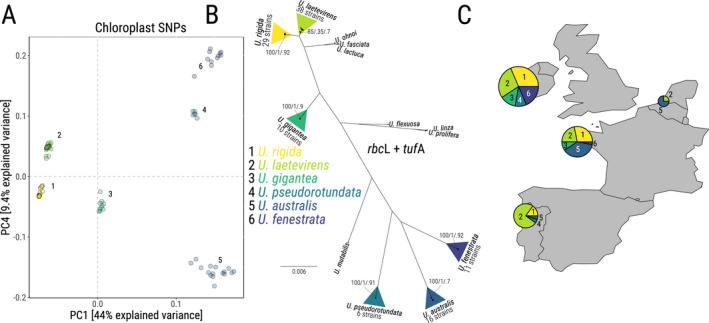
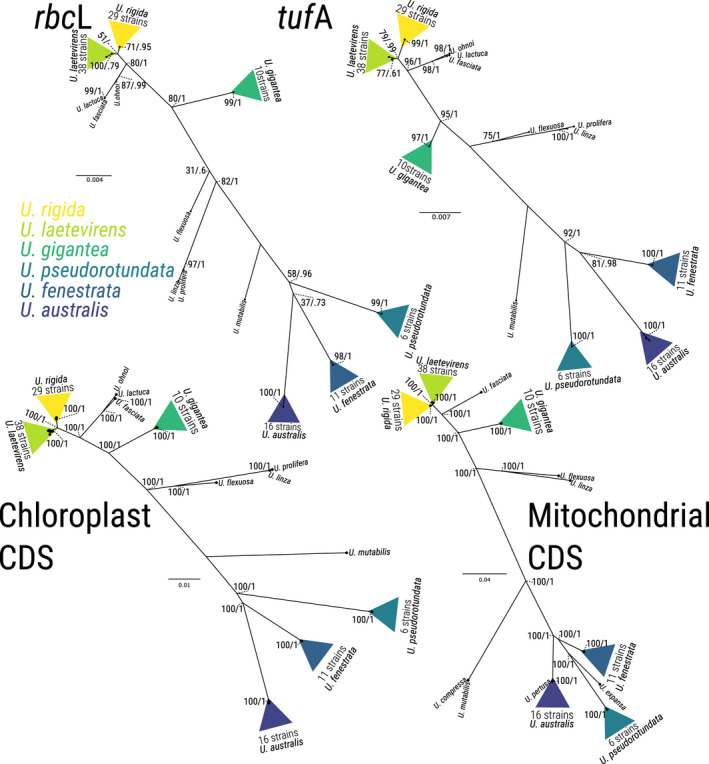
Foliose Ulva spp. have become increasingly important worldwide for their environmental and financial impacts. A large number of such Ulva species have rapid reproduction and proliferation habits, which explains why they are responsible for Ulva blooms, known as "green tides", having dramatic negative effects on coastal ecosystems, but also making them attractive for aquaculture applications. Despite the increasing interest in the genus Ulva, particularly on the larger foliose species for aquaculture, their inter- and intra-specific genetic diversity is still poorly described. We compared the cytoplasmic genome (chloroplast and mitochondrion) of 110 strains of large distromatic foliose Ulva from Ireland, Brittany (France), the Netherlands and Portugal. We found six different species, with high levels of inter-specific genetic diversity, despite highly similar or overlapping morphologies. Genetic variation was as high as 82 SNPs/kb between Ulva pseudorotundata and U. laetevirens, indicating considerable genetic diversity. On the other hand, intra-specific genetic diversity was relatively low, with only 36 variant sites (0.03 SNPs/kb) in the mitochondrial genome of the 29 Ulva rigida individuals found in this study, despite different geographical origins. The use of next-generation sequencing allowed for the detection of a single inter-species hybrid between two genetically closely related species, U. laetevirens, and U. rigida, among the 110 strains analyzed in this study. Altogether, this study represents an important advance in our understanding of Ulva biology and provides genetic information for genomic selection of large foliose strains in aquaculture.
叶状石莼属物种因其对环境和经济的影响而在全球范围内变得越来越重要。大量的叶状石莼物种具有快速繁殖和增殖的习性,这也是为什么它们会引发绿潮,对沿海生态系统产生巨大的负面影响,但也使它们成为水产养殖应用的有吸引力的物种。尽管人们对石莼属(尤其是大型叶状物种)越来越感兴趣,特别是将其用于水产养殖,但它们的种间和种内遗传多样性仍描述不足。我们比较了来自爱尔兰、布列塔尼(法国)、荷兰和葡萄牙的 110 株大型叶状石莼的细胞质基因组(叶绿体和线粒体)。我们发现了六个不同的物种,尽管形态高度相似或重叠,但种间遗传多样性水平很高。在 U. pseudorotundata 和 U. laetevirens 之间遗传变异高达 82 SNPs/kb,表明遗传多样性相当高。另一方面,种内遗传多样性相对较低,在本研究中发现的 29 株 U. rigida 个体的线粒体基因组中只有 36 个变异位点(0.03 SNPs/kb),尽管它们来自不同的地理起源。使用下一代测序技术可以在本研究分析的 110 株菌株中检测到两种遗传上密切相关的物种 U. laetevirens 和 U. rigida 之间的单一种间杂种。总的来说,这项研究代表了我们对石莼生物学理解的重要进展,并为水产养殖中大叶状菌株的基因组选择提供了遗传信息。