Universidade Estadual Paulista, Faculdade de Odontologia de Araçatuba, Departamento de Odontologia Restauradora, Araçatuba, São Paulo, Brasil.
Centro Universitário UNINGÁ, Departamento de Odontologia Restauradora e Prótese, Maringá, Paraná, Brasil.
J Appl Oral Sci. 2020 Sep 28;28:e20200493. doi: 10.1590/1678-7757-2020-0493. eCollection 2020.
This study aimed to evaluate the effects of different toothpastes on the surface wear of enamel, dentin, composite resin (CR), and resin-modified glass ionomer cement (RMGIC), and to perform a topographic analysis of the surfaces, based on representative images generated by atomic force microscopy (AFM) after erosion-abrasion cycles.
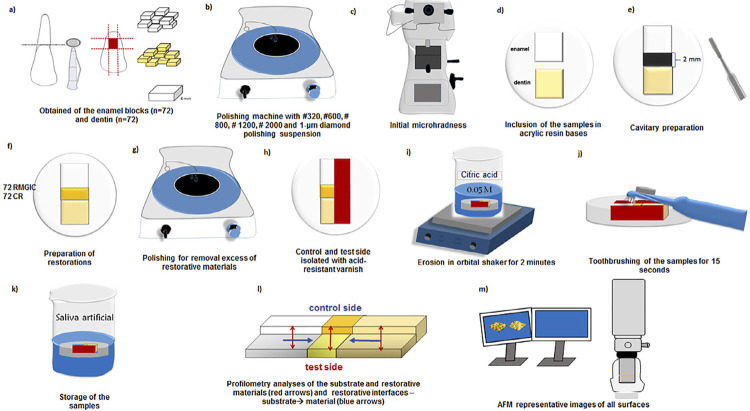
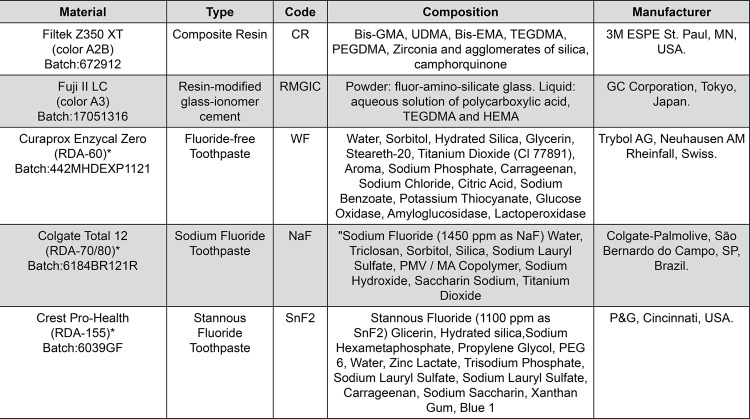
One hundred and forty bovine incisors were collected and divided into two groups: 72 enamel and 72 dentin blocks (4×4 mm). Half of the specimens were restored with CR (Filtek Z350 XT) and the other half with RMGIC (Fuji II LC). Then, samples were submitted to a demineralization cycle (5 days, 4×2 min/day, 1% citric acid, pH 3.2) and exposed to three different toothpastes (2×15 s/day): without fluoride (WF, n=12), sodium fluoride-based (NaF, n=12), and stannous fluoride-based (SnF2, n=12). Surface wear, as well as restoration interfaces wear, were investigated by profilometry of the dental substrates and restorative materials. All representative surfaces underwent AFM analysis. Data were analyzed by two-way analysis of variance and Tukey's tests (α=0.05).
NaF-based toothpaste caused the greater dentin surface wear (p<0.05). Toothpastes affected only enamel-restoration interfaces. AFM analysis showed precipitate formation in dentinal tubules caused by the use of fluoride toothpastes.
NaF-based toothpastes had no protective effect on enamel adjacent to CR and RMGIC against erosion-abrasion challenges, nor on dentin adjacent to RMGIC material. SnF2-based toothpastes caused more damage to interfaces between enamel and RMGIC.
本研究旨在评估不同牙膏对牙釉质、牙本质、复合树脂(CR)和树脂改性玻璃离子水门汀(RMGIC)表面磨损的影响,并通过原子力显微镜(AFM)生成的代表性图像对表面进行形貌分析蚀-磨循环后。
收集 140 颗牛切牙,分为两组:72 个牙釉质和 72 个牙本质块(4×4mm)。一半标本用 CR(Filtek Z350 XT)修复,另一半用 RMGIC(Fuji II LC)修复。然后,样本进行脱矿循环(5 天,每天 4×2 分钟,1%柠檬酸,pH3.2)并暴露于三种不同的牙膏(每天 2×15 秒):无氟(WF,n=12)、含氟酸钠(NaF,n=12)和含氟化锡(SnF2,n=12)。通过牙科基质和修复材料的轮廓测量研究表面磨损和修复体界面磨损。所有代表性表面均进行 AFM 分析。数据采用双因素方差分析和 Tukey 检验(α=0.05)进行分析。
基于 NaF 的牙膏会导致牙本质表面磨损更大(p<0.05)。牙膏仅影响牙釉质-修复体界面。AFM 分析显示,氟牙膏的使用导致牙本质小管中沉淀物的形成。
基于 NaF 的牙膏对 CR 和 RMGIC 邻接牙釉质以及 RMGIC 邻接牙本质的侵蚀磨损无保护作用。基于 SnF2 的牙膏对牙釉质和 RMGIC 之间的界面造成更多损害。