Rodilla Enrique, Saura Alberto, Jiménez Iratxe, Mendizábal Andrea, Pineda-Cantero Araceli, Lorenzo-Hernández Elizabeth, Fidalgo-Montero Maria Del Pilar, López-Cuervo Joaquín Fernandez, Gil-Sánchez Ricardo, Rabadán-Pejenaute Elisa, Abella-Vázquez Lucy, Giner-Galvañ Vicente, Solís-Marquínez Marta Nataya, Boixeda Ramon, Peña-Fernández Andrés de la, Carrasco-Sánchez Francisco Javier, González-Moraleja Julio, Torres-Peña José David, Guisado-Espartero María Esther, Escobar-Sevilla Joaquín, Guzmán-García Marcos, Martín-Escalante María Dolores, Martínez-González Ángel Luis, Casas-Rojo José Manuel, Gómez-Huelgas Ricardo
Internal Medicine Department, University Hospital of Sagunto, Universidad Cardenal Herrera-CEU, CEU Universities, 46520 Sagunto, Spain.
Internal Medicine Department, Regional University Hospital of Málaga, 29010 Málaga, Spain.
J Clin Med. 2020 Sep 28;9(10):3136. doi: 10.3390/jcm9103136.
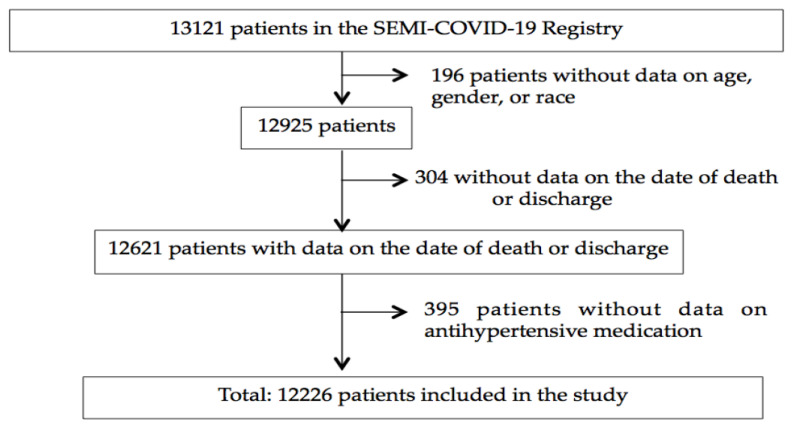
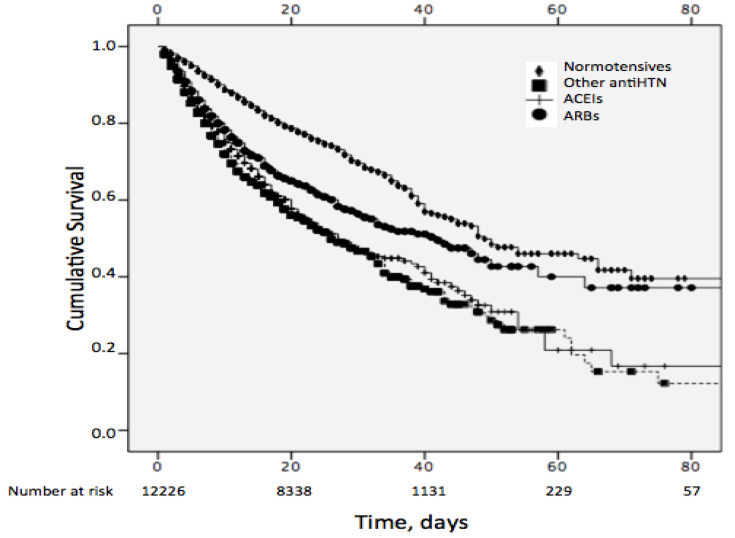
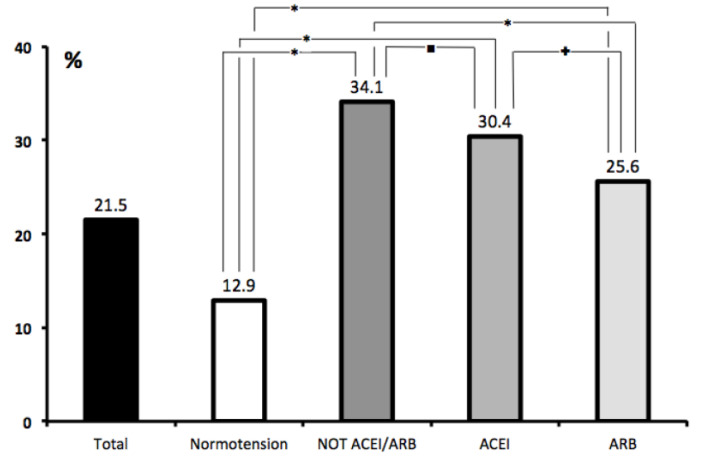
It is unclear to which extent the higher mortality associated with hypertension in the coronavirus disease (COVID-19) is due to its increased prevalence among older patients or to specific mechanisms. Cross-sectional, observational, retrospective multicenter study, analyzing 12226 patients who required hospital admission in 150 Spanish centers included in the nationwide SEMI-COVID-19 Network. We compared the clinical characteristics of survivors versus non-survivors. The mean age of the study population was 67.5 ± 16.1 years, 42.6% were women. Overall, 2630 (21.5%) subjects died. The most common comorbidity was hypertension (50.9%) followed by diabetes (19.1%), and atrial fibrillation (11.2%). Multivariate analysis showed that after adjusting for gender (males, OR: 1.5, = 0.0001), age tertiles (second and third tertiles, OR: 2.0 and 4.7, = 0.0001), and Charlson Comorbidity Index scores (second and third tertiles, OR: 4.7 and 8.1, = 0.0001), hypertension was significantly predictive of all-cause mortality when this comorbidity was treated with angiotensin-converting enzyme inhibitors (ACEIs) (OR: 1.6, = 0.002) or other than renin-angiotensin-aldosterone blockers (OR: 1.3, = 0.001) or angiotensin II receptor blockers (ARBs) (OR: 1.2, = 0.035). The preexisting condition of hypertension had an independent prognostic value for all-cause mortality in patients with COVID-19 who required hospitalization. ARBs showed a lower risk of lethality in hypertensive patients than other antihypertensive drugs.
目前尚不清楚在冠状病毒病(COVID-19)中,与高血压相关的较高死亡率是由于其在老年患者中的患病率增加,还是由于特定机制。这是一项横断面、观察性、回顾性多中心研究,分析了全国性SEMI-COVID-19网络中150家西班牙中心收治的12226例患者。我们比较了幸存者与非幸存者的临床特征。研究人群的平均年龄为67.5±16.1岁,女性占42.6%。总体而言,2630例(21.5%)患者死亡。最常见的合并症是高血压(50.9%),其次是糖尿病(19.1%)和心房颤动(11.2%)。多变量分析显示,在调整性别(男性,OR:1.5,P = 0.0001)、年龄三分位数(第二和第三三分位数,OR:2.0和4.7,P = 0.0001)以及Charlson合并症指数评分(第二和第三三分位数,OR:4.7和8.1,P = 0.0001)后,当高血压合并症用血管紧张素转换酶抑制剂(ACEIs)治疗时(OR:1.6,P = 0.002),或用肾素-血管紧张素-醛固酮阻滞剂以外的药物治疗时(OR:1.3,P = 0.001),或用心房颤动治疗时(OR:1.2,P = 0.035),高血压是全因死亡率的显著预测因素。高血压的既往病史对需要住院治疗的COVID-19患者的全因死亡率具有独立的预后价值。与其他抗高血压药物相比,ARB在高血压患者中显示出较低的致死风险。