Iwasaki Tsutomu, Hifumi Toru, Hayashi Kuniyoshi, Otani Norio, Ishimatsu Shinichi
Emergency and Critical Care medicine St. Luke's International Hospital Tokyo Japan.
Graduate School of Public Health St. Luke's International University Tokyo Japan.
J Am Coll Emerg Physicians Open. 2020 Jul 3;1(4):494-501. doi: 10.1002/emp2.12125. eCollection 2020 Aug.
Even if performing rapid influenza diagnostic tests test will not change clinical decision making, we sometimes perform at triage to reduce length of stay in Japan. Whether performing rapid influenza diagnostic tests at triage may shorten emergency department (ED) length of stay (LOS) is remains unclear. We aimed to determine the utility of rapid influenza diagnostic tests at triage in shortening ED length of stay LOS.
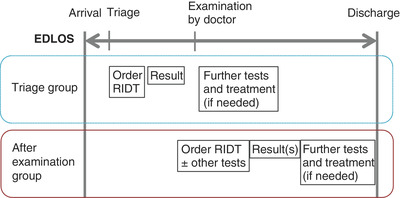
We retrospectively reviewed medical records of patients discharged from our ED after receiving results from rapid influenza diagnostic tests during the influenza season from December, 2013 to March, 2019. Eligibility criteria were a walk-in visit, age ≥15 years, triage performed, rapid influenza diagnostic test administered, and no admission. The triage group received rapid influenza diagnostic tests at triage. The after-examination group received their tests only after examination by a doctor. The primary outcome was ED LOS after propensity score matching to adjust for several covariates.
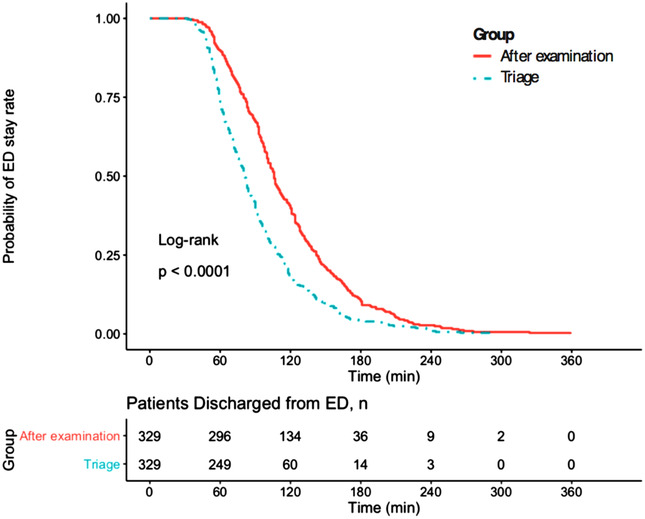
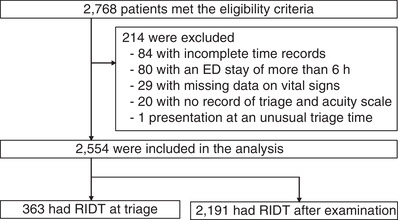
Of 2,768 eligible patients, 2,554 patients were enrolled in the triage group (n = 363) or after examination group (n = 2,191). There were 329 matched pairs after propensity score matching. Median ED LOS was significantly shorter in the triage group than in the after-examination group after propensity score matching (81 min (interquartile range [IQR] 60 to 111) vs 106 min (IQR 80-142); median difference 24 min (95% confidence interval 17-30)).
Performing rapid influenza diagnostic tests at triage was associated with shorter ED LOS during the influenza season.
即使进行快速流感诊断检测不会改变临床决策,但在日本,我们有时会在分诊时进行该检测以缩短住院时间。在分诊时进行快速流感诊断检测是否可缩短急诊科(ED)住院时间尚不清楚。我们旨在确定在分诊时进行快速流感诊断检测对缩短ED住院时间的作用。
我们回顾性分析了2013年12月至2019年3月流感季节期间在我们急诊科接受快速流感诊断检测结果后出院患者的病历。纳入标准为非预约就诊、年龄≥15岁、进行过分诊、接受过快速流感诊断检测且未住院。分诊组在分诊时接受快速流感诊断检测。检查后组仅在医生检查后接受检测。主要结局是在倾向得分匹配以调整多个协变量后的ED住院时间。
在2768名符合条件的患者中,2554名患者被纳入分诊组(n = 363)或检查后组(n = 2191)。倾向得分匹配后有329对匹配对。倾向得分匹配后,分诊组的ED住院时间中位数明显短于检查后组(81分钟(四分位间距[IQR]60至111) vs 106分钟(IQR 80 - 142);中位数差异24分钟(95%置信区间17 - 30))。
在分诊时进行快速流感诊断检测与流感季节期间较短的ED住院时间相关。