University of Montpellier, Montpellier, France.
Department of Microbiology, Faculty of Medicine, Khon Kaen University, Khon Kaen, Thailand.
PLoS Negl Trop Dis. 2020 Oct 1;14(10):e0008703. doi: 10.1371/journal.pntd.0008703. eCollection 2020 Oct.
BACKGROUND/OBJECTIVES: Dengue fever is an important public health concern in most tropical and subtropical countries, and its prevention and control rest on vector surveillance and control. However, many aspects of dengue epidemiology remain unclear; in particular, the relationship between Aedes vector abundance and dengue transmission risk. This study aims to identify entomological and immunological indices capable of discriminating between dengue case and control (non-case) houses, based on the assessment of candidate indices, as well as individual and household characteristics, as potential risk factors for acquiring dengue infection.
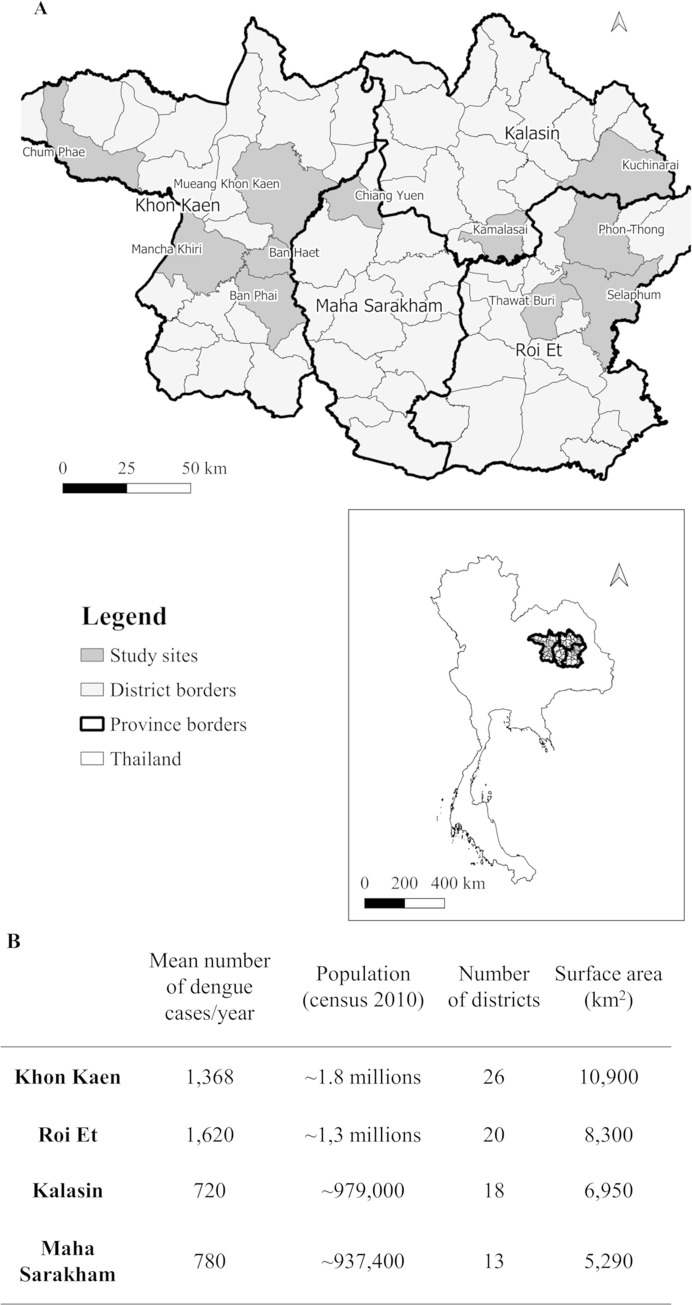
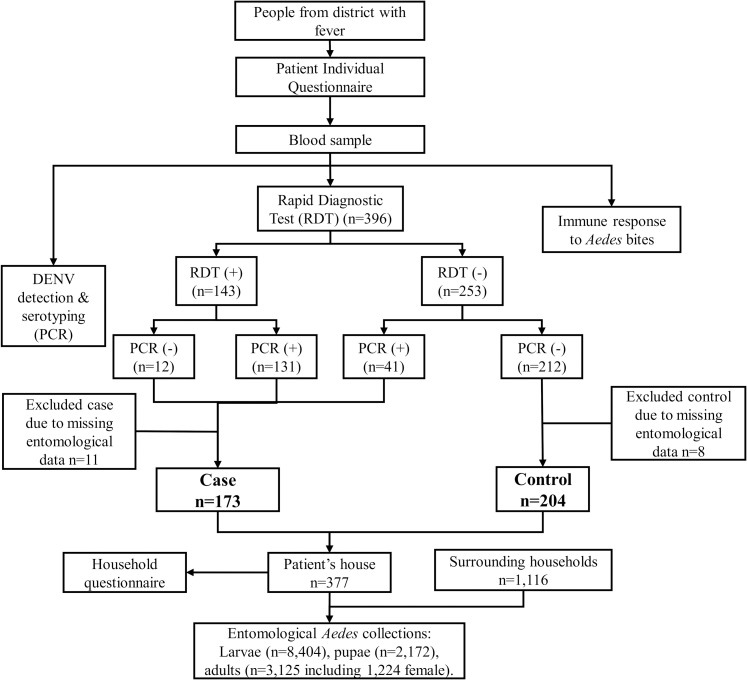
This prospective, hospital-based, case-control study was conducted in northeastern Thailand between June 2016 and August 2019. Immature and adult stage Aedes were collected at the houses of case and control patients, recruited from district hospitals, and at patients' neighboring houses. Blood samples were tested by RDT and PCR to detect dengue cases, and were processed with the Nterm-34 kDa salivary peptide to measure the human immune response to Aedes bites. Socioeconomic status, and other individual and household characteristics were analyzed as potential risk factors for dengue.
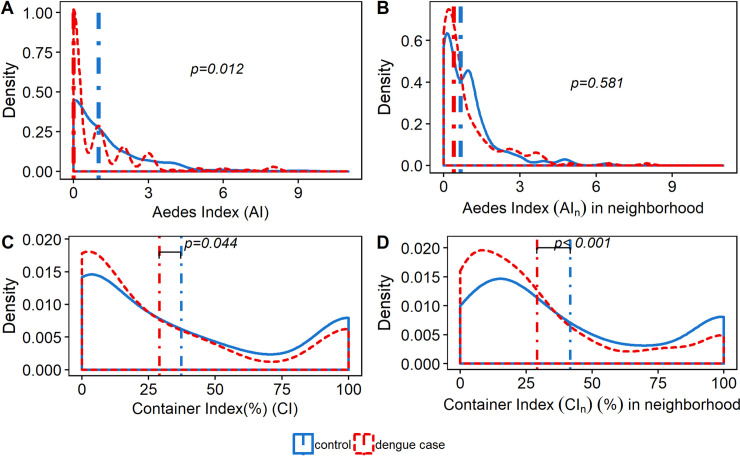
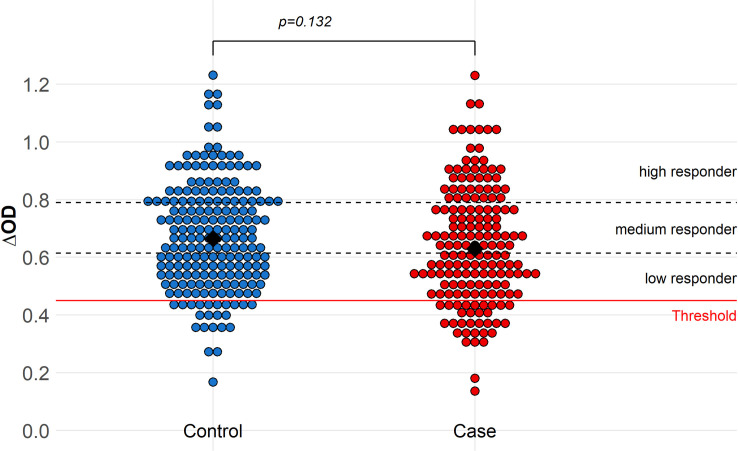
Study findings showed complex relationships between entomological indices and dengue risk. The presence of DENV-infected Aedes at the patient house was associated with 4.2-fold higher odds of dengue. On the other hand, Aedes presence (irrespective of infectious status) in the patient's house was negatively associated with dengue. In addition, the human immune response to Aedes bites, was higher in control than in case patients and Aedes adult abundance and immature indices were higher in control than in case houses at the household and the neighboring level. Multivariable analysis showed that children aged 10-14 years old and those aged 15-25 years old had respectively 4.5-fold and 2.9-fold higher odds of dengue infection than those older than 25 years.
DENV infection in female Aedes at the house level was positively associated with dengue infection, while adult Aedes presence in the household was negatively associated. This study highlights the potential benefit of monitoring dengue viruses in Aedes vectors. Our findings suggest that monitoring the presence of DENV-infected Aedes mosquitoes could be a better indicator of dengue risk than the traditional immature entomological indices.
背景/目的:登革热是大多数热带和亚热带国家的重要公共卫生关注点,其预防和控制依赖于病媒监测和控制。然而,登革热流行病学的许多方面仍不清楚;特别是,伊蚊丰度与登革热传播风险之间的关系。本研究旨在根据候选指标的评估,以及个体和家庭特征作为获得登革热感染的潜在危险因素,确定能够区分登革热病例和对照(非病例)房屋的昆虫学和免疫学指标。
这是一项在泰国东北部进行的前瞻性医院病例对照研究,时间为 2016 年 6 月至 2019 年 8 月。在区医院招募的病例和对照患者的家中以及患者附近的房屋中采集了伊蚊的幼虫和成虫阶段。通过 RDT 和 PCR 检测血液样本以检测登革热病例,并通过 N 端-34 kDa 唾液肽检测来测量人类对伊蚊叮咬的免疫反应。分析社会经济地位以及其他个体和家庭特征作为登革热的潜在危险因素。
研究结果表明,昆虫学指标与登革热风险之间存在复杂的关系。在患者家中存在感染 DENV 的伊蚊与登革热的几率增加 4.2 倍有关。另一方面,患者家中存在(无论是否具有传染性)伊蚊与登革热呈负相关。此外,与病例患者相比,控制组的人类对伊蚊叮咬的免疫反应更高,并且在家庭和邻居层面,控制组的成蚊丰度和幼蚊指数更高。多变量分析显示,10-14 岁和 15-25 岁的儿童感染登革热的几率分别是 25 岁以上儿童的 4.5 倍和 2.9 倍。
在家庭层面,雌性伊蚊中 DENV 的感染与登革热感染呈正相关,而家庭中成年伊蚊的存在则呈负相关。本研究强调了监测登革热病毒在伊蚊媒介中的潜在益处。我们的研究结果表明,监测感染 DENV 的伊蚊的存在可能比传统的幼蚊昆虫学指标更能反映登革热风险。