Department of Microbiology, Faculty of Medicine, Khon Kaen University, Khon Kaen 40002, Thailand.
Department of Statistics, Begum Rokeya University, Rangpur 5404, Bangladesh.
Int J Environ Res Public Health. 2021 Jun 2;18(11):5971. doi: 10.3390/ijerph18115971.
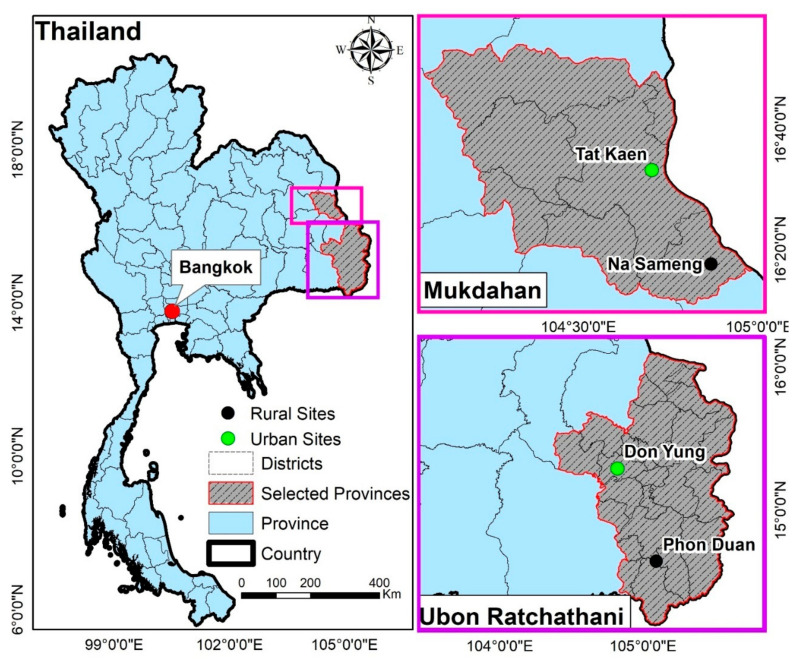
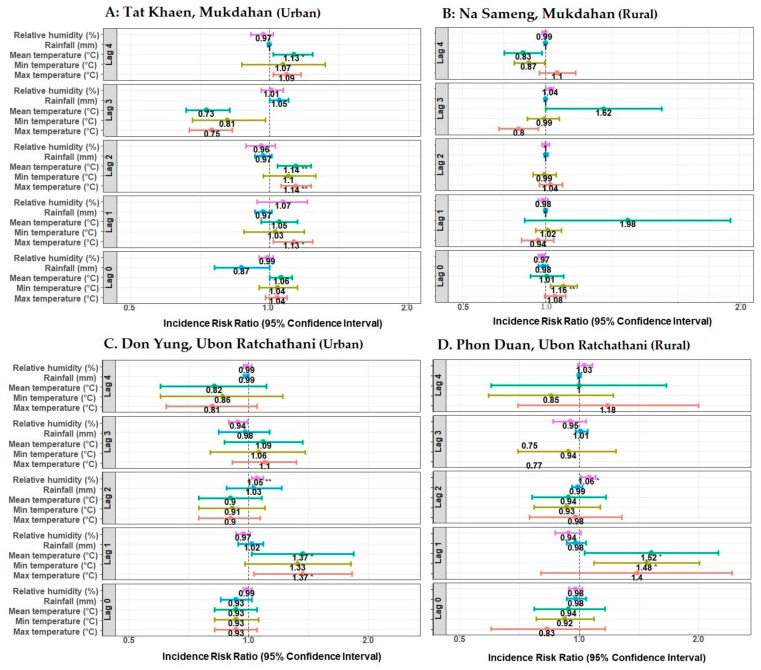
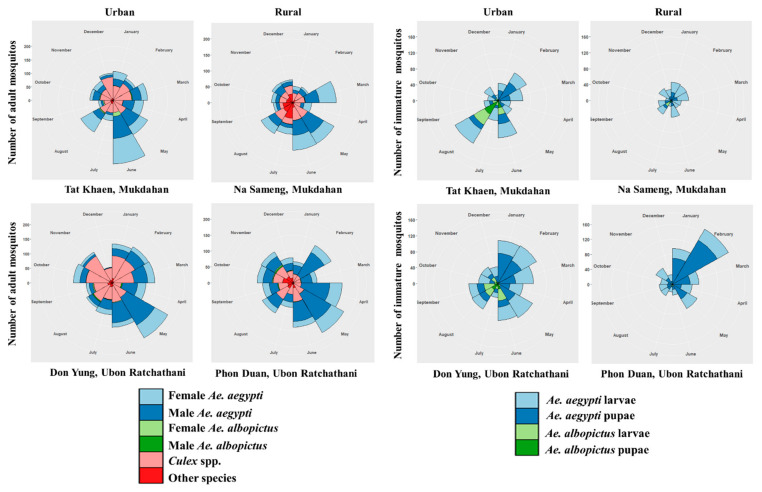
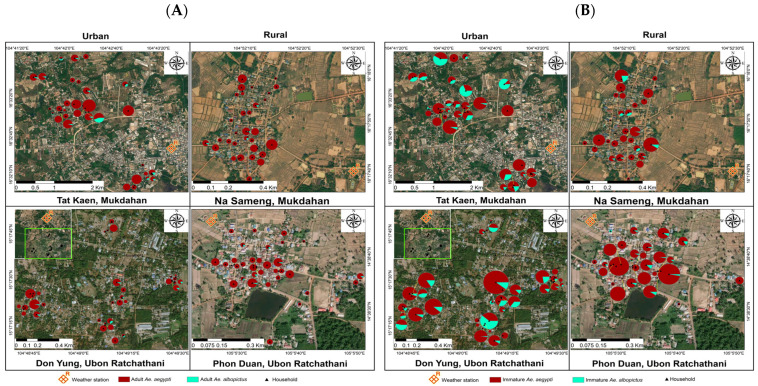
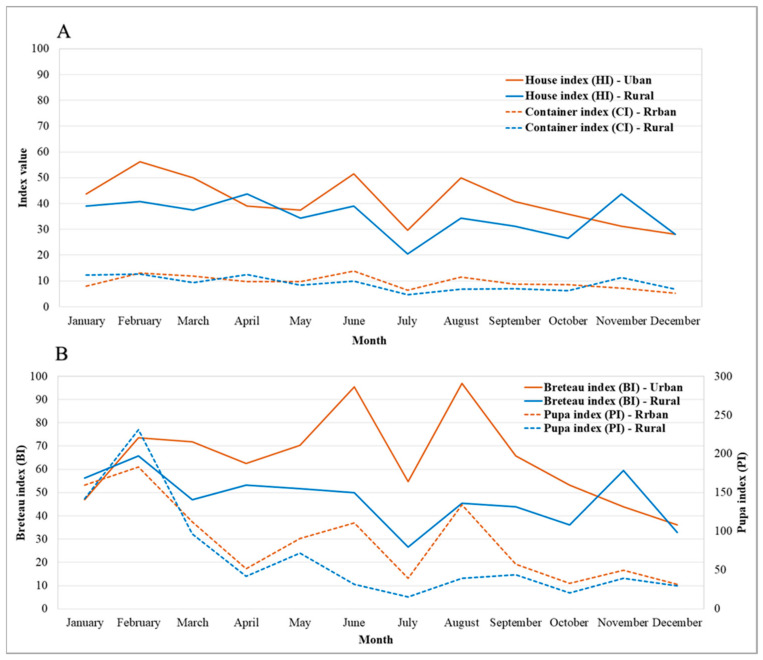
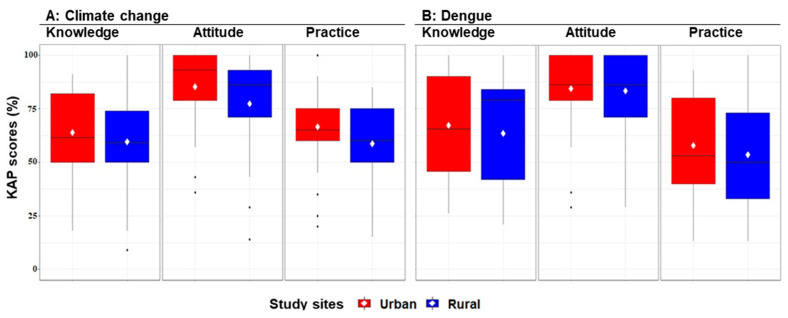
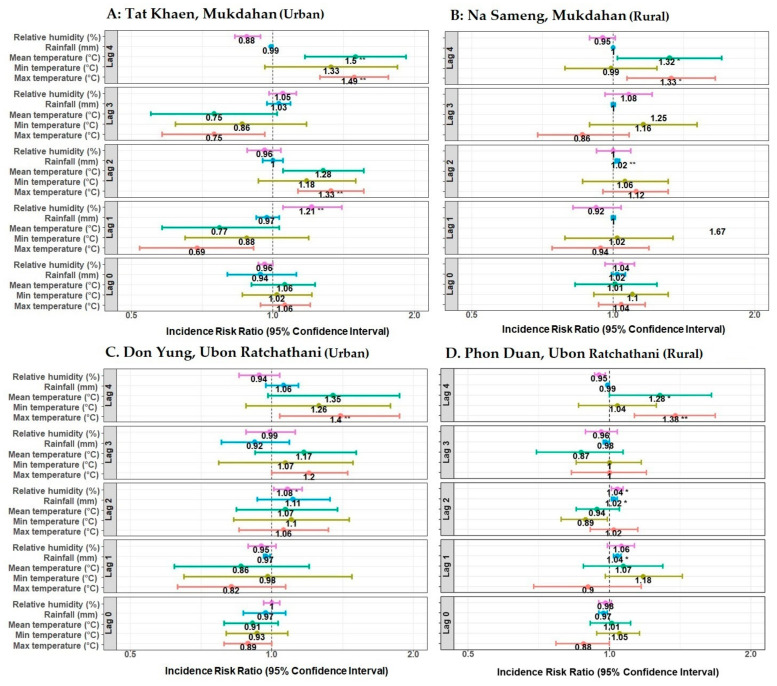
is the main vector of dengue globally. The variables that influence the abundance of dengue vectors are numerous and complex. This has generated a need to focus on areas at risk of disease transmission, the spatial-temporal distribution of vectors, and the factors that modulate vector abundance. To help guide and improve vector-control efforts, this study identified the ecological, social, and other environmental risk factors that affect the abundance of adult female and immature in households in urban and rural areas of northeastern Thailand. A one-year entomological study was conducted in four villages of northeastern Thailand between January and December 2019. Socio-demographic; self-reported prior dengue infections; housing conditions; durable asset ownership; water management; characteristics of water containers; knowledge, attitudes, and practices (KAP) regarding climate change and dengue; and climate data were collected. Household crowding index (HCI), premise condition index (PCI), socio-economic status (SES), and entomological indices (HI, CI, BI, and PI) were calculated. Negative binomial generalized linear models (GLMs) were fitted to identify the risk factors associated with the abundance of adult females and immature . Urban sites had higher entomological indices and numbers of adult mosquitoes than rural sites. Overall, participants' KAP about climate change and dengue were low in both settings. The fitted GLM showed that a higher abundance of adult female was significantly ( < 0.05) associated with many factors, such as a low education level of household respondents, crowded households, poor premise conditions, surrounding house density, bathrooms located indoors, unscreened windows, high numbers of wet containers, a lack of adult control, prior dengue infections, poor climate change adaptation, dengue, and vector-related practices. Many of the above were also significantly associated with a high abundance of immature mosquito stages. The GLM model also showed that maximum and mean temperature with four-and one-to-two weeks of lag were significant predictors ( < 0.05) of the abundance of adult and immature mosquitoes, respectively, in northeastern Thailand. The low KAP regarding climate change and dengue highlights the engagement needs for vector-borne disease prevention in this region. The identified risk factors are important for the critical first step toward developing routine surveillance and reliable early warning systems for effective dengue and other mosquito-borne disease prevention and control strategies at the household and community levels in this region and similar settings elsewhere.
是全球登革热的主要传播媒介。影响登革热媒介丰度的变量众多且复杂。这就需要关注有疾病传播风险的地区、媒介的时空分布以及调节媒介丰度的因素。为了帮助指导和改进病媒控制工作,本研究确定了影响泰国东北部城乡家庭成年雌性和未成熟蚊数量的生态、社会和其他环境风险因素。2019 年 1 月至 12 月,在泰国东北部的四个村庄进行了为期一年的昆虫学研究。收集了社会人口统计学资料;自我报告的先前登革热感染情况;住房条件;耐用资产所有权;水管理;水容器特征;关于气候变化和登革热的知识、态度和实践(KAP);以及气候数据。计算了家庭拥挤指数(HCI)、前提条件指数(PCI)、社会经济地位(SES)和昆虫学指数(HI、CI、BI 和 PI)。拟合了负二项广义线性模型(GLMs),以确定与成年雌性和未成熟蚊数量相关的风险因素。城市地点的昆虫学指数和成年蚊数量高于农村地点。总体而言,两个环境中的参与者关于气候变化和登革热的 KAP 都很低。拟合的 GLM 显示,成年雌性数量较多与许多因素显著相关(<0.05),例如家庭受访者的教育水平低、家庭拥挤、住房条件差、周围房屋密度大、浴室位于室内、未装纱窗的窗户、大量潮湿容器、缺乏成虫控制、先前的登革热感染、对气候变化适应不良、登革热和与蚊媒相关的做法。其中许多因素也与大量未成熟蚊阶段显著相关。GLM 模型还显示,在泰国东北部,最大和平均温度以及滞后四到两周的温度是成年和未成熟蚊子数量的重要预测因子(<0.05)。关于气候变化和登革热的知识、态度和实践的低 KAP 突出了该地区预防蚊媒传播疾病的参与需求。确定的风险因素对于在该地区以及其他类似环境中,在家庭和社区层面制定常规监测和可靠早期预警系统以有效预防和控制登革热和其他蚊媒传播疾病的策略至关重要。