Department of Marine Science and Technology, Faculty of Fisheries and Marine Sciences, IPB University, Bogor, Indonesia.
Department of Biology, Faculty of Mathematics and Natural Science, University of Indonesia, Depok, Indonesia.
PLoS One. 2020 Oct 1;15(10):e0230763. doi: 10.1371/journal.pone.0230763. eCollection 2020.
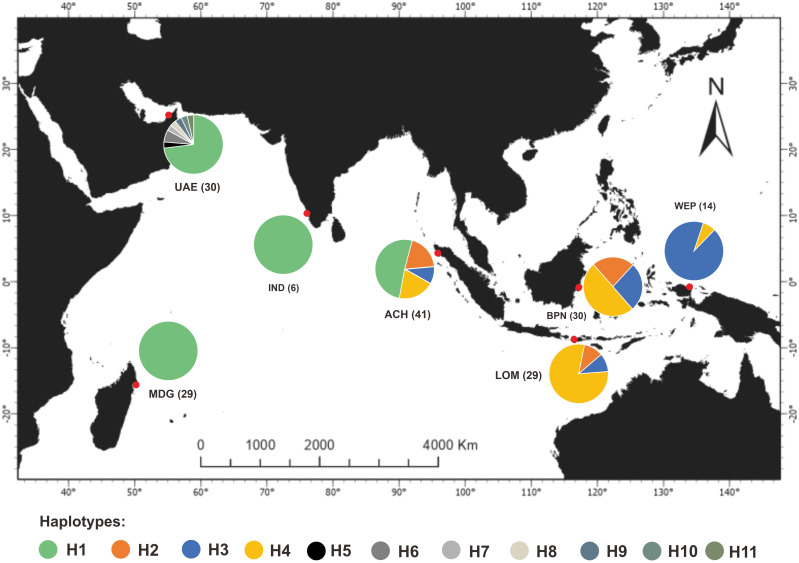
Scalloped Hammerhead shark (Sphyrna lewini) is an endangered species which its populations have been declining globally including in Indonesia, the world's top shark fishing country. However, there is a lack of information on the recent population structure of this species to promote proper management and its conservation status. This study aimed to investigate the genetic diversity, population structure, and connectivity of the S. lewini population, in three major shark landing sites: Aceh (n = 41), Balikpapan (n = 30), and Lombok (n = 29). Meanwhile, additional sequences were retrieved from West Papua (n = 14) and the Western Indian Ocean (n = 65) populations. From the analyses of the mitochondrial CO1 gene, a total of 179 sequences of S. lewini, with an average size of 594 bp, and 40 polymorphic loci in four and eight haplotypes for the Indonesian population and the Western Indian Ocean population were identified. The overall values of genetic diversity were high (h = 0.717; π = 0.013), with the highest values recorded in Aceh (h = 0.668; π = 0.002) and the lowest in Papua (h = 0.143; π = 0.000). On the contrary, the overall value was fairly low in the Western Indian Ocean (h = 0.232; π = 0.001). Furthermore, AMOVA and FST showed three significant subdivisions in Indonesia (FST = 0.442; P < 0.001), with separated populations for Aceh and West Papua, and mixed between Balikpapan and Lombok (FST = 0.044; P = 0.091). In contrast, genetic homogeneity was observed within the population of the Western Indian Ocean (FST = -0.013; P = 0.612). The establishment of a haplotype network provided evidence of a significantly different population and a limited genetic distribution between the Indonesian and the Western Indian Ocean populations (FST = 0.740; P < 0.001). This study showed the presence of a complex population of S. lewini with limited connectivity only in Indonesia separated from the Western Indian Ocean and requiring specific management measures based on the population structure at the regional level.
锯齿锤头鲨(Sphyrna lewini)是一种濒危物种,其数量在全球范围内都在减少,包括世界上最大的鲨鱼捕捞国印度尼西亚。然而,关于该物种最近的种群结构的信息很少,无法对其进行适当的管理和保护状况评估。本研究旨在调查三个主要的鲨鱼登陆点(亚齐省[n = 41]、巴厘巴板[n = 30]和龙目岛[n = 29])的 S. lewini 种群的遗传多样性、种群结构和连通性。同时,还从西巴布亚(n = 14)和西印度洋(n = 65)的种群中获取了其他序列。通过对线粒体 CO1 基因的分析,在印度尼西亚种群和西印度洋种群中鉴定出了总共 179 个 S. lewini 序列,平均大小为 594bp,有 40 个多态性位点,4 个和 8 个单倍型。遗传多样性的总体值较高(h = 0.717;π = 0.013),其中亚齐省的值最高(h = 0.668;π = 0.002),巴布亚的值最低(h = 0.143;π = 0.000)。相反,西印度洋的总体值相当低(h = 0.232;π = 0.001)。此外,AMOVA 和 FST 显示印度尼西亚有三个显著的亚群(FST = 0.442;P < 0.001),亚齐省和西巴布亚省的种群是分开的,巴厘巴板和龙目岛的种群是混合的(FST = 0.044;P = 0.091)。相比之下,西印度洋的种群遗传均一性较高(FST = -0.013;P = 0.612)。单倍型网络的建立提供了证据,表明印度尼西亚的 S. lewini 种群与西印度洋的种群之间存在明显的差异,遗传分布有限(FST = 0.740;P < 0.001)。本研究表明,锯齿锤头鲨在印度尼西亚存在一个复杂的种群,与西印度洋的种群之间连通性有限,需要根据区域水平的种群结构采取具体的管理措施。