Department of Biology, Federico II University complesso universitario di Monte Sant' Angelo via Cinthia, 80126, Napoli, Italy.
Institute of Biomolecular Chemistry, National Research Council of Italy, Pozzuoli (Naples), Italy.
Microb Cell Fact. 2020 Oct 1;19(1):185. doi: 10.1186/s12934-020-01446-6.
Bacterial spores displaying heterologous antigens or enzymes have long been proposed as mucosal vaccines, functionalized probiotics or biocatalysts. Two main strategies have been developed to display heterologous molecules on the surface of Bacillus subtilis spores: (i) a recombinant approach, based on the construction of a gene fusion between a gene coding for a coat protein (carrier) and DNA coding for the protein to be displayed, and (ii) a non-recombinant approach, based on the spontaneous and stable adsorption of heterologous molecules on the spore surface. Both systems have advantages and drawbacks and the selection of one or the other depends on the protein to be displayed and on the final use of the activated spore. It has been recently shown that B. subtilis builds structurally and functionally different spores when grown at different temperatures; based on this finding B. subtilis spores prepared at 25, 37 or 42 °C were compared for their efficiency in displaying various model proteins by either the recombinant or the non-recombinant approach.
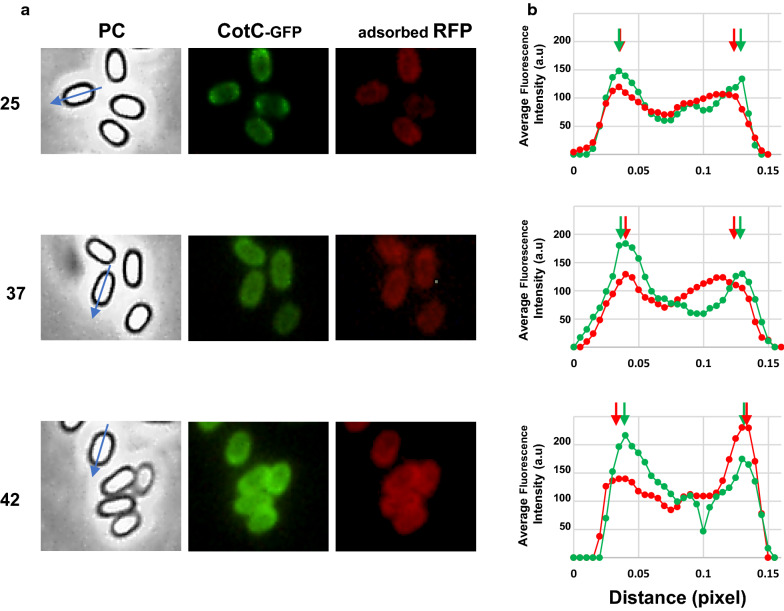
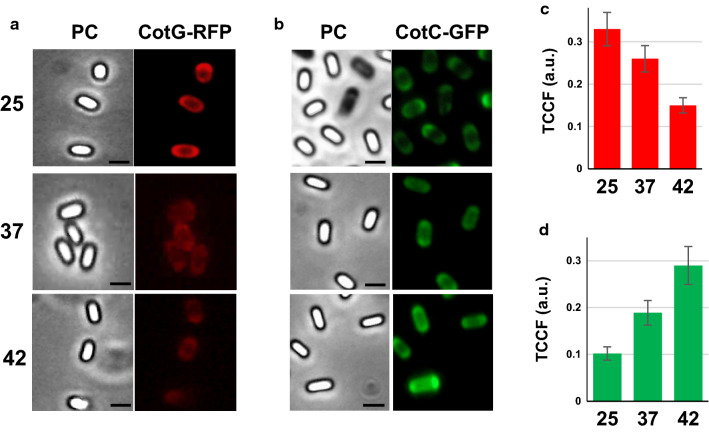
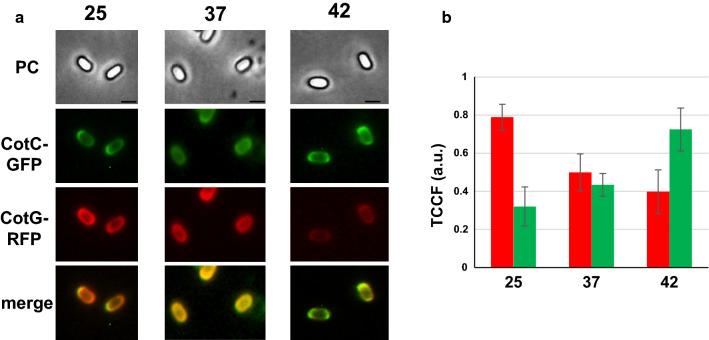
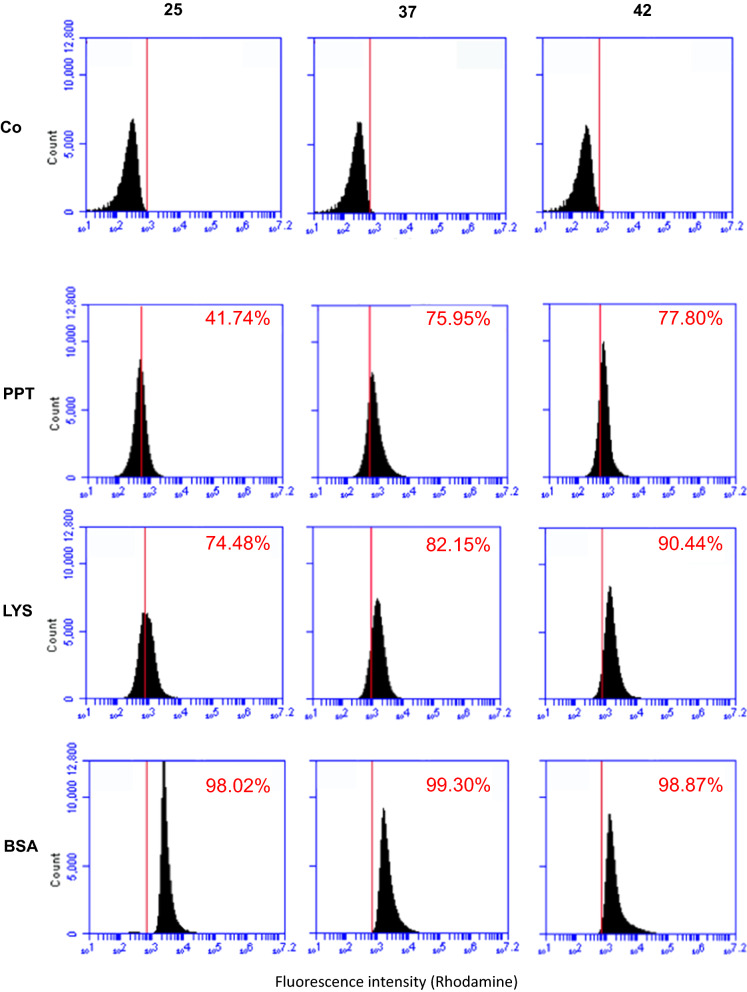
Immune- and fluorescence-based assays were used to analyze the display of several model proteins on spores prepared at 25, 37 or 42 °C. Recombinant spores displayed different amounts of the same fusion protein in response to the temperature of spore production. In spores simultaneously displaying two fusion proteins, each of them was differentially displayed at the various temperatures. The display by the non-recombinant approach was only modestly affected by the temperature of spore production, with spores prepared at 37 or 42 °C slightly more efficient than 25 °C spores in adsorbing at least some of the model proteins tested.
Our results indicate that the temperature of spore production allows control of the display of heterologous proteins on spores and, therefore, that the spore-display strategy can be optimized for the specific final use of the activated spores by selecting the display approach, the carrier protein and the temperature of spore production.
展示异源抗原或酶的细菌孢子长期以来一直被提议作为黏膜疫苗、功能益生菌或生物催化剂。为了在枯草芽孢杆菌孢子表面展示异源分子,已经开发了两种主要策略:(i)基于构建一个基因融合的重组方法,该融合由一个编码外壳蛋白(载体)的基因和要展示的蛋白质的 DNA 编码组成;(ii)基于异源分子自发且稳定吸附在孢子表面的非重组方法。这两种系统都有各自的优点和缺点,选择其中一种或另一种方法取决于要展示的蛋白质和激活孢子的最终用途。最近的研究表明,当在不同温度下生长时,枯草芽孢杆菌会形成结构和功能不同的孢子;基于这一发现,比较了在 25、37 或 42°C 下制备的枯草芽孢杆菌孢子,以评估它们通过重组或非重组方法展示各种模型蛋白的效率。
使用免疫和荧光分析方法分析了在 25、37 或 42°C 下制备的孢子上展示的几种模型蛋白。响应孢子产生的温度,重组孢子展示了不同量的相同融合蛋白。在同时展示两种融合蛋白的孢子中,每种蛋白在不同温度下的展示方式都不同。非重组方法的展示受孢子产生温度的影响较小,在 37 或 42°C 下制备的孢子比 25°C 下的孢子略微更有效地吸附至少一些测试的模型蛋白。
我们的结果表明,孢子产生的温度可以控制异源蛋白在孢子上的展示,因此,可以通过选择展示方法、载体蛋白和孢子产生的温度来优化孢子展示策略,以适应激活孢子的特定最终用途。