GENUD Toledo Research Group, Universidad de Castilla-La Mancha, Toledo, Spain.
CIBER of Frailty and Healthy Aging (CIBERFES), Madrid, Spain.
Sci Rep. 2020 Oct 1;10(1):16337. doi: 10.1038/s41598-020-73395-4.
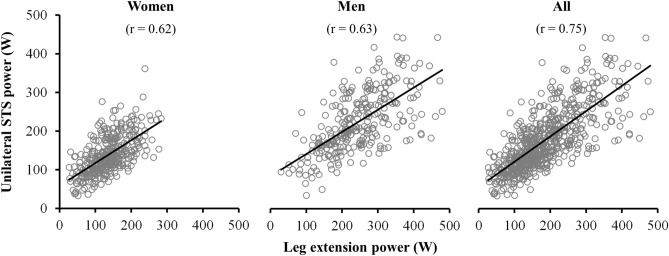
This study aimed to assess the validity and functional relevance of a standardized procedure to assess lower limb muscle power by means of the 30-s sit-to-stand (STS) test when compared to leg extension power (LEP), traditional STS performance and handgrip strength. A total of 628 community-dwelling older subjects (60-93 years) from the Copenhagen Sarcopenia Study were included. Physical performance was assessed by the 30-s STS and 10-m maximal gait speed tests. Handgrip strength and LEP were recorded by a hand-held dynamometer and the Nottingham power rig, respectively. STS muscle power was calculated using the subjects' body mass and height, chair height and the number of repetitions completed in the 30-s STS test. We found a small albeit significant difference between LEP and unilateral STS power in older men (245.5 ± 88.8 vs. 223.4 ± 81.4 W; ES = 0.26; p < 0.05), but not in older women (135.9 ± 51.9 vs. 138.5 ± 49.6 W; ES = 0.05; p > 0.05). Notably, a large positive correlation was observed between both measures (r = 0.75; p < 0.001). Relative STS power was more strongly related with maximal gait speed than handgrip strength, repetition-based STS performance and relative LEP after adjusting for age (r = 0.53 vs 0.35-0.45; p < 0.05). In conclusion, STS power obtained from the 30-s STS test appeared to provide a valid measure of bilateral lower limb power and was more strongly related with physical performance than maximal handgrip strength, repetition-based STS performance and LEP.
本研究旨在评估通过 30 秒坐站(STS)测试评估下肢肌肉力量的标准化程序的有效性和功能相关性,与腿部伸展力量(LEP)、传统 STS 表现和握力进行比较。共纳入来自哥本哈根肌肉减少症研究的 628 名社区居住的老年受试者(60-93 岁)。通过 30 秒 STS 和 10 米最大步行速度测试评估身体表现。通过手持测力计和诺丁汉力量测试装置分别记录握力和 LEP。STS 肌肉力量使用受试者的体重和身高、椅子高度和 30 秒 STS 测试中完成的重复次数计算。我们发现,在老年男性中,LEP 和单侧 STS 力量之间存在微小但显著的差异(245.5 ± 88.8 与 223.4 ± 81.4 W;ES = 0.26;p < 0.05),但在老年女性中没有(135.9 ± 51.9 与 138.5 ± 49.6 W;ES = 0.05;p > 0.05)。值得注意的是,这两个测量值之间存在很大的正相关性(r = 0.75;p < 0.001)。在调整年龄后,相对 STS 力量与最大步行速度的相关性强于握力、基于重复的 STS 表现和相对 LEP(r = 0.53 与 0.35-0.45;p < 0.05)。总之,30 秒 STS 测试中获得的 STS 力量似乎提供了一种有效的双侧下肢力量测量方法,与最大握力、基于重复的 STS 表现和 LEP 相比,与身体表现的相关性更强。