Bubrig Louis T, Sutton John M, Fierst Janna L
Department of Biological Sciences The University of Alabama Tuscaloosa AL USA.
Ecol Evol. 2020 Aug 24;10(18):9886-9895. doi: 10.1002/ece3.6646. eCollection 2020 Sep.
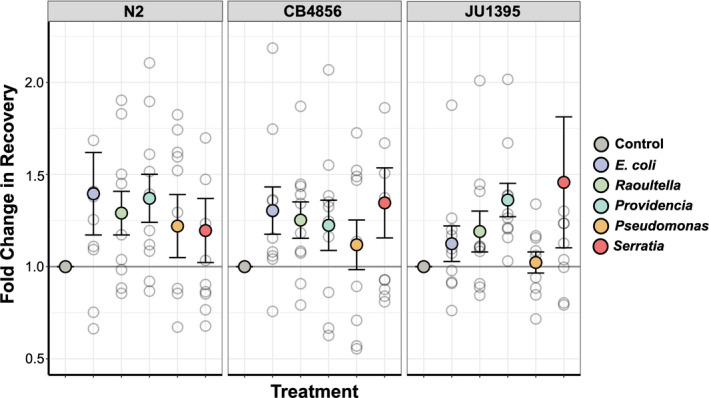
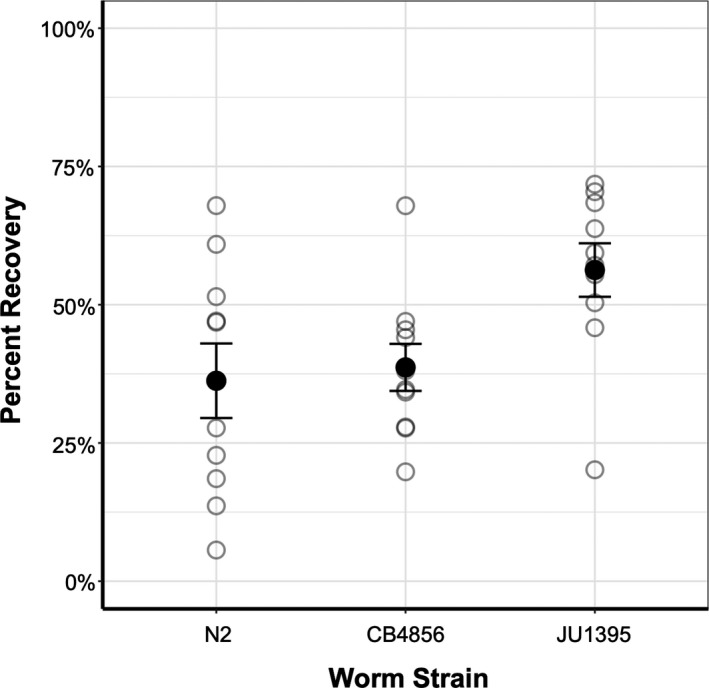
Many species use dormant stages for habitat selection by tying recovery to informative external cues. Other species have an undiscerning strategy in which they recover randomly despite having advanced sensory systems. We investigated whether elements of a species' habitat structure and life history can bar it from developing a discerning recovery strategy. The nematode has a dormant stage called the dauer larva that disperses between habitat patches. On one hand, colonization success is profoundly influenced by the bacteria found in its habitat patches, so we might expect this to select for a discerning strategy. On the other hand, ' habitat structure and life history suggest that there is no fitness benefit to varying recovery, which might select for an undiscerning strategy. We exposed dauers of three genotypes to a range of bacteria acquired from the worms' natural habitat. We found that dauers recover in all conditions but increase recovery on certain bacteria depending on the worm's genotype, suggesting a combination of undiscerning and discerning strategies. Additionally, the worms' responses did not match the bacteria's objective quality, suggesting that their decision is based on other characteristics.
许多物种通过将恢复与信息丰富的外部线索联系起来,利用休眠阶段进行栖息地选择。其他物种则有一种不加区分的策略,即尽管拥有先进的感官系统,但它们仍随机恢复。我们研究了一个物种的栖息地结构和生活史的要素是否会阻碍其发展出一种有辨别力的恢复策略。线虫有一种称为 dauer 幼虫的休眠阶段,它在栖息地斑块之间扩散。一方面,定殖成功受到其栖息地斑块中发现的细菌的深刻影响,所以我们可能期望这会选择一种有辨别力的策略。另一方面,栖息地结构和生活史表明,改变恢复方式并没有适应性益处,这可能会选择一种不加区分的策略。我们将三种基因型的 dauer 幼虫暴露于从蠕虫自然栖息地获取的一系列细菌中。我们发现,dauer 幼虫在所有条件下都会恢复,但根据蠕虫的基因型,在某些细菌上恢复会增加,这表明存在不加区分和有辨别力策略的组合。此外,蠕虫的反应与细菌的客观质量不匹配,这表明它们的决定是基于其他特征。