Epidemiol Rev. 2020 Jan 31;42(1):103-116. doi: 10.1093/epirev/mxaa006.
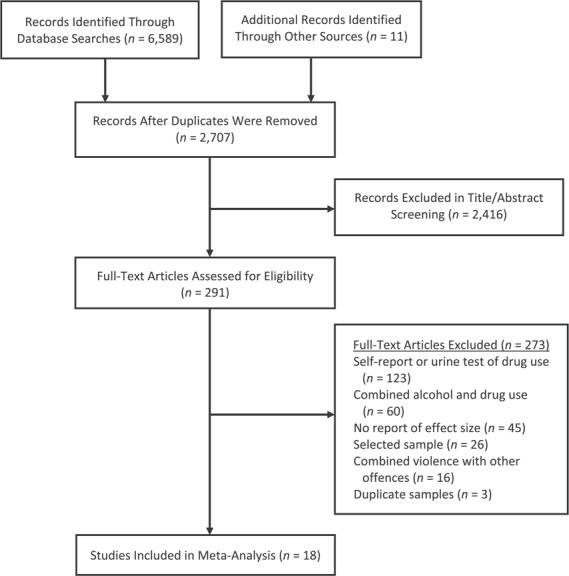
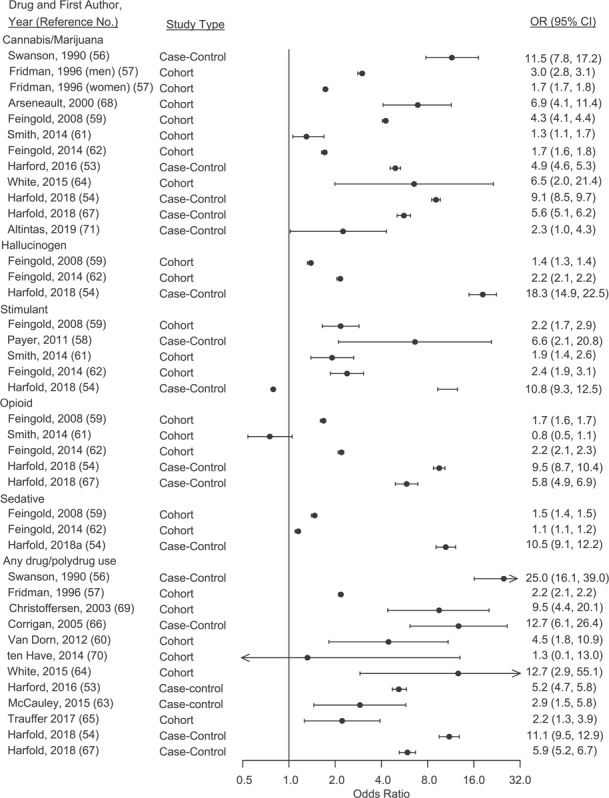
We conducted a systematic review that examined the link between individual drug categories and violent outcomes. We searched for primary case-control and cohort investigations that reported risk of violence against others among individuals diagnosed with drug use disorders using validated clinical criteria, following Preferred Reporting Items for Systematic Reviews and Meta-Analysis guidelines. We identified 18 studies published during 1990-2019, reporting data from 591,411 individuals with drug use disorders. We reported odds ratios of the violence risk in different categories of drug use disorders compared with those without. We found odds ratios ranging from 0.8 to 25.0 for most individual drug categories, with generally higher odds ratios among individuals with polydrug use disorders. In addition, we explored sources of between-study heterogeneity by subgroup and meta-regression analyses. Cohort investigations reported a lower risk of violence than case-control reports (odds ratio = 2.7 (95% confidence interval (CI): 2.1, 3.5) vs. 6.6 (95% CI: 5.1, 8.6)), and associations were stronger when the outcome was any violence rather than intimate partner violence (odds ratio = 5.7 (95% CI: 3.8, 8.6) vs. 1.7 (95% CI: 1.4, 2.1)), which was consistent with results from the meta-regression. Overall, these findings highlight the potential impact of preventing and treating drug use disorders on reducing violence risk and associated morbidities.
我们进行了一项系统评价,研究了个体药物类别与暴力结局之间的关系。我们搜索了使用经过验证的临床标准诊断为药物使用障碍的个体中针对他人暴力风险的主要病例对照和队列研究报告,遵循系统评价和荟萃分析报告的首选条目。我们确定了 1990 年至 2019 年间发表的 18 项研究,报告了 591411 名患有药物使用障碍的个体的数据。我们报告了不同类别药物使用障碍与无药物使用障碍个体的暴力风险的优势比。我们发现,大多数个体药物类别的优势比范围为 0.8 至 25.0,而多药使用障碍个体的优势比通常更高。此外,我们通过亚组和荟萃回归分析探索了研究间异质性的来源。队列研究报告的暴力风险低于病例对照报告(优势比=2.7(95%置信区间(CI):2.1, 3.5)比 6.6(95% CI:5.1, 8.6)),当结局是任何暴力而不是亲密伴侣暴力时,关联更强(优势比=5.7(95% CI:3.8, 8.6)比 1.7(95% CI:1.4, 2.1)),这与荟萃回归的结果一致。总体而言,这些发现强调了预防和治疗药物使用障碍对降低暴力风险和相关发病率的潜在影响。