• 文献检索
  • 文档翻译
  • 深度研究
  • 学术资讯
  • Suppr Zotero 插件Zotero 插件
  • 邀请有礼
  • 套餐&价格
  • 历史记录
应用&插件
Suppr Zotero 插件Zotero 插件浏览器插件Mac 客户端Windows 客户端微信小程序
定价
高级版会员购买积分包购买API积分包
服务
文献检索文档翻译深度研究API 文档MCP 服务
关于我们
关于 Suppr公司介绍联系我们用户协议隐私条款
关注我们

Suppr 超能文献

核心技术专利:CN118964589B侵权必究
粤ICP备2023148730 号-1Suppr @ 2026

文献检索

告别复杂PubMed语法,用中文像聊天一样搜索,搜遍4000万医学文献。AI智能推荐,让科研检索更轻松。

立即免费搜索

文件翻译

保留排版,准确专业,支持PDF/Word/PPT等文件格式,支持 12+语言互译。

免费翻译文档

深度研究

AI帮你快速写综述,25分钟生成高质量综述,智能提取关键信息,辅助科研写作。

立即免费体验

人口层面上美国医院对 COVID-19 的兴趣和远程医疗能力:对谷歌搜索和国家医院调查数据的横断面分析。

Population-Level Interest and Telehealth Capacity of US Hospitals in Response to COVID-19: Cross-Sectional Analysis of Google Search and National Hospital Survey Data.

机构信息

Department of Health Services Research, Management and Policy, College of Public Health and Health Professions, University of Florida, Gainesville, FL, United States.

Biomedical Sciences Graduate Program, College of Medicine, The Ohio State University, Columbus, OH, United States.

出版信息

JMIR Public Health Surveill. 2020 Apr 7;6(2):e18961. doi: 10.2196/18961.

DOI:10.2196/18961
PMID:32250963
原文链接:https://pmc.ncbi.nlm.nih.gov/articles/PMC7141249/
Abstract

BACKGROUND

As the novel coronavirus disease (COVID-19) is widely spreading across the United States, there is a concern about the overloading of the nation's health care capacity. The expansion of telehealth services is expected to deliver timely care for the initial screening of symptomatic patients while minimizing exposure in health care facilities, to protect health care providers and other patients. However, it is currently unknown whether US hospitals have the telehealth capacity to meet the increasing demand and needs of patients during this pandemic.

OBJECTIVE

We investigated the population-level internet search volume for telehealth (as a proxy of population interest and demand) with the number of new COVID-19 cases and the proportion of hospitals that adopted a telehealth system in all US states.

METHODS

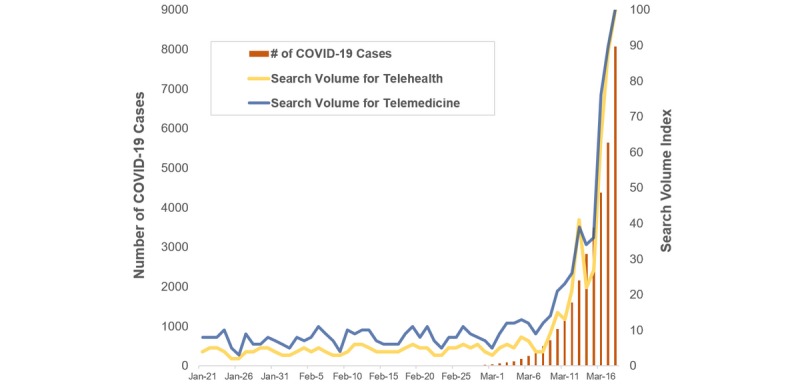
We used internet search volume data from Google Trends to measure population-level interest in telehealth and telemedicine between January 21, 2020 (when the first COVID-19 case was reported), and March 18, 2020. Data on COVID-19 cases in the United States were obtained from the Johns Hopkins Coronavirus Resources Center. We also used data from the 2018 American Hospital Association Annual Survey to estimate the proportion of hospitals that adopted telehealth (including telemedicine and electronic visits) and those with the capability of telemedicine intensive care unit (tele-ICU). Pearson correlation was used to examine the relations of population search volume for telehealth and telemedicine (composite score) with the cumulative numbers of COVID-19 cases in the United States during the study period and the proportion of hospitals with telehealth and tele-ICU capabilities.

RESULTS

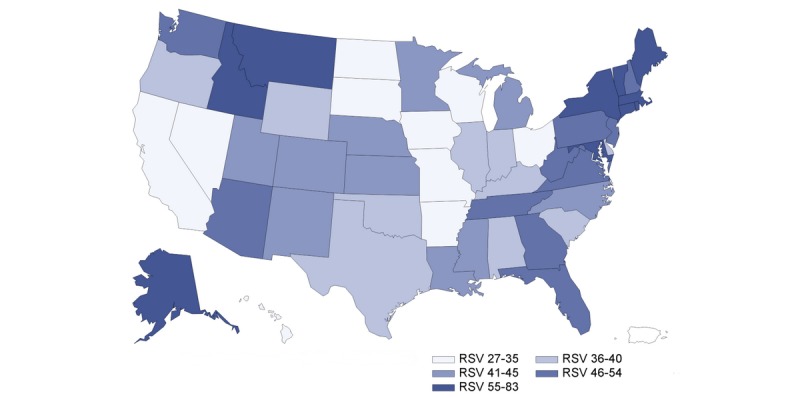
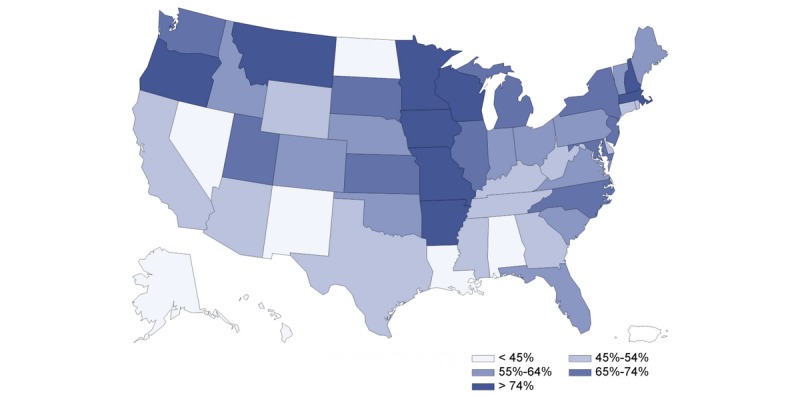
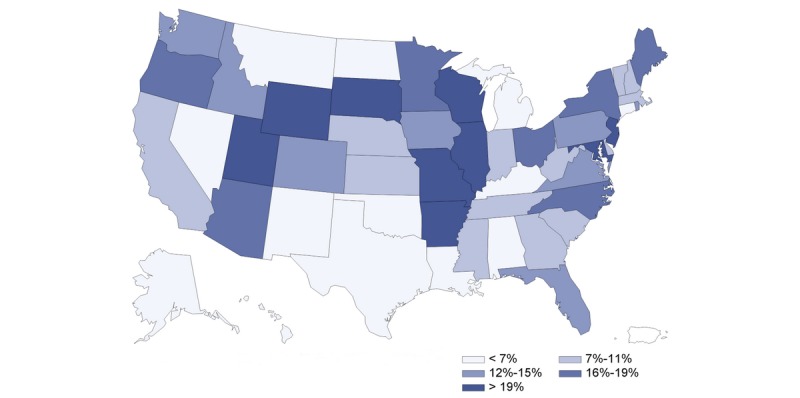
We found that US population-level interest in telehealth increased as the number of COVID-19 cases increased, with a strong correlation (r=0.948, P<.001). We observed a higher population-level interest in telehealth in the Northeast and West census region, whereas the proportion of hospitals that adopted telehealth was higher in the Midwest region. There was no significant association between population interest and the proportion of hospitals that adopted telehealth (r=0.055, P=.70) nor hospitals having tele-ICU capability (r=-0.073, P=.61).

CONCLUSIONS

As the number of COVID-19 cases increases, so does the US population's interest in telehealth. However, the level of population interest did not correlate with the proportion of hospitals providing telehealth services in the United States, suggesting that increased population demand may not be met with the current telehealth capacity. Telecommunication infrastructures in US hospitals may lack the capability to address the ongoing health care needs of patients with other health conditions. More practical investment is needed to deploy the telehealth system rapidly against the impending patient surge.
https://cdn.ncbi.nlm.nih.gov/pmc/blobs/aacb/7141249/291c0e98606d/publichealth_v6i2e18961_fig4.jpg
https://cdn.ncbi.nlm.nih.gov/pmc/blobs/aacb/7141249/db08f42bbd8a/publichealth_v6i2e18961_fig1.jpg
https://cdn.ncbi.nlm.nih.gov/pmc/blobs/aacb/7141249/ab67817f3dc3/publichealth_v6i2e18961_fig2.jpg
https://cdn.ncbi.nlm.nih.gov/pmc/blobs/aacb/7141249/5d73b090b0c8/publichealth_v6i2e18961_fig3.jpg
https://cdn.ncbi.nlm.nih.gov/pmc/blobs/aacb/7141249/291c0e98606d/publichealth_v6i2e18961_fig4.jpg
https://cdn.ncbi.nlm.nih.gov/pmc/blobs/aacb/7141249/db08f42bbd8a/publichealth_v6i2e18961_fig1.jpg
https://cdn.ncbi.nlm.nih.gov/pmc/blobs/aacb/7141249/ab67817f3dc3/publichealth_v6i2e18961_fig2.jpg
https://cdn.ncbi.nlm.nih.gov/pmc/blobs/aacb/7141249/5d73b090b0c8/publichealth_v6i2e18961_fig3.jpg
https://cdn.ncbi.nlm.nih.gov/pmc/blobs/aacb/7141249/291c0e98606d/publichealth_v6i2e18961_fig4.jpg
摘要

背景

随着新型冠状病毒病(COVID-19)在美国广泛传播,人们担心美国的医疗保健能力将不堪重负。扩大远程医疗服务有望为有症状的患者进行初步筛查提供及时的护理,同时最大限度地减少医疗保健设施中的暴露,以保护医疗保健提供者和其他患者。然而,目前尚不清楚美国医院是否有远程医疗能力来满足大流行期间不断增长的患者需求。

目的

我们通过美国各州新的 COVID-19 病例数量和采用远程医疗系统的医院比例,调查了人口层面远程医疗(作为人口兴趣和需求的代表)的互联网搜索量。

方法

我们使用谷歌趋势(Google Trends)的互联网搜索量数据,在 2020 年 1 月 21 日(首次报告 COVID-19 病例)至 2020 年 3 月 18 日期间,测量了人口对远程医疗和远程医疗的兴趣。美国的 COVID-19 病例数据来自约翰霍普金斯冠状病毒资源中心(Johns Hopkins Coronavirus Resources Center)。我们还使用了 2018 年美国医院协会年度调查的数据,以评估采用远程医疗(包括远程医疗和电子就诊)的医院比例,以及具备远程医疗重症监护室(远程 ICU)能力的医院比例。我们使用 Pearson 相关分析来检验远程医疗和远程医疗(综合评分)的人口搜索量与研究期间美国 COVID-19 病例累计数量以及具有远程医疗和远程 ICU 能力的医院比例之间的关系。

结果

我们发现,随着 COVID-19 病例数量的增加,美国人口对远程医疗的兴趣也在增加,相关性很强(r=0.948,P<.001)。我们发现,远程医疗在东北部和西部人口普查区的人口兴趣更高,而在中西部地区,采用远程医疗的医院比例更高。人口兴趣与采用远程医疗的医院比例(r=0.055,P=.70)或具有远程 ICU 能力的医院(r=-0.073,P=.61)之间没有显著的关联。

结论

随着 COVID-19 病例数量的增加,美国人口对远程医疗的兴趣也在增加。然而,人口兴趣水平与美国提供远程医疗服务的医院比例没有相关性,这表明增加的人口需求可能无法满足当前的远程医疗能力。美国医院的电信基础设施可能缺乏满足其他健康状况患者持续医疗需求的能力。需要进行更多实际的投资,以快速部署远程医疗系统,应对即将到来的患者激增。

相似文献

1
Population-Level Interest and Telehealth Capacity of US Hospitals in Response to COVID-19: Cross-Sectional Analysis of Google Search and National Hospital Survey Data.人口层面上美国医院对 COVID-19 的兴趣和远程医疗能力:对谷歌搜索和国家医院调查数据的横断面分析。
JMIR Public Health Surveill. 2020 Apr 7;6(2):e18961. doi: 10.2196/18961.
2
Telehealth Availability in US Hospitals in the Face of the COVID-19 Pandemic.美国医院在 COVID-19 大流行期间的远程医疗可用性。
J Rural Health. 2020 Sep;36(4):577-583. doi: 10.1111/jrh.12482. Epub 2020 Jun 30.
3
What Was the Change in Telehealth Usage and Proportion of No-show Visits for an Orthopaedic Trauma Clinic During the COVID-19 Pandemic?在 COVID-19 大流行期间,骨科创伤诊所的远程医疗使用情况和失约就诊比例有何变化?
Clin Orthop Relat Res. 2020 Oct;478(10):2257-2263. doi: 10.1097/CORR.0000000000001396.
4
Telehealth Uptake into Prenatal Care and Provider Attitudes during the COVID-19 Pandemic in New York City: A Quantitative and Qualitative Analysis.纽约市新冠疫情期间远程医疗在产前护理中的应用及提供者态度:一项定量与定性分析
Am J Perinatol. 2020 Aug;37(10):1005-1014. doi: 10.1055/s-0040-1712939. Epub 2020 Jun 9.
5
Telehealth Utilization in Response to the Novel Coronavirus (COVID-19) Pandemic in Orthopaedic Surgery.远程医疗在应对骨科新型冠状病毒(COVID-19)大流行中的应用。
J Am Acad Orthop Surg. 2020 Jun 1;28(11):e487-e492. doi: 10.5435/JAAOS-D-20-00339.
6
Health Inequalities in the Use of Telehealth in the United States in the Lens of COVID-19.新冠疫情视角下美国远程医疗使用中的健康不平等问题。
Popul Health Manag. 2020 Oct;23(5):368-377. doi: 10.1089/pop.2020.0186. Epub 2020 Aug 18.
7
Telehealth transformation: COVID-19 and the rise of virtual care.远程医疗转型:COVID-19 与虚拟医疗的兴起。
J Am Med Inform Assoc. 2020 Jun 1;27(6):957-962. doi: 10.1093/jamia/ocaa067.
8
Concerns for low-resource countries, with under-prepared intensive care units, facing the COVID-19 pandemic.对于资源匮乏国家而言,其重症监护病房准备不足,正面临着新冠疫情,令人担忧。
Infect Dis Health. 2020 Nov;25(4):227-232. doi: 10.1016/j.idh.2020.05.008. Epub 2020 Jun 5.
9
Essential Case Management Practices Amidst the Novel Coronavirus Disease 2019 (COVID-19) Crisis: Part 1: Tele-Case Management, Surge Capacity, Discharge Planning, and Transitions of Care.2019年新型冠状病毒病(COVID-19)危机期间的基本病例管理实践:第1部分:远程病例管理、应急能力、出院计划及护理转接
Prof Case Manag. 2020 Sep/Oct;25(5):248-266. doi: 10.1097/NCM.0000000000000454.
10
Surge capacity of intensive care units in case of acute increase in demand caused by COVID-19 in Australia.澳大利亚因 COVID-19 导致对重症监护病房的需求急性增加时的重症监护病房容量。
Med J Aust. 2020 Jun;212(10):463-467. doi: 10.5694/mja2.50596. Epub 2020 Apr 19.

引用本文的文献

1
Virtual Reality-Based Screening Tool for Distance Horizontal Fusional Vergence in Orthotropic Young Subjects: A Prospective Pilot Study.基于虚拟现实的正交异性年轻受试者远距离水平融合性聚散筛查工具:一项前瞻性试点研究。
Life (Basel). 2025 Aug 13;15(8):1286. doi: 10.3390/life15081286.
2
Acceptability and Feasibility of a Prototype Regional Disaster Teleconsultation System for COVID-19 Pandemic Response: Pilot Field Test.用于应对 COVID-19 大流行的区域灾害远程会诊系统原型的可接受性和可行性:现场试点测试
JMIR Form Res. 2025 Aug 19;9:e73078. doi: 10.2196/73078.
3
Sociodemographic and Socioeconomic Determinants for the Usage of Digital Patient Portals in Hospitals: Systematic Review and Meta-Analysis on the Digital Divide.

本文引用的文献

1
Hospital Capacity and Operations in the Coronavirus Disease 2019 (COVID-19) Pandemic-Planning for the Nth Patient.2019年冠状病毒病(COVID-19)大流行期间的医院容量与运营——为第N位患者做准备
JAMA Health Forum. 2020 Mar 2;1(3):e200345. doi: 10.1001/jamahealthforum.2020.0345.
2
Covid-19: a remote assessment in primary care.新冠肺炎:基层医疗中的远程评估
BMJ. 2020 Mar 25;368:m1182. doi: 10.1136/bmj.m1182.
3
Securing the Safety Net and Protecting Public Health During a Pandemic: Medicaid's Response to COVID-19.在大流行期间保障安全网并保护公众健康:医疗补助计划对新冠疫情的应对措施
医院数字患者门户网站使用情况的社会人口学和社会经济决定因素:关于数字鸿沟的系统评价和荟萃分析
J Med Internet Res. 2025 Jun 3;27:e68091. doi: 10.2196/68091.
4
Barriers to and Facilitators of Implementing Overnight Nursing Teleconsultation in Small, Rural Long-Term Care Facilities: Qualitative Interview Study.小型农村长期护理机构实施夜间护理远程会诊的障碍与促进因素:定性访谈研究
JMIR Aging. 2025 May 7;8:e71950. doi: 10.2196/71950.
5
Impact of the COVID-19 pandemic on the National Telehealth Service for triage and referral in Sweden: a national retrospective observational study.新冠疫情对瑞典国家远程医疗分诊及转诊服务的影响:一项全国性回顾性观察研究
BMJ Open. 2024 Dec 4;14(12):e091627. doi: 10.1136/bmjopen-2024-091627.
6
Does the impact of medical publications vary by disease indication and publication type? An exploration using a novel, value-based, publication metric framework: the EMPIRE Index.医学出版物的影响是否因疾病指征和出版物类型而异?利用一种新颖的、基于价值的出版指标框架——EMPIR 指数进行的探索。
F1000Res. 2024 Oct 30;11:107. doi: 10.12688/f1000research.75805.5. eCollection 2022.
7
Telehealth service use and quality of care among US adults with diabetes: A cross-sectional study of the 2022 health information national trends survey.美国成年人糖尿病患者的远程医疗服务使用情况和护理质量:2022 年健康信息国家趋势调查的横断面研究。
BMJ Open. 2024 Nov 3;14(10):e086418. doi: 10.1136/bmjopen-2024-086418.
8
Individual heart failure patient variability in nocturnal hypoxia and arrhythmias.个体心力衰竭患者夜间低氧和心律失常的变异性。
Medicine (Baltimore). 2024 Oct 11;103(41):e40083. doi: 10.1097/MD.0000000000040083.
9
Public and Research Interest in Telemedicine From 2017 to 2022: Infodemiology Study of Google Trends Data and Bibliometric Analysis of Scientific Literature.2017 年至 2022 年的远程医疗的公众和研究兴趣:谷歌趋势数据的信息流行病学研究和科学文献的文献计量分析。
J Med Internet Res. 2024 May 16;26:e50088. doi: 10.2196/50088.
10
Complex Management of Basal Cell Carcinoma in a Frail Patient.体弱患者基底细胞癌的复杂管理
Cureus. 2024 Feb 3;16(2):e53518. doi: 10.7759/cureus.53518. eCollection 2024 Feb.
JAMA. 2020 May 26;323(20):2009-2010. doi: 10.1001/jama.2020.4272.
4
Virtually Perfect? Telemedicine for Covid-19.近乎完美?用于新冠疫情的远程医疗
N Engl J Med. 2020 Apr 30;382(18):1679-1681. doi: 10.1056/NEJMp2003539. Epub 2020 Mar 11.
5
Trends in e-visit adoption among U.S. office-based physicians: Evidence from the 2011-2015 NAMCS.美国门诊医生电子问诊采用率的趋势:来自 2011-2015 年NAMCS 的证据。
Int J Med Inform. 2019 Sep;129:260-266. doi: 10.1016/j.ijmedinf.2019.06.025. Epub 2019 Jun 25.
6
Infectious Diseases Society of America Position Statement on Telehealth and Telemedicine as Applied to the Practice of Infectious Diseases.美国传染病学会关于远程医疗和远程医疗在传染病实践中的应用的立场声明。
Clin Infect Dis. 2019 Apr 24;68(9):1437-1443. doi: 10.1093/cid/ciy907.
7
Telemedicine/Virtual ICU: Where Are We and Where Are We Going?远程医疗/虚拟重症监护病房:我们现状如何,又将走向何方?
Methodist Debakey Cardiovasc J. 2018 Apr-Jun;14(2):126-133. doi: 10.14797/mdcj-14-2-126.
8
Google Search Trends and Skin Cancer: Evaluating the US Population's Interest in Skin Cancer and Its Association With Melanoma Outcomes.谷歌搜索趋势与皮肤癌:评估美国人群对皮肤癌的关注度及其与黑色素瘤预后的关联。
JAMA Dermatol. 2015 Aug;151(8):903-5. doi: 10.1001/jamadermatol.2015.1216.
9
The utility of Google Trends data to examine interest in cancer screening.谷歌趋势数据在研究癌症筛查关注度方面的效用。
BMJ Open. 2015 Jun 8;5(6):e006678. doi: 10.1136/bmjopen-2014-006678.