Fundamental and Applied Research for Animals & Health (FARAH), Faculty of Veterinary Medicine, University of Liège, Sart Tilman B43, B-4000 Liège, Belgium.
Viruses. 2020 Sep 30;12(10):1116. doi: 10.3390/v12101116.
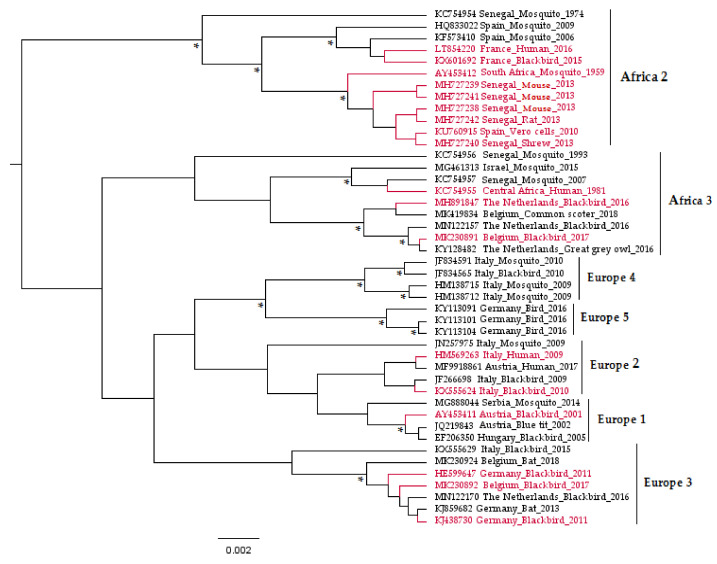
Usutu virus USUV), a mosquito-borne zoonotic flavivirus discovered in South Africa in 1959, has spread to many European countries over the last 20 years. The virus is currently a major concern for animal health due to its expanding host range and the growing number of avian mass mortality events. Although human infections with USUV are often asymptomatic, they are occasionally accompanied by neurological complications reminiscent of those due to West Nile virus (another flavivirus closely related to USUV). Whilst USUV actually appears less threatening than some other emergent arboviruses, the lessons learned from Chikungunya, Dengue, and Zika viruses during the past few years should not be ignored. Further, it would not be surprising if, with time, USUV disperses further eastwards towards Asia and possibly westwards to the Americas, which may result in more pathogenic USUV strains to humans and/or animals. These observations, inviting the scientific community to be more vigilant about the spread and genetic evolution of USUV, have prompted the use of experimental systems to understand USUV pathogenesis and to boost the development of vaccines and antivirals. This review is the first to provide comprehensive coverage of existing in vitro and in vivo models for USUV infection and to discuss their contribution in advancing data concerning this neurotropic virus. We believe that this paper is a helpful tool for scientists to identify gaps in the knowledge about USUV and to design their future experiments to study the virus.
乌苏图病毒(USUV)是一种蚊媒传播的人畜共患黄病毒,于 1959 年在南非发现,在过去 20 年中已传播到许多欧洲国家。由于其宿主范围不断扩大,以及越来越多的鸟类大量死亡事件,该病毒目前对动物健康构成重大威胁。尽管人类感染 USUV 通常无症状,但偶尔会伴有神经并发症,使人联想到西尼罗河病毒(另一种与 USUV 密切相关的黄病毒)引起的并发症。虽然 USUV 的威胁似乎不如其他一些新兴虫媒病毒那么大,但过去几年从基孔肯雅热、登革热和寨卡病毒中吸取的教训不容忽视。此外,如果随着时间的推移,USUV 向东传播到亚洲,甚至向西传播到美洲,可能会导致对人类和/或动物更具致病性的 USUV 株,也不应感到意外。这些观察结果促使科学界更加警惕 USUV 的传播和遗传进化,并促使使用实验系统来了解 USUV 的发病机制,并推动疫苗和抗病毒药物的开发。这是第一篇全面介绍 USUV 感染现有体外和体内模型的综述,并讨论了它们在推进有关这种神经嗜性病毒的数据方面的贡献。我们相信,本文为科学家提供了一个有用的工具,可以帮助他们识别有关 USUV 的知识空白,并设计未来的实验来研究该病毒。