Department of Radiology, The First Affiliated Hospital of Soochow University, No.188, Shi Zi Street, Suzhou, 215006, Jiangsu, China.
Department of Radiology, The Affiliated Infectious Diseases Hospital of Soochow University, Suzhou, 215000, China.
BMC Med Imaging. 2020 Oct 2;20(1):111. doi: 10.1186/s12880-020-00513-z.
To develop and validate a nomogram for early identification of severe coronavirus disease 2019 (COVID-19) based on initial clinical and CT characteristics.
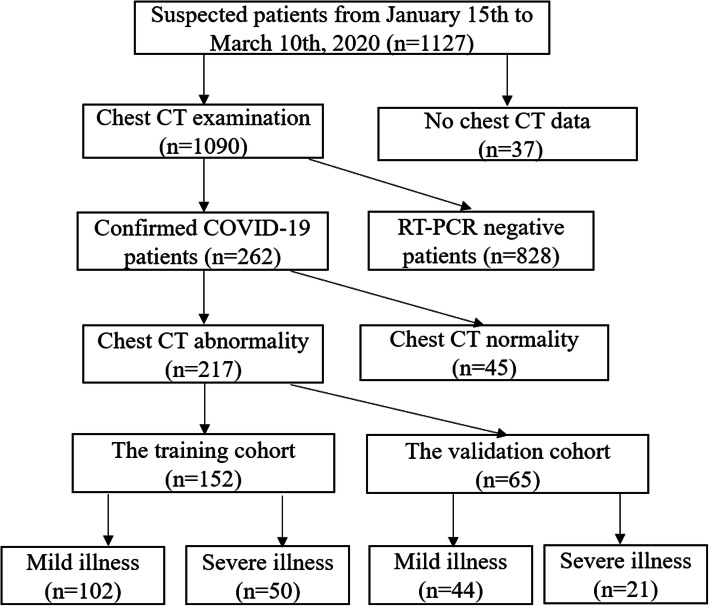
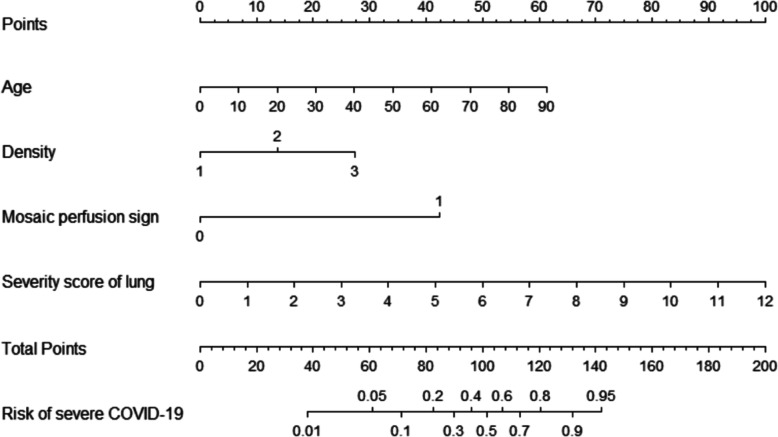
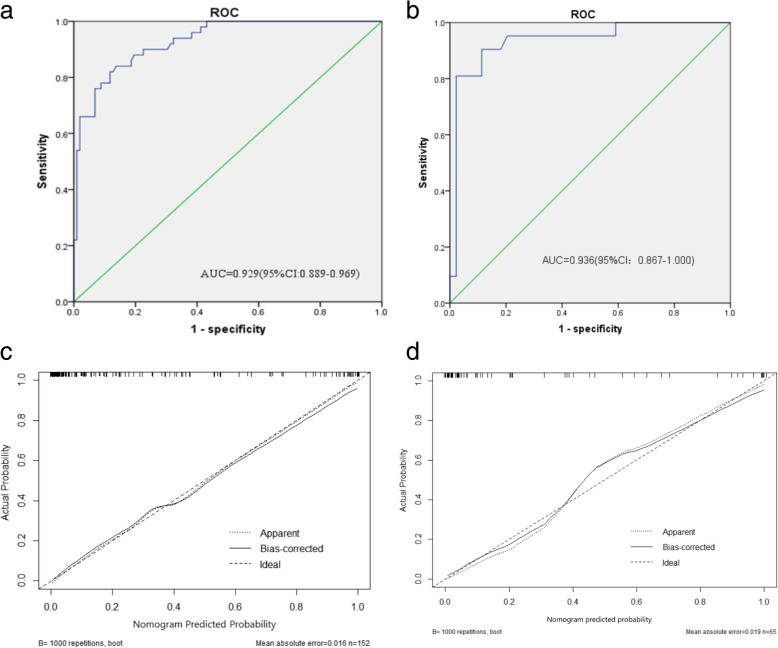
The initial clinical and CT imaging data of 217 patients with COVID-19 were analyzed retrospectively from January to March 2020. Two hundred seventeen patients with 146 mild cases and 71 severe cases were randomly divided into training and validation cohorts. Independent risk factors were selected to construct the nomogram for predicting severe COVID-19. Nomogram performance in terms of discrimination and calibration ability was evaluated using the area under the curve (AUC), calibration curve, decision curve, clinical impact curve and risk chart.
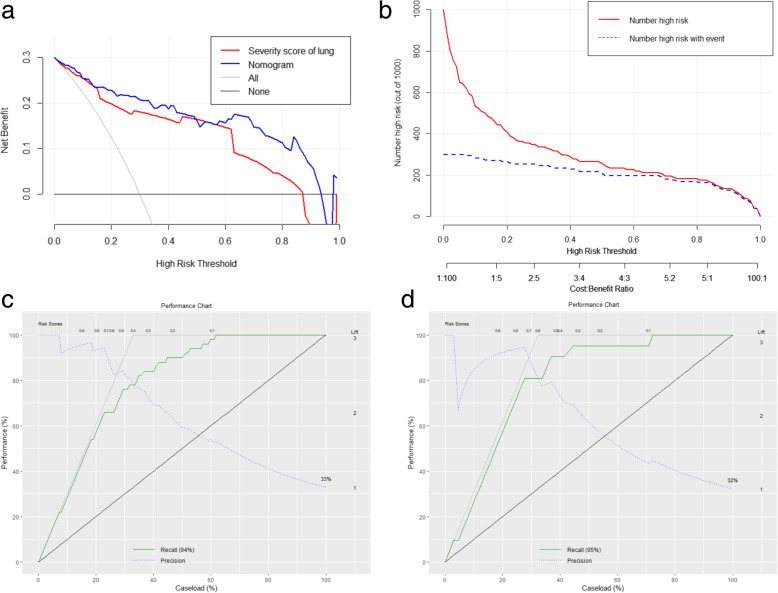
In the training cohort, the severity score of lung in the severe group (7, interquartile range [IQR]:5-9) was significantly higher than that of the mild group (4, IQR,2-5) (P < 0.001). Age, density, mosaic perfusion sign and severity score of lung were independent risk factors for severe COVID-19. The nomogram had a AUC of 0.929 (95% CI, 0.889-0.969), sensitivity of 84.0% and specificity of 86.3%, in the training cohort, and a AUC of 0.936 (95% CI, 0.867-1.000), sensitivity of 90.5% and specificity of 88.6% in the validation cohort. The calibration curve, decision curve, clinical impact curve and risk chart showed that nomogram had high accuracy and superior net benefit in predicting severe COVID-19.
The nomogram incorporating initial clinical and CT characteristics may help to identify the severe patients with COVID-19 in the early stage.
为了基于初始临床和 CT 特征,开发并验证一种用于早期识别严重 2019 冠状病毒病(COVID-19)的列线图。
回顾性分析 2020 年 1 月至 3 月期间 217 例 COVID-19 患者的初始临床和 CT 影像学数据。将 217 例患者随机分为训练队列和验证队列,其中 146 例为轻症,71 例为重症。选择独立的危险因素来构建预测严重 COVID-19 的列线图。使用曲线下面积(AUC)、校准曲线、决策曲线、临床影响曲线和风险图表评估列线图在区分能力和校准能力方面的表现。
在训练队列中,重症组(7 分,四分位距 [IQR]:5-9)的肺部严重程度评分明显高于轻症组(4 分,IQR:2-5)(P < 0.001)。年龄、密度、马赛克灌注征和肺部严重程度评分是严重 COVID-19 的独立危险因素。该列线图在训练队列中的 AUC 为 0.929(95%CI,0.889-0.969),敏感性为 84.0%,特异性为 86.3%,在验证队列中的 AUC 为 0.936(95%CI,0.867-1.000),敏感性为 90.5%,特异性为 88.6%。校准曲线、决策曲线、临床影响曲线和风险图表表明,该列线图在预测严重 COVID-19 方面具有较高的准确性和优势净收益。
纳入初始临床和 CT 特征的列线图有助于在早期识别 COVID-19 重症患者。